
Dr. Manoj Dash, Bhubaneswar, 25 December 2025
India’s rural poor endure multifaceted challenges stemming from economic insecurity, inadequate access to basic services like healthcare and education, and pervasive social inequalities. Their suffering is deeply tied to the precarious nature of their livelihoods and a lack of infrastructural development.
The rural economy is heavily dependent on agriculture, which is often seasonal, low-paying, and vulnerable to unpredictable weather patterns, droughts, and floods exacerbated by climate change.
Many farmers and labourers are trapped in cycles of debt due to high input costs and reliance on high-interest loans from informal moneylenders, sometimes leading to tragic outcomes like farmer suicides.
Limited non-farm job opportunities lead to high rates of underemployment and stagnant real wages. This forces many young and able-bodied individuals to migrate to urban areas in search of work, often living in slums and facing exploitation.
The rural poor often struggle to access affordable formal credit, insurance, and banking services, which limits their ability to invest in improving their situation or protect themselves against financial risks.
The Arrival of MGNREGS
The Mahatma Gandhi National Rural Employment Guarantee Scheme (MGNREGS) was a landmark law enacted by the Congress-led United Progressive Alliance (UPA) government in 2005. It made the government legally bound to provide at least 100 days of work to every rural household that demands it, failing which it must pay them an unemployment allowance.
Introduction of this scheme mattered significantly in a country where 65% of 1.4 billion people live in rural areas and nearly half rely on farming, which generates insufficient income, accounting for just 16% of India’s GDP.
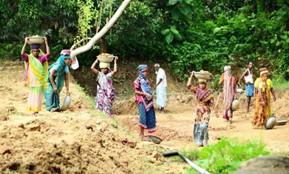
Providing unskilled public work across India excluding fully urban districts, the scheme was hailed as a backbone of rural livelihoods, cushioning demand during economic shocks. It is also among the world’s most studied anti-poverty programmes, with strong equity: over half of the estimated 126 million scheme workers are women, and around 40% come from “scheduled castes” or tribes, who constitute the most deprived Indians. This crucial reform brought about broader, economy-wide impacts which helped rise in beneficiary households’ earnings by 14%, and reduced poverty by 26%. Workers demanded higher wages, land returns fell in case of large landholders, and job gains were larger in villages.
However, the scheme faced multiple and persistent challenges, including underfunding, delays in wage payments, ghost workers and non-existent work even when payments were made for the same. Nationally, only a small percentage of workers (9.5%) and households (7%) received the full quota of work in the past two years. Despite these challenges, the scheme appeared to have delivered measurable impact.
What the G RAM G Scheme Provides?
The only visible promise of the new scheme is, it raises the number of guaranteed days of work to 125 from 100 without any promise to enhance the wage rate. The real gain from this enhancement is doubtful because a large number of work seekers are anyway not realising their full quota.
It makes provisions to plug the leakages by making attendance failproof by adopting biometric technology. In reality, this provision may drive away uneducated and digitally shy poor people from seeking jobs because they deem technology as intrusive. Besides, the digital devices may not work on ground in remote rural areas because of non-existent internet connectivity.
Section 4 (5) of the Act states, “The Central Government shall determine the State-wise normative allocation for each financial year, based on objective parameters as may be prescribed by the Central Government.” Through this section, the government ends the demand driven feature of MGNREGS because the central government will decide work allocation.
Work will be planned under Viksit Gram Panchayat Plans, which will be prepared by local gram panchayats, but the plan may not get ultimately implemented if the Central Government’s notification doesn’t include that area or region for allocation of work. This effectively reduces the power of gram panchayats to formulate work orders. Hence, work seekers in those areas will not get any real work even if they are in need of some work. This may compel them to move to cities in search of work. Therefore, in many areas of the country people will lose the right to work in their own villages or gram panchayats.
As per the new scheme, the Centre will provide 60% of funds to all states, except those in the North East, Uttarakhand, Himachal Pradesh and Jammu and Kashmir where the Centre will pay 90% of the wages. This provision makes the new scheme just another centrally-sponsored scheme with 60:40 cost-sharing, at the discretion of the central government. State governments can only decide on procedures to maintain accounts of labourers and expenditure related to implementation of the scheme. If the state spends in excess of the funds allocated by the Centre, it will have to bear the cost, as per procedures laid down by the central government.
The scheme also proposes a 60-day pause on guaranteed work during agricultural seasons. The central government has reasoned that this will “facilitate adequate farm-labour availability during peak agricultural seasons”. However, this provision will put farm labourers at a disadvantage during this period.
The repealed rural employment guarantee scheme not just acted as a safe cushion, it also empowered rural work seekers to bargain for better wages during peak agricultural seasons. If there is a clause that there will be no work at all during that time, then labourers will certainly lose their earlier bargaining power. MGNREGS was able to largely destroy the dependence of labourers on landlords which gave them a sense of dignity. But the new work guarantee scheme effectively kills that privilege for at least two months. It will put landlords in feudal control, and can lead to exploitative wages resulting in loss of dignity for the rural poor.