The Nirvik Bureau, Bhubaneswar, 31 December 2025
As the sun sets on Odisha’s capital, the dawn of a “New Odisha” looks suspiciously like last year’s rerun—just with more claimants to the crown and fewer people minding the state.
The sun has set in Bhubaneswar, and the sky is painted with hope, fireworks, and the faint sound of political calculators clicking in the background. A new year is about to begin, and with it, a fresh season of Odisha’s favorite reality show: “Who Wants To Be The Real Chief Minister?”
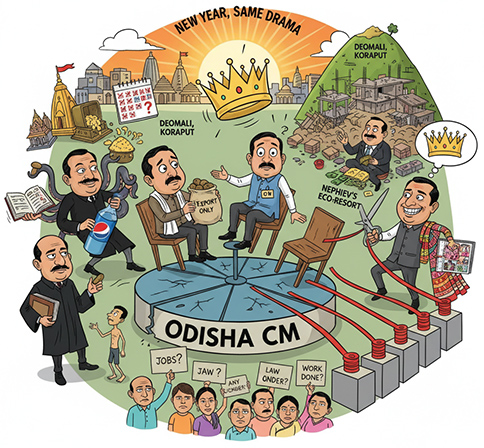
Officially, Mohan Majhi wears the crown. Unofficially, the crown seems to be on a nationwide Bharat Darshan, resting briefly on every ambitious head in and around the state. The oath was taken, the garlands were offered, but the lingering question on every Odia’s mind is: “Who is actually running the state?” The answer changes every news cycle, like a rotating caller tune nobody asked for.
At the center of this symphony stands the Law Minister—Odisha’s self-appointed Minister of Everything Everywhere All at Once. Constitutionally, he’s supposed to keep law and order. Practically, he has taken a sabbatical from law to focus on order—order in Ratna Bhandar, order in Mahaprasad, order in temple calendars, and even order in how to rehabilitate political fossils like Dilip Ray, of coal scam fame.
Why bother with crime, when you can rearrange temple rituals and script your own mythological spin-off? Somewhere, the police is still waiting for the Law Minister to remember they exist.
Then we have Deputy Chief Minister Number One—the Agriculture-in-Charge and Pepsi’s unofficial brand ambassador. With the cunning of a seasoned stock trader, he has brought Pepsi into the fields of Odisha to grow potatoes not for Odias, but for nameless, faceless consumers outside the state.
The farmers get contracts, Pepsi gets potatoes, and Odisha gets… Instagram posts about “investment inflow”. The Odia consumer, meanwhile, is still haggling over aloo prices in the bazaar and wondering if “development” is also being exported along with the spuds. Of course, our Agriculture DCM is not just sowing potatoes; he’s sowing his own chances for the crown, watering them daily with press conferences.
Deputy Chief Minister Number Two is no less enterprising—she has discovered that tourism is the new gold rush. Eco-retreats are mushrooming faster than policies, and contracts are flowing gracefully in the direction of certain nephews, like rivers that mysteriously know which relative’s land to irrigate.
Koraput’s Deomali, once a proud mountain, now looks down upon a clutter of confused “eco” projects that are neither eco-friendly nor tourist-friendly, but very “nephew-friendly” indeed. She too has one eye on the crown and the other on the next “retreat”, proving that multitasking is still possible in Indian politics.
Hovering over all of this is Dharmendra Pradhan, who seems to have been gently nudged out of the Prime Minister’s good books and gently pushed into the Scissor and Ribbon Department. From Sambalpur to Sundargarh, no gate, no pump house, no statue is too small for his grand inaugurations. His smile is permanent, like a stuck WhatsApp sticker, but behind it lives an eternal hope: that one day, the crown might remember his address.
And then there is Aparajita Sarangi, fresh from hosting what may well have been the Wedding of the Year, complete with lavish spreads, high-profile guests, and enough selfies to last three elections. With the daughter happily married, Aparajita is now free to marry her ambitions to the throne. She has stepped back into the ring of this musical chair game—except here, the music never stops and the chairs keep shrinking, but the claimants keep multiplying.
In this circus, Mohan Majhi, the nominal ringmaster, smiles and waves, while everyone around him quietly measures his head and their own, just in case the crown slips.
As the New Year’s first sunrise prepares to bathe Bhubaneswar in golden light, the people of Odisha prepare too—emotionally, spiritually, and financially—for the next season of scams, ribbon-cuttings, temple “reforms”, eco-retreat muddles, corporate potato farming, and the grand old tradition of “no work, only drama”.
The slogans may shout “New Odisha, New Beginning,” but the script looks eerily familiar. The only real game in town is still the same:
Not governance.
Not development.
Just musical chairs—with a crown that fits everyone
and serves no one.