
The Nirvik Bureau, Bhubaneswar, 26 January 2026
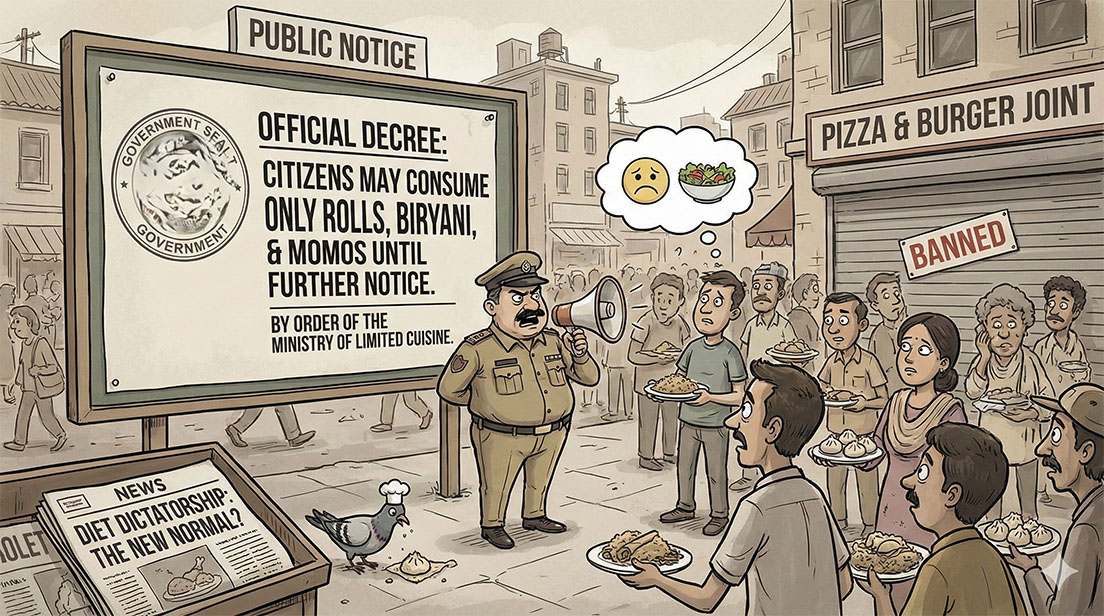
Authorities confirm: citizens may consume only rolls, biryani, and momos until further notice
Bhubaneswar, Odisha: In an unprecedented culinary coup, the city of Bhubaneswar has voluntarily surrendered its palate. After years of democratic deliberation in street corners, college canteens, and food-delivery menus, the residents have agreed to restrict their diet to three constitutionally protected dishes — Egg Roll for the carnivores, Paneer Roll for the heretics, and Momo for those flirting with multiculturalism but too shy to commit.
The Food Variety Board (fictional, but regrettably believable) reports 98% non-compliance with anything that doesn’t come wrapped in maida or swimming in biryani spice. Cafés offering “something different” have been gently escorted out of the market, often replaced overnight by another “Kolkata Roll Centre” or “Himalayan Momo Point,” both mysteriously serving the same neon-orange sauces.
Matryoshka of Monotony
What began as a street-food trend has now evolved into a totalitarian regime of sameness. Ask a Bhubaneswar local what’s for dinner, and you’ll witness the proud shrug of certainty: roll, biryani, or momo — because innovation is suspicious and taste diversity is bourgeois indulgence. The city that once prided itself on cultural renaissance has now discovered peace through predictability.
Food delivery apps confirm this mass hypnosis. Their algorithm has stopped suggesting anything new. Search for “Italian,” and it quietly redirects you to “chicken egg roll — 5 mins away.” A quiet digital arrest has been achieved; citizens no longer browse, they obey.
The Great Escape That Never Was
Attempts at culinary insurgency have repeatedly failed. A café once introduced handcrafted ramen; locals mistook it for thin biryani broth and demanded extra chicken pieces. Another adventurous soul tried tacos, but the crowd kept asking for “paneer stuffing inside roll shape.” Resistance, as history shows, is futile.
Even momo — once the daring outsider — has now joined the establishment. Once soft emissaries of Nepalese kitchens, momos have been fully domesticated, baptized in mayonnaise and chaat masala, now indistinguishable from their roll cousins. The momo revolution was televised — and then deep‑fried into compliance.
Taste Paralysis, Perfected
Sociologists (read: gossiping food bloggers) theorise that Bhubaneswar’s obsession with these dishes reflects a deeper craving — the comfort of sameness in a world that changes too fast. Or perhaps it’s sheer culinary laziness disguised as loyalty. In either case, the city stands as a glowing monument to edible conformity.
Meanwhile, the global cuisine movement trembles at Bhubaneswar’s achievement: a successful experiment in mouth-level authoritarianism. Rome had Caesar, France had Napoleon, and Bhubaneswar has the Chicken Roll — ever fresh, ever greasy, eternally victorious.
Until further notice, the citizens continue their noble fast against diversity, chewing through destiny one roll at a time.