
The Nirvik Bureau, Bhubaneswar, 23 February 2026
When everyone is a victim, history is just a bad attitude problem and caste is a networking error.
Vice-chancellors, in the good old days, used to speak the dull language of syllabus and seminars. Now, they speak the sexy language of American talk shows: “wokeism”, “victimhood”, “equity gone wrong”. Somewhere between Oprah and Orwell, JNU seems to have acquired its very own philosopher-queen of grievance management.
In her latest 52-minute sermon, the JNU VC has solved in under an hour what social movements have been struggling with for centuries: caste is over, victimhood is a lifestyle, and UGC’s anti-discrimination regulations are “unnecessary”. Why? Because “everyone is fighting a battle”. The man denied housing in Delhi because of his surname, and the man denied a fifth parking slot in Vasant Vihar because of his neighbour’s SUV, are, of course, suffering equally.
The real breakthrough, however, is the discovery of “permanent victimhood”. Apparently, Dalits are now like those people who keep “milking” a minor inconvenience from 3,000 years ago — Manusmriti, untouchability, massacres, institutional deaths — such drama, yaar. Blacks in America had affirmative action, Dalits in India had reservations; clearly this is just a global franchise of Complaining Unlimited, Pvt. Ltd.
What is particularly touching is the VC’s concern that “equity regulation” has become “inequitable” by giving “powers” to “one group”. One can only assume she is referring to that dangerous, over-empowered group: students who don’t want to be discriminated against on the basis of caste, gender, or region. Next they might ask for functioning hostels, and where will this madness stop?
JNU, in her telling, was once a “garrisoned university”, an “adda” of the Left, a hotbed of Naxalism and “intellectual authoritarianism”. To rescue it, the state appointed a VC who proudly fights the tyranny of ideas with the freedom of FIRs, suspensions, and patriotism workshops. Intellectual authoritarianism shall be firmly replaced by ideological obedience. Students are now free to think, as long as it has already been pre-approved by HQ.
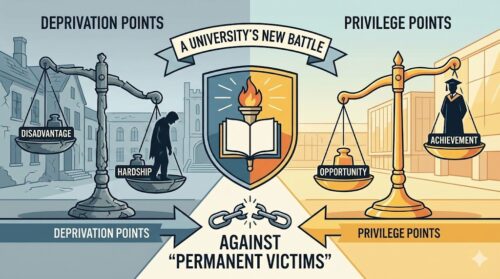
The irony is almost poetic. JNU was one of the first to develop deprivation points, quietly acknowledging that some students start the race 100 metres behind the line. The new discourse gently suggests that this is unfair — not to those behind, but to those already sitting at the finish line, panting from the exhaustion of watching others run.
“Everyone is fighting a battle,” the VC reminds us. True. Some battle hunger, humiliation, caste slurs, and systemic exclusion. Others bravely fight the horror of having to share a university seat with someone from a village who topped the exam despite bad schooling and worse bus connectivity. Tragedies come in many scales; some just happen to be air-conditioned.
In this new moral physics, history is a nuisance, context is an inconvenience, and marginalisation is a branding opportunity. The language of social justice has been beautifully recycled: now even the most structurally privileged can cosplay as endangered species. Upper-caste anxiety gets relabelled as “reverse discrimination”, and centuries of oppression get relabelled as “past issues we should move on from”.
The government that appointed her must now clarify a simple doubt: is she expressing a personal opinion, or reading from the official script? If it is personal, they may wish to say so. If it is scripted, they may as well print a new slogan: “Sabka Saath, Sabka Vikalp: Justice for All, History for None.”
After all, why confront the discomfort of caste reality when you can declare the oppressed as “permanent victims” and the powerful as temporary sufferers of woke injustice? It is a neat solution: you keep the hierarchy, change the vocabulary, and call it reform. The ladder stays exactly where it was — only the footnotes about who got kicked off it are quietly deleted.