The Nirvik Bureau, Bhubaneswar, 4 May 2026
How to turn one election result into a civilisational TED Talk
West Bengal, we are told, has delivered not just a verdict, but a “verdict of history.” A beautiful phrase, really. It has the grand smell of old stadium speeches, freshly ironed flags, and men who have discovered a map of India and decided to read it as destiny. Bengal did not merely vote. It rose, thundered, corrected history, redeemed civilisation, and apparently changed the wallpaper of the republic.
That is the magic of political writing today: no result is ever just a result. A win must become a “historic mandate,” a loss must become “the complete rejection of fear,” and a routine counting of votes must be dressed up like the final act of a mythological epic. A few seats up, a few seats down, and suddenly the electorate is no longer choosing representatives – it is pronouncing on civilisation itself.
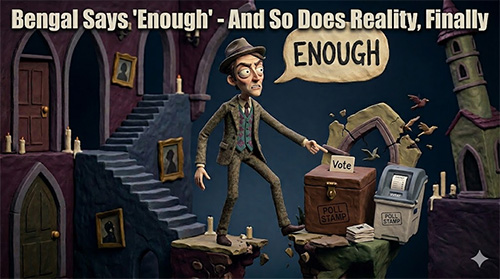
One word: “enough.” Bengal has apparently had enough of violence, broken promises, intimidation, patronage, and all the other sins that political parties conveniently discover only when they are in opposition. This is the oldest trick in the democratic playbook: every party arrives like a reformer, rules like a machine, loses like a martyr, and returns like a sage. If memory were a campaign slogan, India would have the shortest election speeches in the world.
Then comes the sacred upgrade from politics to poetry. We are reminded that Bengal is the land of Tagore, Vivekananda, Netaji, and others – as if voters were sitting in polling booths silently comparing manifestos with literary heritage. Because nothing says “development agenda” like invoking a cultural hall of fame to justify a victory lap. Somewhere, Rabindranath Tagore is being drafted into campaign branding without his consent.
Let’s perform the standard miracle of democratic storytelling: it takes a complex political shift and converts it into a morality play where one side stands for light, and the other for darkness. This is very useful, because nuance is a terrible inconvenience when you are trying to celebrate a win at maximum volume. Governance becomes virtue, opposition becomes decay, and every campaign worker becomes a warrior in the great battle between progress and all previous governments.
And of course, no modern political sermon is complete without the glorious enlargement of the party worker into a national instrument of destiny. The cadre is never just a cadre. It is disciplined, tireless, invincible, booth-level, village-level, civilization-level. One can almost hear the poor volunteer in a hot polling booth wondering when exactly he was promoted from voter-contact worker to foot soldier of history.
The funniest part is the confidence. Though one election has not only ended an era, but sealed the future forever. That is the special optimism of Indian politics: every victory is permanent until the next defeat arrives with a broom, a drum, or a slogan.
In the end, what we are really reading is not analysis, but a victory anthem pretending to be journalism. It does not ask what changed in Bengal. It announces what must now be believed about Bengal. And that, perhaps, is the oldest political tradition of all: when facts are uncertain, raise the volume, borrow Tagore, salute the cadre, and call it history.