

Dr. Manoj Dash, Bhubaneswar, 11 March 2026
Understanding the human civilization better requires one to appreciate the stories that have been told over the past centuries. We are not just Homo sapiens (the wise man); we are also Homo narrans (the storytelling man). While other species communicate to signal danger or food, humans are the only creatures capable of creating narratives that do not physically exist. This ability to create “fictional realities” is the invisible thread that pulled us out of the caves and have propelled us into the galaxy of stars. Through the ages, millions of us have told stories to many other millions which were never true. But that has not deterred us from inventing more stories by spinning compelling narratives.
How Storytelling Evolved?
Around flickering campfires in the Stone Age, our ancestors huddled, their voices weaving tales of mighty hunts and vengeful spirits. The campfire was the first classroom and the first courtroom. These weren’t mere entertainment; they were survival tools. Stories bound tribes, passing down knowledge of edible plants, predator tracks, and migration routes etched into memory through epic chants. Without writing, oral narratives shaped social bonds, enforced taboos, and sparked innovations—like the first stone tools imagined in a storyteller’s vivid recounting of a hero’s clever strike. Civilization’s cradle rocked on these myths, turning scattered nomads into cohesive groups that built the first ever settlements. Stories transformed a collection of individuals into a “tribe” with a shared socio-cultural compass.

As humans settled into organised habitats, stories grew from local myths into grand narratives. This era proved that if one could get thousands of people to believe the same story, one could easily build an empire. Rulers solidified their power by telling stories of divine lineage. Whether it was the Pharaohs of Egypt or the Mandate of Heaven in China, the “story” of authority prevented constant civil war. Concepts like “laws,” “human rights,” and “money” are effectively stories. A gold coin or a paper bill has value only because the society agrees on the collective narrative that it represents wealth.
As empires rose in the Bronze Age, stories scaled up. Sumerian scribes etched the Epic of Gilgamesh on clay tablets around 2100 BCE, immortalizing quests for immortality that mirrored humanity’s drive to conquer death through cities and laws. In ancient Greece, Homer’s Iliad and Odyssey fuelled the heroic ideal, inspiring Athens’ democracy and Alexander’s conquests. These narratives didn’t just record history; they scripted it. Pharaohs like Ramses II commissioned victory tales on temple walls, rallying armies and legitimizing rule. Religions crystallized around stories—Abrahamic faiths spread via parables, while the Ramayana and the Mahabharata guided dharma on the Indian sub-continent—uniting millions under shared moral universes that birthed laws, art, and wars.

Religion has been one of humanity’s most profound and enduring stories, shaping civilizations, wars, art, and ethics for millennia. Religion has unified tribes, justified empires, and inspired moral codes essential for large-scale societies. Figures like Lord Rama or Jesus with their billion-plus followers, exemplify their massive reach despite being shrouded in myths. Historians note religion’s role in providing legitimacy to rulers and intrinsic motivation for laws, aiding the rise of civilizations and causing their downfall later.
Emergence of Modern Stories
The printing press, invented by Johannes Gutenberg around 1440, revolutionized information sharing by enabling mass production of books, shifting humanity from slow, elite-controlled knowledge systems to their rapid and widespread dissemination. This “fast-forwarded” human progress by exploding literacy rates, fuelling intellectual movements, and accelerating innovation across society. Earlier, books were handmade by scribes, making them rare, expensive, and accessible mainly to a chosen few such as clergy and nobility. Knowledge spread slowly through limited copies prone to errors, restricting it to elites and slowing cultural or scientific exchange.
Gutenberg’s Bible democratized scripture, igniting the Renaissance and Reformation; Luther’s pamphlets toppled empires. Novels like Uncle Tom’s Cabin (1852) galvanized abolitionists, hastening slavery’s end in America, while Darwin’s Origin of Species (1859), framed as a grand evolutionary saga, reshaped science and society. Mass media amplified this: Newspapers fanned revolutions, from the American independence sparked by Paine’s Common Sense to Bolshevik broadsheets fuelling 1917’s upheaval. Hollywood’s silver screen exported the American Dream, steering post-World War II consumerism and Cold War ideologies worldwide.
With the Enlightenment and the Industrial Revolution, the narrative shifted from the “will of the gods” to the “triumph of reason.” We began telling a story of linear progress—that through science and industry, humanity could conquer nature and eliminate suffering. The 20th century was essentially a battlefield between competing stories: Capitalism, Communism, Fascism and Democracy. These weren’t just economic systems; they were stories about the “correct” way for a human being to live, work and socialize. The printing press, radio, and television – as the tools of mass propaganda – allowed a single story to be told to millions simultaneously albeit with suitable variations, that created unity and fermented divisions across the globe. The 2000s brought smartphones, social media, and cloud computing, accelerating global connectivity but sparking villains like data privacy breaches, cyber threats, and digital divides.

The Industrial Revolution and IT Revolution also caused tensions to arise as protagonists—innovators and workers—clashed with antagonists like harsh labour conditions, child exploitation, and social upheaval, mirroring a classic plot’s rising conflicts. This phase created widespread prosperity, a new middle class, and global spread, though with enduring themes of rising inequality and environmental degradation precipitating climate change.
Politicians across geographies often tell compelling stories to voters that they later struggle or fail to deliver on. This usually isn’t just about “lying”; it’s about how political communication, incentives, and real-world constraints interact to acquire power. Here’s how it typically happens. During campaigns, politicians simplify complex problems into emotionally powerful stories: we will create twenty million jobs annually; one and half million rupees will get credited to everyone’s bank account in next two months; every household will have a house before the next elections are due. If the stories that got votes for the politicians do not come true, they start manufacturing more stories for blaming opposition parties, previous administrations and unknown international actors.

The Age of Artificial Intelligence (AI)
Today, the society has entered a phase where the storyteller is no longer exclusively human. Humans are moving from “creating stories” to “living inside” them. Algorithms now curate personal narratives for us. We no longer share one big story; we live in millions of fragmented “micro-stories” that often reinforce our biases. Today, AI propels the story forward, promising efficiency but challenging jobs and ethics—much like the Industrial Revolution’s factories. Benefits accrue to users via falling costs and productivity surges, though unevenly distributed. This narrative inspires awe at humanity’s leap into a ” Super Information Age.”
However, information isn’t inherently truth because it often serves purposes like persuasion, simplification, or social bonding rather than objective accuracy. We should be wary of it due to risks like misinformation, bias, and manipulation that can distort decisions and reality. Information acts as a tool for coordination and storytelling, not as a direct reflection of verifiable facts. For instance, myths or ideologies can unite groups effectively without being true, because humans tend to prioritize compelling narratives over reality. Truth demands evidence and context, while information can spread unchecked via familiarity or emotion. People selectively seek belief-confirming data, amplifying echo-chambers and polarization. Platforms boost engaging falsehoods over facts, fostering overconfidence in errors. Historical examples show even advanced societies fall for delusions when information networks prioritize virality over scrutiny. Misinformation influences behaviors like voting or health choices by exploiting intuitive thinking. It persists due to cues like repetition, not rigour, making discernment hard even for experts. AI exacerbates this by curating without regard for truth, potentially polarizing societies further.
AI can now generate convincing myths, deepfakes, and histories in seconds. The line between “objective truth” and “compelling fiction” is blurring more than ever before! As the society looks forward to the future, the stories we tell about AI—whether it is a “merciful god,” a “soulless tool,” or an “existential threat”—will dictate the policies the society will write and the future it will build.
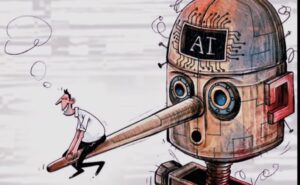
Yet AI also liberates – generative models co-author histories, simulate futures, and democratize creation, letting anyone in any place craft a useful manifesto. From cave shadows to neural networks, stories remain our species’ operating system—forging fates by encoding beliefs, igniting change, and now, programming the machines that might outstory us all.