
Dr. Manoj Dash, Bhubaneswar, 17 March 2026
The modern-day game of chess originated in Persia (present day Iran) as Shatranj which is widely regarded as its predecessor. The sport was played for hundreds of years throughout the Islamic world, India, and parts of Europe before evolving into the game of chess the world knows these days. Shatranj’s historic significance provides glimpses of its strategic complexity which has influenced war tactics, business, lifestyle, and art.
History and Origins of Chess
Shatranj is thought to have advanced from an older Indian sport version called chaturanga, a strategy recreation of 6th-century CE. Chaturanga changed into a four-component sport, representing the four divisions of the ancient Indian military system: infantry, cavalry, elephants, and chariots. The sport made its way to Persia, where it eventually got refined into Shatranj.
By the time it reached Persia, around the seventh century, Shatranj had already grown to be a favourite interest in royal courts. Persian students and noblemen enjoyed the game’s complexity. The reach of the game widened gradually to the Arab world after the Islamic conquest of Persia.
Over the centuries, Shatranj made its way to Europe through Spain and Italy where it got transformed into the modern game of chess. The introduction of chess to Europe can be traced back to the Muslim conquest of the Iberian Peninsula, which began in 711 CE. From Spain, the game spread throughout Southern Europe during the 9th century CE, eventually reaching Russia and the United Kingdom. As in other regions, chess in Europe was primarily played by aristocrats and intellectuals.
As chess spread across Europe, it underwent significant changes. By the 11th century CE, the King’s advisor had transformed into the Queen, and the elephants had become bishops. The chessboard also evolved, becoming checkered, though not always in black and white. These changes marked the beginning of the transition towards the international game the world knows today.
The spread of Persian chess across different cultures and continents has had a lasting impact on the game. As it travelled far and wide, chess adapted to new cultural contexts, with piece names and rules changing to suit local traditions. However, the core strategy and intellectual challenge of the game remained, cementing its place as one of the world’s most enduring and popular board games.
Some chess terms that are now used in English have Persian roots. For example: the word “Shahmat” in Persian is the root of the English word “Checkmate”, or “Rukh” (chariot) in Persian is the root of the word “rook” in English.
These modifications, along with the formalization of guidelines for test, checkmate, and stalemate, made the sport quicker and extra dynamic.
Evolution of Chess and Its Impact on Modern Life
In the Middle Ages, Shatranj commenced to adapt itself into modern chess while it unfolded across Europe. Key modifications included the transformation of the “firzan” into an awfully more powerful “Queen”, reflecting societal modifications and the rising prominence of queens in European monarchies. In the 15th century CE, this major innovation took place in Spain when the queen’s movement was dramatically expanded. Previously limited to one square diagonally, the queen gained the ability to move across the entire board both diagonally and in straight lines. This change, known as “de la dama” (in the style of the queen), revolutionized the game and increased its strategic depth. Additionally, pawns have been given the choice to move two squares on their first move, speeding up the sport, and the “alfil” (elephant in Persian) turned into the more versatile “bishop”.
Gradually, Shatranj did not simply remain a recreational indoor sport, but got transformed into an illustration of warfare, strategy, and intelligence. In the Persian and Islamic golden age, it became a symbol of intellectual achievement. Caliphs and rulers could regularly host Shatranj tournaments, and expert gamers were frequently spotted within the court premises. Some of the earliest recorded chess players, which included al-Adli and as-Suli, were masters of Shatranj and wrote considerably about the sport, creating manuals that laid down the principles of approach, methods, and styles utilized in chess.
Furthermore, Shatranj made its way into literature and art. Persian poets and students, which included Rumi and Firdowsi, frequently referred to the game in their writings, by using different terms as metaphors for lifestyles, destiny, and the struggles of energy. The shah (king), surrounded by powerful allies, symbolized power’s vulnerabilities.
Persian poets often used chess as a metaphor for human experiences and the complexities of life. Almost all great Persian poets, including Moezzi, Sanai, Khayyam, Awhadi, Saadi, and Hafez, had incorporated chess imagery into their works. These poets often drew parallels between the game’s strategic moves and the challenges faced in life, using chess to explore themes of fate, power, and human relationships.
How Is Chess Determining Iran’s War Strategy in 2026?
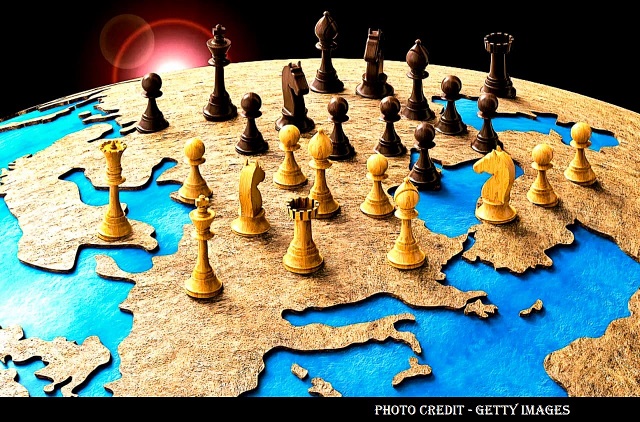
The current military conflict between Iran on one side and the combined force of USA and Israel on the other, provides many indications that Iran is using strategies from the ancient game of Satranj to design its war plans. Many geopolitical analysts say that Iran’s strategic behaviour often resembles “chess-like thinking”—long-term planning, indirect moves, and sacrificing small pieces to gain positional advantage.
Long-term positioning rather than direct confrontation: In chess (and its Persian predecessor Satranj), crafty players often avoid the opponent’s strongest pieces and slowly build positional advantage. Iran’s strategy mirrors this idea. Instead of confronting the superior military power of USA and Israel head-on, it focuses on asymmetric warfare—missiles, drones, cyber actions, and proxy forces.
When weaker states face stronger militaries, they rarely fight only on the main battlefield. Instead, they widen the ambit of the war. They strike allies, shipping lanes, energy infrastructure, or distant targets. The real goal is not battlefield victory. Rather, the goal is to fracture the coalition supporting the war. This strategy lets Iran apply pressure while avoiding a conventional war in which a direct confrontation could force Iran to lose.
Using “pawns” as proxy networks: A common chess concept is advancing pawns to shape the board. Iran’s war strategy is exhibited through its use of allied groups (often called proxies) across the Middle East to extend influence without direct confrontation. Typical examples are: Hezbollah in Lebanon; Militias in Iraq and Syria and Houthis in Yemen. This approach allows multiple pressure points simultaneously, similar to spreading pieces across the chessboard.
Controlling key squares (strategic geography): In chess, controlling central squares limits one’s opponent’s mobility. Iran applies something similar geographically: Strait of Hormuz; Persian Gulf shipping lanes; and missile coverage of regional bases of USA and Israel. Its anti-access/area-denial strategy in the Strait of Hormuz aims to restrict enemy movement using mines, fast boats, and anti-ship missiles. All these essentially constitute board control on strategic chokepoints.
Playing a longer game: Persian political culture often treats negotiations and conflicts as prolonged contests of endurance, where patience can exhaust opponents. That mindset fits the chess principle of winning through attrition and time rather than through decisive battles. Examples often cited by analysts are: gradual resistance to sanctions; long proxy conflicts; and incremental escalation.

Wars inflicted by stronger opponents often begin with tactical success. Enemy’s targets are destroyed; leaders get killed; and infrastructure stands damaged. But the opponent does not concede politically (there is no regime change in Iran yet even after the Ayatollah Khamenei’s assassination!). Instead of reconsidering strategy, the current leadership of USA and Israel is constantly escalating its striking capabilities. The result is: tactical success but strategic failure which is leading to expanded and prolonged war. This is the core strategy of Iran which it has been able to directly replicate from the game of Satranj.
Persian literature often used chess metaphors to narrate politics and war. Because of that cultural history, war commentators often describe Iran’s present war strategy as a “chess match” with the U.S. and Israel in which the new chessboard is unfortunately the global economy.