Dr. Manoj Dash, Bhubaneswar, 10 December 2025
We the people of Bharat often consider our land as a united territory in continuum since eternity. We are aware, a country is not limited to a specific geographical entity but includes its people, rivers, forests, livelihoods, culture, traditions, ethos, and collective aspirations. Bharat has a long past that spans several centuries and we as a people have a collective experience that cannot be captured in a linear narration. Its character has been layered, nuanced, and diverse since inception.
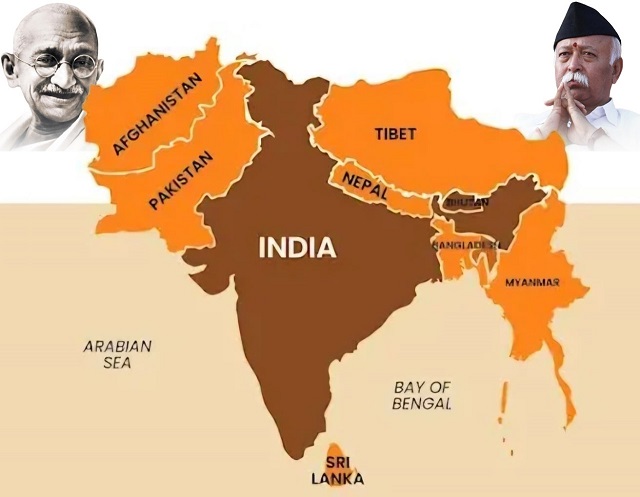
Recently, Mohan Bhagwat, the ‘Sarsanghchalak‘ of Rashtriya Swayamsevak Sangh (RSS) made an assertion at the Nagpur Book Festival that the perception that Bharat stood fragmented before the British made our country its colony, is a false narrative. He quoted the opinion of Mahatma Gandhi from Hind Swaraj to support his own point of view. Contrary to the claims of Mohan Bhagwat, Gandhiji has mentioned in Hind Swaraj that, “The English have not taken India; we have given it to them. They are not in India because of their strength, but because we keep them…… We have already seen that the English merchants were able to get a footing in India because we encouraged them. When our Princes fought among themselves, they sought the assistance of Company Bahadur. That corporation was versed alike in commerce and war. It was unhampered by questions of morality. Its object was to increase its commerce and to make money. It accepted our assistance, and increased the number of its warehouses. To protect the latter, it employed an army which was utilized by us also. Is it not then useless to blame the English for what we did at that time? The Hindus and the Mahomedans were at daggers drawn. This, too, gave the Company its opportunity and thus we created the circumstances that gave the Company its control over India.”
This opinion of Mahatma Gandhi that the British were able to gain control over India because of the weaknesses and rifts among our own people contradicts the RSS Sarsanghchalak’s version and it is not at all surprising because the RSS Chief is known for making statements that are not based on facts.
Was Bharat Ever United in the Distant Past?
Bharat was never a united territory in the shape we find it today. Even its people were not united, which one can find out from recorded accounts available in scholarly works of different time periods. Not much is known about the condition of the society in our country in the eras that preceded Indus Valley Civilisation (IVC), which includes Harappa and Mahenjo-Daro – the most advanced human settlements of that era. These covered a vast area in the North-West of the territory of Bharat in the past. However, there was no trace of any major conflict or war among different groups in the era of IVC. There were other settlements in Bharat of that period, traces of which are found in different locations across south, mid-Gangetic plains and present-day States of Rajasthan, Gujarat, Haryana, and Punjab. Historical accounts corroborate the view that the people of that era were more interested in trade with others rather than conquest and glory.
The first glimpse of conflicts or battles is available in Rig Veda in the use of the term ‘Dasarajna Yuddha’ In that battle, a king called Sudas of the Bharata tribe fought and defeated a confederation of ten other tribes. Experts generally consider this battle of the ten kings as a historical event today, and the actual battles were probably fought in the area of Punjab in Northern India. The army of Sudas prevailed and his tribe became prominent in the northern plains.
Historians state that the ancient Indian armies consisted of a formation called the ‘Chaturanga’ – four divisions consisting of infantry, cavalry, chariots, and elephants – although it is not yet determined when this formation actually started. If one imagines the Kurukshetra War of the Mahabharata in current times, one would find that all these four divisions were operated in that war. One is aware that Mahabharata started from the internal conflicts of a family and gradually engulfed many other kingdoms that got themselves aligned with both the warring parties.
Around the 6th century BC, out of the sixteen Mahajanapadas, Magadha in Eastern India became very powerful when its charismatic king Bimbisara annexed the neighbouring Anga and consolidated his empire through further conquests. Bimbisara’s son Ajatashatru – a king with an unquenchable thirst for war and conquest – was able to annexe Vaishali to his kingdom. After a few more centuries, Maurya emperor Ashoka fought a bloody war with the state of Kalinga, which saw unprecedented bloodshed inflicted by people of one region on another.
Gradually, with the passing of time, as more migrations and invasions happened in India, they also brought in a host of new conflicts that led to more divisions among the native Indian rulers. After the Mauryas, various kingdoms and empires appeared on the Indian scene like the Satavahanas, the Guptas, and then the various South Indian kingdoms including the mighty Cholas.
Bharat’s Trajectory in Medieval and Modern Periods
After the advent and subsequent decline of the Chola Empire around the 13th century, the soil of Bharat experienced significant political fragmentation and continuous warfare among successor and rival states. The major powers that emerged and fought for supremacy were the Pandyas, the Hoysalas, and the Kakatiyas. A major, long-drawn conflict emerged in the early medieval period between three powerful dynasties – the Gurjara-Pratiharas, the Rashtrakutas, and the Palas – for control over the strategically important city of Kanauj. These new kingdoms soon became embroiled in their own mutual conflicts, which included plundering towns, weakening of political stability, and rise of penury among their subjects. The expansion of the Delhi Sultanate in the north added another layer of complexity to the already fragmented society.
The Timurid invasion, the First Battle of Panipat, the Battle of Talikota, and the Third Battle of Panipat – led to the rise of rival regional kingdoms, and entrenched social and communal divisions that persisted for centuries. Later, alongside the rise of the Mughal Empire, which consolidated large parts of northern and central Bharat, many other powerful regional kingdoms, such as the Vijayanagara Empire, the Marathas, the Sikhs, the Nawabs of Awadh and Bengal, and the Nizam of Hyderabad rose to power and thrived independently, which often led to significant rise in social strife and antagonism among the people.
Ultimately, the arrival of European trading companies – primarily the Portuguese, Dutch, French, and the British East India Company – introduced a new dimension to the power struggles and further divisions. Exploiting the political fragmentation among the regional powers, the British East India Company strategically intervened in local conflicts, eventually transforming itself from a commercial entity into a dominant political and colonial power in India through key victories like the Battle of Plassey.
Constant warfare and competition for territory led to widespread instability, loss of life, and economic disruption, impacting the general populace severely. While some rulers promoted syncretic cultures, others adopted orthodox policies, which heightened religious tensions and contributed to social unrest.
The Curse of Bharat’s Caste Divisions
Perhaps the most egregious fracture in Indian society is the caste system. It began in ancient India during the Vedic Period as the Varna system, a functional division of society (Brahmins, Kshatriyas, Vaishyas, Shudras) based on occupation, but it became rigid and hereditary over centuries, with birth determining social status. This caste system, also known as ‘Jati‘, exacerbated social divisions by institutionalizing discrimination, denying mobility, assigning degrading jobs to lower castes, and creating deep-seated inequality in marriage, education, and economic opportunities, a legacy that persists despite modern legal reforms.
Despite Bharat’s independence and affirmative action policies (reservations), caste-based discrimination, particularly against Dalits and Adivasis, continues to adversely impact access to education, housing, and other opportunities, thereby creating lasting social and economic disparities.
‘Jati‘ is not limited only to Hindus: Indian Muslims, Sikhs, and Christians all hold on to age-old sectarian identities, with prescribed rules and customs analogous to ‘jati‘ , within their larger belief system. Indian society is divided into thousands of these endogamous kinship groups, no one is sure how many. The bigger ‘jatis‘ are further subdivided, in accordance with observable differences in custom and rule. A Hindu’s ‘jati‘ prescribes the rules and rituals of life: the foods they can eat, whom they can marry and socially interact with, where and how they pray.
It is true that all societies are shaped by social stratification. Modernisation has moderated Western class systems, while development has seen a fading in the importance of Bharat’s caste system. But discrimination via the caste system has a deleterious impact on Indian lives, dividing society, restricting opportunity for large numbers of Indian citizens, and preventing the nation from realizing its full human potential. Dalit poverty is twice the national average and discrimination on the ground of caste remains endemic, especially in rural areas where most of Bharat’s population lives.
The Aspiration for Unity Must Fly High
Wiping out the caste system and other social divisions is widely argued by economists, sociologists, and political analysts to be the tool that can significantly accelerate Bharat’s rise by unlocking the full potential of its human capital, promoting social cohesion, and fostering inclusive economic growth. Bharat’s global aspirations include being a leading moral and economic power apart from being a developed nation in the next two decades or so. Eliminating systemic divisions would align the nation with universal human rights standards, enhancing its international standing, attracting foreign investment, and increasing its “soft power” on the world stage. Hence, it is imperative for the people of Bharat and various organisations that work towards achieving unity in the country to keep their hopes and aspirations ticking and moving forward.
Instead of creating a false narrative and belief that Bharat has been a ‘Rashtra‘ whose unity has always remained organic and civilisational, the ‘Sarsanghchalak‘ of RSS must deeply introspect and exhort the ‘ Swayamsevaks ‘ to work towards a Bharat that sets itself free from the caste and gender-based divisions by the time it declares itself a developed nation.
Recently, the most successful ‘ Swayamsevak ‘ of RSS and the Prime Minister of India gave a clarion call to the people of Bharat to shake off the mentality of slavery in the next ten years. In my view, if Bharat needs to discard any sense of slavery that would really set its people free, it is the caste system that severely limits their ability to rise individually and collectively. The eradication of caste and other divisions would transform Bharat’s population from a fragmented collection of segmented groups into a unified national asset, creating a more dynamic, equitable, and efficient nation capable of faster and more sustainable rise to the top as a global power.