
The Nirvik Bureau, Bhubaneswar, 25 February 2026
When a legendary dissenter’s bust replaces an architect’s bust, and everyone calls it “freedom”, you know the republic has finally mastered the art of renovating walls while leaving the mind exactly where Macaulay left it.
Bust Politics: From Gulami To Gulmohar
The government has announced a visionary plan: by 2035, on the sacred bicentenary of Macaulay’s Minute, India will be completely free of “gulami ki mansikta”. This will be measured scientifically — not by critical thinking, quality of schools, or intellectual freedom, but by the number of British names deleted, sandstone rearranged, and busts rotated like chairs in a musical statue game.
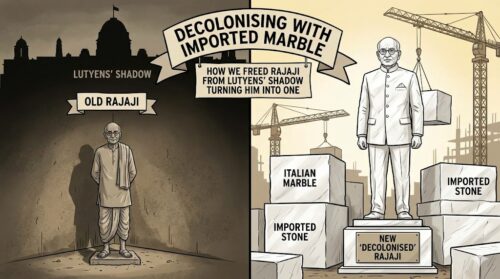
Thus, the solemn removal of Edwin Lutyens’ bust from Rashtrapati Bhavan and its replacement with that of C Rajagopalachari. The man who designed the building must now vacate his little corner so the man who might not have approved of the eviction can occupy it. This is called poetic justice, or, in current policy language, “decolonisation with photo-op potential”.
Rajaji, the Dissenting Prop In The Backdrop
Rajagopalachari was a principled dissenter, a man who defended inconvenient truth even when the crowd demanded convenient myths. Naturally, in New India, the best way to honour such a person is to convert him into high-quality backdrop material for speeches, garlanding ceremonies, and official selfies.
In life, Rajaji warned that “truth should not be sacrificed at the altar of other objectives.” In death, he has been placed on an altar whose main objective is precisely to sacrifice truth – about history, complexity, and intellectual freedom — so that a tidy narrative can glide smoothly through a teleprompter.
Somewhere, his ghost might be murmuring: “I dissented so you could erase the other fellow’s bust? This was not quite the cultural freedom I had in mind.”
Decolonisation by Deleting The Architect, Retaining The Architecture
The new doctrine is elegant:
- Keep the building Lutyens designed.
- March into it every day.
- Use it as the stage for your civilisation reboot.
- But remove his bust, because sentiment, not structure, is the true enemy.
We will not dismantle the Viceroy’s House; we will merely pretend it was always emotionally Vaishnavite, spiritually Indic and architecturally self-assembled by ancient Vastu vibrations. A mature republic, we are told, can hold both the courage of a statesman and the aesthetic bequest of a colonial architect in the same frame. Our response: why hold both when you can crop one out and call it “reclaiming the frame”?
Syllabus of Forgetting 101
The decolonisation project has discovered its core pedagogy:
- If a chapter hurts your narrative, delete it.
- If a lane name disturbs your sleep, rename it.
- If a statue troubles your speech, replace it.
- If an idea questions your power, brand it “fifth column”.
This way, history becomes a multiple-choice question with only one correct answer: “What existed before us?”
Option A: Darkness.
Option B: Slavery.
Option C: Lutyens’ Delhi.
Correct answer: All of the above, to be gradually removed by 2035.
From Cultural Freedom To Curated Freedom
Rajaji called it cultural freedom when truth was allowed to stand, even if it contradicted the comforting story of the day. We now practice a more modern version: curated freedom — the liberty to say anything as long as it can be carved into a government press release, a school textbook revision, or a new plaque on an old wall.
The bust of Rajagopalachari now looks silently at the empty spot where Lutyens once stood. The architecture remains, the architect vanishes, the dissenter becomes décor, and we congratulate ourselves for finally breaking the chains of gulami ki mansikta by rearranging the furniture in the colonial drawing room.
Macaulay, if he’s watching, must be impressed. The buildings survived the Empire. The mindset, it appears, survived everyone.