The Nirvik Bureau, Bhubaneswar, 28 March 2026
How the world mastered the noble art of economic “resilience” through war, fuel hikes, and selective sorrow.
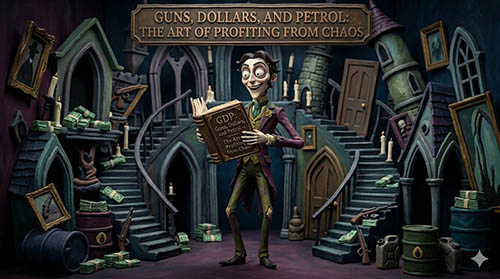
In a world where peace is bad for business, the US – Iran war has emerged as the global economy’s surprise fitness trainer – burning some countries’ fat (read: reserves) while building up others’ muscle (read: defense stocks). According to the OECD, the global GDP remains “resilient.” Which is financial-speak for, “Yes, it’s a mess, but look how calmly we’re panicking.”
America, it appears, has rediscovered the ancient economic principle that nothing stimulates growth faster than detonations and defense contracts. With an extra 0.3% GDP growth this quarter, the US proves that when the world burns, Wall Street learns.
India, on the other hand, is experiencing that rare national talent – celebrating “resilience” while the rupee experiences acute dizziness, fainting at ₹94.6 per dollar. It’s a proud moment: our currency has finally achieved “international competitiveness” by becoming so light it floats away.
Winners, Losers, and the Financially Sanctified
- The United States: Profits from both war and peace – sells the weapons, then sells the reconstruction contracts. Bonus points for selling moral lectures as premium exports.
- Russia: Mysteriously grows richer every time someone else has a war. Possibly powered by schadenfreude-flavored oil.
- China: Stands politely at the side, waiting to buy everyone’s discounted despair at wholesale prices.
- Europe: Wonders why siding with America always leads to bankruptcy, then repeats it anyway – a long-standing NATO tradition.
- India: Continues to measure success in “coping mechanisms per capita,” oscillating between “Atmanirbhar Bharat” and “Imported Inflation.”
Inflation — the World’s New Religion
Inflation has become the new global faith. Saudi Arabia, sitting on oceans of oil, plays God. Everyone else prays for affordable diesel. India, whose inflation target was 4%, now prepares for 5.1%, proving that optimism is our fastest-growing sector. Economists describe it as “manageable.” That’s economist-speak for “we can’t do anything about it, so please stop asking.”
Meanwhile, the OECD calls this economic turbulence “temporary.” Which is true, because by the time it stabilizes, we’ll have found another region to bomb and another commodity to panic about.
The Moral of the War: Markets Before Mortals
The modern GDP narrative is refreshingly clear: wars are temporary, but quarterly earnings are eternal. As smoke rises over Hormuz, economies rise in Pentagon spreadsheets.
In summary, the planet has achieved that rare synchronization – where everyone loses differently, but the US Federal Reserve gains the moral right to say, “See, it could’ve been worse.”
And as markets open on Monday, investors everywhere will sit back, sip their inflation-priced lattes, and say, “What a time to be resilient!”