The Nirvik Bureau, Bhubaneswar, 28 February 2026
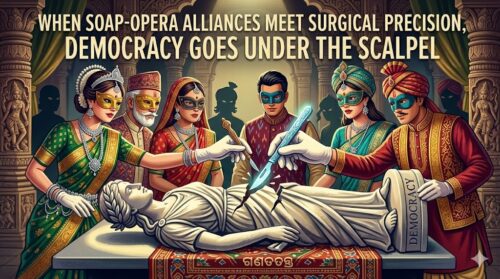
When soap-opera alliances meet surgical precision, democracy goes under the scalpel.
Once upon a time in Odisha, politics was a game of numbers. Today, it’s a case waiting for a specialist. Former Chief Minister Naveen Patnaik, after twenty-four years of ruling the state and a dignified sabbatical to “reflect and recollect,” seems to have discovered the ultimate cure for losing power: a urologist.
Yes, the man who once operated on kidneys is now expected to unclog Odisha’s political urethra, where BJP stones have settled stubbornly since 2024. Meet Dr. Datteswar Hota — physician, academic, and now, “common candidate” for an uncommon coalition. Naveen-babu and the Congress seem to have diagnosed the state’s ailment as a constipation of consensus, and the treatment plan reads: one shot of urology, twice daily till Rajya Sabha results.
For the uninitiated, Odisha’s Rajya Sabha election this March is less about Upper House seats and more about political rehabilitation centers. The BJP, drunk on majority vitamins, expects to pocket two seats automatically. The BJD has the numbers for one and the appetite for two – because why let math stop you when nostalgia fuels you? And then comes the fourth seat, dangling like a hospital bed vacancy, inviting every party to check their blood pressure and loyalties.
So, as BJP fumbles to name its candidates, Naveen has out-prescribed them all. He’s offered a “common candidate” not just to Congress but to “all parties who value humanity” – a phrase that, in political dialect, means “please lend me 30 votes before the operation fails.”
The Congress, thrilled to be invited to any relevance party, agreed immediately. Odisha Congress chief Bhakta Charan Das declared the alliance as being “for the larger interest of the state,” which is political language for “we finally have someone willing to take our calls.”
Observers suggest that Naveen’s new-found embrace of Congress is not a shift in ideology but in posture – the yoga of survival performed elegantly after losing power. After all, there is no better exercise for flexibility than opposition politics.
BJP sources, meanwhile, say they are “watching developments closely,” which roughly translates to “waiting to see if the patient survives the operation before billing the insurance.”
Political commentators across the state are marveling at the transformation: from “BJD – the silent ally of NDA” to “BJD – the secular savior of democracy.” It’s almost as if politicians discovered that the side effects of opposition include humility, empathy, and an urgent desire for bipartisan friendship.
Dr. Hota, ever the professional, has promised to use his Rajya Sabha stint to “strengthen public health.” A noble goal, considering the first patient seems to be Odisha’s political bloodstream itself – dehydrated, over-medicated, and occasionally suffering short-term memory loss.
As Odisha heads into another political surgery, one truth stands out: in this state, alliances are not born out of ideology but necessity. Power may change hands, but everyone still queues up to scrub in.