
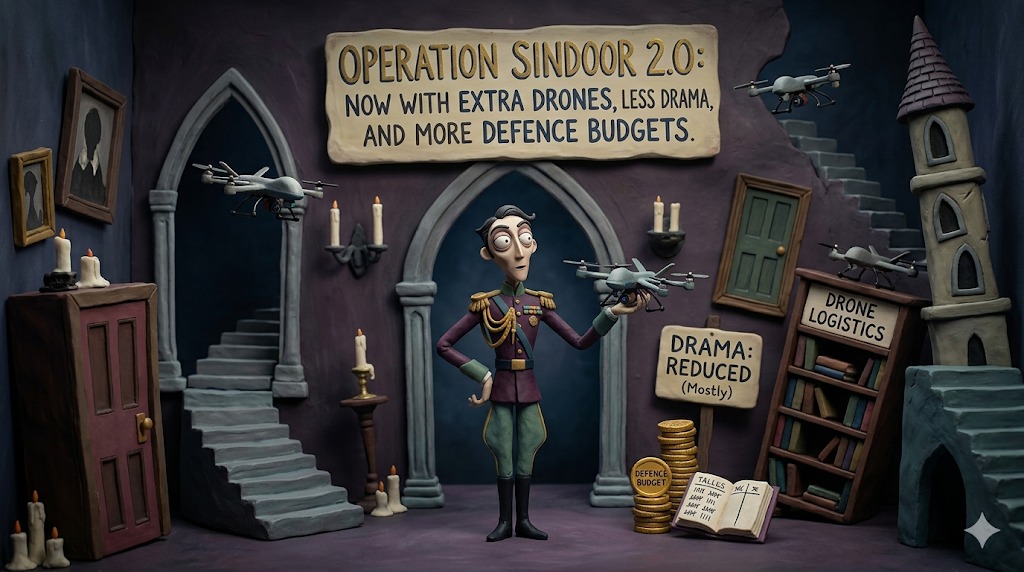
The Nirvik Bureau, Bhubaneswar, 7 May 2026
Welcome to the Age of Budget Warfare
If Operation Sindoor was India’s loud, precise answer to terrorism, then the Iran war has arrived like a grim reminder from the future saying: “Nice strike. Now try surviving the sequel.” In other words, modern war is no longer about grand battlefield heroics and slow-moving tanks posing for history books. It is about cheap drones, expensive interceptors, nervous airbases, and politicians discovering military vocabulary only after the fighting starts.
That is the real lesson India cannot ignore. The next conflict may not arrive with a traditional bang, but with a buzzing swarm, a missile from nowhere, and a hundred headlines about “strategic recalibration.” The battlefield is no longer a field. It is a network, a spreadsheet, and a very expensive insurance claim.
Welcome to the Age of Budget Warfare
The Iran conflict has taught military planners a deliciously cruel lesson: the cheapest weapon may cause the costliest headache. A $35,000 drone can force an enemy to burn a $4 million missile. That is not warfare. That is commercial-scale financial sabotage with a patriotic soundtrack.
This is the new genius of modern conflict. You no longer need to destroy the enemy’s entire force. You only need to keep making them pay absurd amounts to stop your very affordable troublemakers. It is like throwing pebbles at a billionaire and watching him hire private security, helicopters, and a crisis consultant.
India must therefore prepare not just for firepower, but for arithmetic. Because the enemy’s best strategy may be to make every interception feel like a procurement regret.
From Silent to Violent, Very Quickly
Operation Sindoor already showed that India can move from silence to violence faster than many bureaucracies can process a file. That part is reassuring. The less reassuring part is that the next war may reward not just speed, but saturation. One strike is not enough. One drone wave is not enough. One missile defence layer is not enough.
The future belongs to systems that can see, track, jam, intercept, and still have enough energy left to answer the phone. In this world, mobility matters. Static air defence is like standing under a tree in a thunderstorm and calling it a doctrine.
Geography: Pakistan’s Favorite Unwanted Asset
Then there is geography, nature’s most underappreciated battlefield planner. Pakistan’s size, unfortunately for it, is also a strategic vulnerability. In a future conflict, India may not need to cross borders to create serious disruption. Long-range missiles, drones, and stand-off weapons can do the job from a distance, while everyone involved insists they are “exercising restraint.”
This is the modern miracle: you can now paralyse an enemy’s military infrastructure while remaining technically polite.
The Arms Race of Cheap Trouble
So yes, India needs more than pride, precision, and patriotic hashtags. It needs mass-produced drones, mobile air defence, stronger electronic warfare, faster missile systems, and a doctrine that understands the economics of attrition. The next war may be won by the side that can keep operating while the other side’s accountants faint.
If Operation Sindoor was the warning shot, then Operation Sindoor 2.0 must be built for a world where war is faster, cheaper, and nastier. And if that sounds unpleasant, it should. That’s the point.