The Nirvik Bureau, Bhubaneswar, 18 November 2025
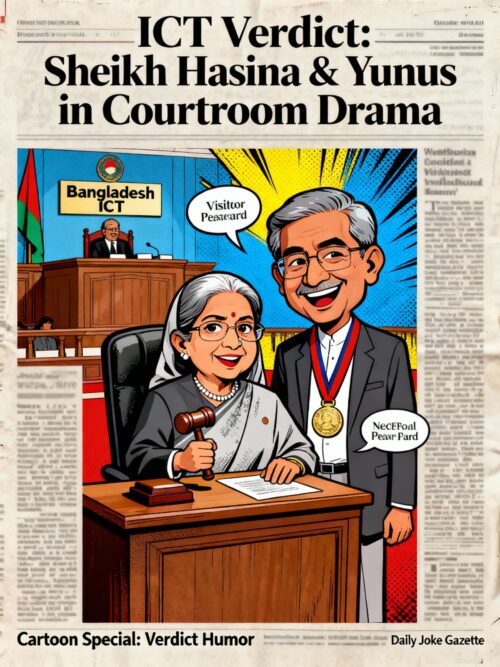
Bangladesh, that eternally experimental republic of democracy and déjà vu, has once again stolen the global spotlight. The International Crimes Tribunal (ICT), in a performance worthy of an Oscar for Best Political Screenplay, has handed Sheikh Hasina a death sentence—thus proving once again that in Bangladesh, the only thing faster than a cricket over is the delivery of justice when politics is the umpire.
Citizens, global observers, and a few startled embassy staff are all calling this the “landmark verdict.” A landmark, because one can always spot it from miles away as the place where politics, ambition, and selective morality collide in slow motion.
The Courtroom as Reality TV
The proceedings reportedly had everything: suspense, drama, backstory, and a plot twist so predictable it could have been sponsored by Netflix. Witnesses testified with the conviction of Shakespearean actors, evidence appeared on cue, and the verdict came down faster than a bad Wi-Fi connection.
Transparency was, of course, ensured at every step—so clear that nobody quite knew what was happening, but everyone agreed it was historic. As one observer put it, “It’s not justice as much as performance art.”
The Return of the Banker Messiah
Amid this thunderous judicial opera, enter the newly appointed caretaker of the interim government: Dr. Muhammad Yunus. Yes, the same Yunus who once changed the world with microloans and smiling village bankers has now upgraded to macro-politics and unsmiling bureaucrats. The once modest purveyor of small credit now deals in big mandates.
It’s a poetic career leap. From lending goats to farmers, he now lends legitimacy to regimes. From collecting interest in villages, he now collects interest from international think tanks and high-profile newspaper columns on “how Bangladesh can heal.”
The Peace Prize Economy
Of course, let us not forget that Yunus’s greatest asset remains his Peace Prize—a shiny medal that doubles as both international currency and moral armor. After all, when questioned about money-spinning, moral-spinning, and microloan misadventures, he can always point to that golden medallion and announce, “But I brought peace!”
And now, in his new role as the custodian of Bangladesh’s interim soul, the man once known for empowering rural women is now empowering urban elites. Justice, like microcredit, is being disbursed liberally—terms and conditions very much applied.
The Dawn of Selective Salvation
Under this new order, righteousness has become the national dress code. The ICT’s verdict assures the world that Bangladesh will not tolerate wrongdoing, provided it’s the wrongdoing of someone out of favor. Meanwhile, Yunus’s calm sermons on good governance drift across television channels like lullabies for the politically weary.
Ordinary citizens watch in silence, already knowing the ending. Hasina, the eternal villain or heroine depending on who writes the script, has once again become the nation’s defining plot twist. The rest of the cast—the economists, lawyers, and activists—play their parts with rehearsed moral clarity.
Curtain Call
So, as the gavel falls and the cameras flash, one can only marvel at Bangladesh’s cutting-edge innovation: justice reimagined as performance, politics reduced to public relations, and the Nobel transformed into a national brand.
History will decide whether Yunus’s peace-building and the ICT’s punishment mark a rebirth or merely another rerun. But one thing is certain: in the theater of Bangladeshi politics, irony will never go out of style—and the show, as always, must go on.