
The Nirvik Bureau, Bhubaneswar, 3 December 2025
The Birth of a Digital Messiah
Some say revolutions begin in the streets; in modern India, they begin in press conferences. One bright morning, amid slogans of “Digital India 2.0,” the Government unveiled its next great promise to the nation’s 1.4 billion mobile users—the Sanchar Sathi app. A technological soldier, they said, armed to protect citizens from mobile fraud, identity theft, and possibly, alien invasions too.
Ministers declared it the dawn of a fraud-free India. Bureaucrats spoke as if the app would transform our phones into electronic Gandhis—truthful, pure, and forever call-logged.
Enter the Big Tech Trio
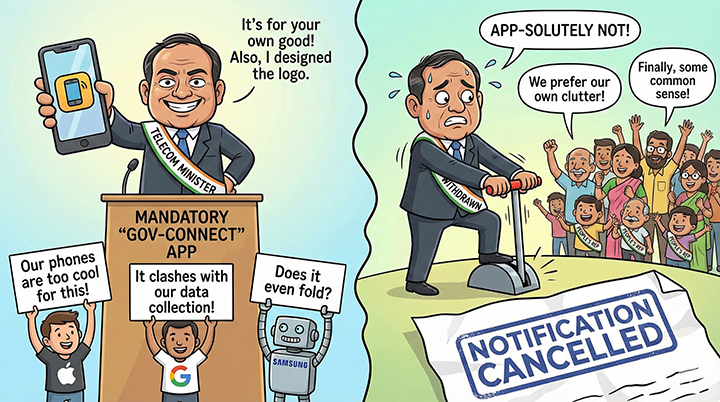
Then came the test of global brotherhood. The Government, brimming with confidence, extended an invitation to technology’s holy trinity: Apple, Google (yes, they spelled it “Andriod” in one memo), and Samsung. The plan was simple—pre-install Sanchar Sathi in every device. After all, nothing says freedom like an app you never asked for.
Apple, that bastion of privacy, politely refused, saying something about “user rights,” followed by an eye roll visible from space. Google adjusted its tie, coughed diplomatically, and declined too. Samsung, ever the courteous guest at political dinners, said it would “think about it,” which in corporate language means “absolutely not.”
Suddenly, the great digital dream began buffering.
A National Saga of Notifications
Undeterred, the Government issued a notification announcing mandatory activation. Citizens read it and wondered—would Sanchar Sathi save them from spam calls or simply join in? Memes flourished faster than the download link itself.
Then came the twist. The Government clarified that installation was purely “optional.” Freedom was restored, albeit temporarily. Civil servants sighed in relief—there would be no headlines like “India tracks everyone, including your cat.”
But the reprieve was short-lived. Just as people were learning to pronounce “Sathi,” the Government executed a graceful pirouette. The notification was withdrawn, the app reconsidered, and the digital Messiah quietly packed its bags for indefinite hibernation.
The U-turn Parade
This, of course, wasn’t a U-turn. It was “policy recalibration,” a phrase that now rivals “achhe din” in national vocabulary. Critics accused the Government of short-circuiting its own wiring. Supporters called it “responsive governance.” Meanwhile, the app that promised safety ended up ghosting the nation, leaving behind only WhatsApp forwards to prove its existence.
Some insiders claim the app’s development team had prepared an update called “Sanchar Sathi Pro” with features like tracking your ex’s number and locating your uncle’s missing Aadhaar card. Alas, the Pro never made it past the prototype stage, buried somewhere between “national security concerns” and “server down.”
Lessons from the Digital Dust
The Sanchar Sathi saga will be remembered as a masterclass in how not to court Big Tech—or public trust. Somewhere, deep within the corridors of bureaucracy, a committee is now doubtless evaluating what went wrong. They might conclude that timeliness, clarity, or maybe even humility could have helped. Or they might just recommend a new app: Sanchar Sathi Reborn, to help citizens track the previous one.
After all, in a country that once sent rockets to Mars on a shoestring budget, failing to install an app on a few billion phones feels poetically tragic. The tryst with technology continues—now armed with better PowerPoint slides and a slightly bruised ego.