The Nirvik Bureau, Bhubaneswar, 9 January 2026
Odisha’s New Power Symbol: One Chair Cover to Rule Them All
In Odisha’s new political astrology, the most powerful object is not the Chief Minister’s pen, not the Constitution, not even the people’s vote. It is the sacred, untouchable, eternally reserved… White Towel on Mohan Charan Majhi’s chair.
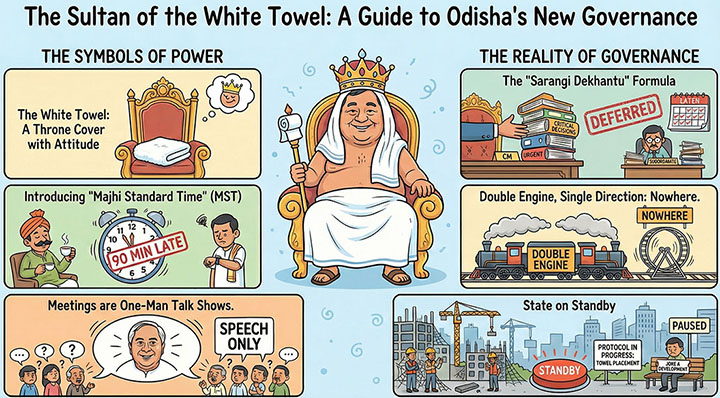
It’s not a towel; it’s a throne cover with attitude. The unwritten rule is simple: wherever he sits, the headrest must be draped in that spotless white cloth, like a VIP tilak on furniture. The message is blunt—this is my chair, my power, and no one else dares sink their head where the Highness of Half-Work has rested his.
Welcome to Odisha, where governance may be missing, but the towel protocol is fully implemented.
White Towel, Dark Reality
Officials rush ahead to meetings—not to prepare policies, but to prepare the towel. It must be aligned, crisp, and waiting, like the state itself: silent, obedient, and forever on standby.
Roads may wait, jobs may wait, projects may rot, but the chair must never be seen naked. Development can be stained and crumpled, but the towel must remain pure and white, like the pretence that everything is fine.
When citizens ask, “Why is nothing moving in Odisha?”, the answer is simple: movement might disturb the towel.
Majhi Standard Time: Always Late, Always Right
Odisha now runs on two time zones: IST for normal people and MST—Majhi Standard Time—for the Chief Minister. MST is reliably 90 minutes behind any scheduled event, because punctuality is for people who actually need to prove they work.
Programme at 11:00 a.m.? The public comes at 11:30, the officials at 11:45, and the Chief Minister floats in sometime after 12:30, armed with the one thing that never runs late: his sense of self-importance.
“Sorry, busy with urgent work,” is the official excuse. What that work is, no one knows. Maybe it’s towel inspection. Maybe it’s practising dramatic late entries. Maybe it’s rehearsing the same speech about how everything is “in progress” while the state stands perfectly still.
Speech, Speech, and Nothing But Speech
Once he arrives, the real ordeal begins. Meetings, conferences, public programmes—everything becomes a one-man talk show. He does not address gatherings; he takes them hostage.
Others on the dais are technically “dignitaries,” but functionally furniture. Guest speakers, experts, and local leaders bring their notes; they go back with those same notes, untouched, because there is no time left after the Chief Minister finishes singing the long, never-ending ballad of his own greatness and “future plans.”
The crowd doesn’t clap out of excitement; they clap out of survival instinct, hoping applause will signal “please stop.” Even the air conditioners get tired. The quickest way to end an event in Odisha is not a schedule—it’s collective exhaustion.
Governance by “Sarangi Dekhantu”
And then, there are files—the boring, annoying documents that actually decide people’s lives. When something critical comes up, Odisha’s new governance formula kicks in: “Sarangi dekhantu.”
Let Mr. Sarangi check. Let Mr. Sarangi discuss. Let Mr. Sarangi basically do the job.
This is the grand administrative innovation: one Chief Minister for the speeches, one Man Friday for the thinking, one white towel for the authority, and one entire state waiting for something—anything—to actually change.
No wonder decisions crawl. Policies don’t move; they marinate. Files don’t get cleared; they get outsourced to eternal “discussion mode,” while the Chief Minister masters the art of delegation without responsibility.
Double Engine, Single Direction: Nowhere
We were sold the dream of “double engine sarkar”—state and Centre, both aligned, development at double speed. Instead, what Odisha got is a high-decibel, low-delivery circus: one engine stuck in neutral, the other revving loudly for optics.
On paper, everything is grand: investments, announcements, MoUs, schemes. On the ground, it’s the same old story—youth leave for jobs elsewhere, villages wait for basic facilities, and disasters hit harder than they should in a state that’s always “almost ready” but never quite prepared.
The only thing running on time is the ritual: towel ready, CM late, speech long, files deflected, people ignored.
But do not lose hope. As long as the white towel is in position, the illusion of control is intact. As long as the Chief Minister arrives late, you know he is “busy.” As long as he keeps talking, no one will have the energy left to question him.
Jai ho Odisha. Jai ho White Towel. And jai ho double engine sarkar—idling proudly on the side of the road, while the state watches from the footpath, still waiting for a lift.