The Nirvik Bureau, Bhubaneswar, 8 April 2026
The Inner Circle’s Favorite Hobby
In the modern imperial salon, war is no longer sold as tragedy. It is marketed as strategy, served with a patriotic garnish, and whispered about like a masculine adventure designed for men who have never had to count body bags or rebuild cities. The inner circle, naturally, was in no mood for subtlety. Why debate peace when one can stage a thunderous little crisis, flex on television, and call it leadership?
And if outside pressure was nudging the whole machine forward, well, that only made the performance more theatrical. Nothing sharpens political courage like a combination of ego, allies with demands, and a room full of people eager to confuse aggression with resolve.
This is how foreign policy gets turned into a backstage prank: everyone pretending to be serious while treating the world like a chessboard made of gasoline.
The Coterie of Confidence
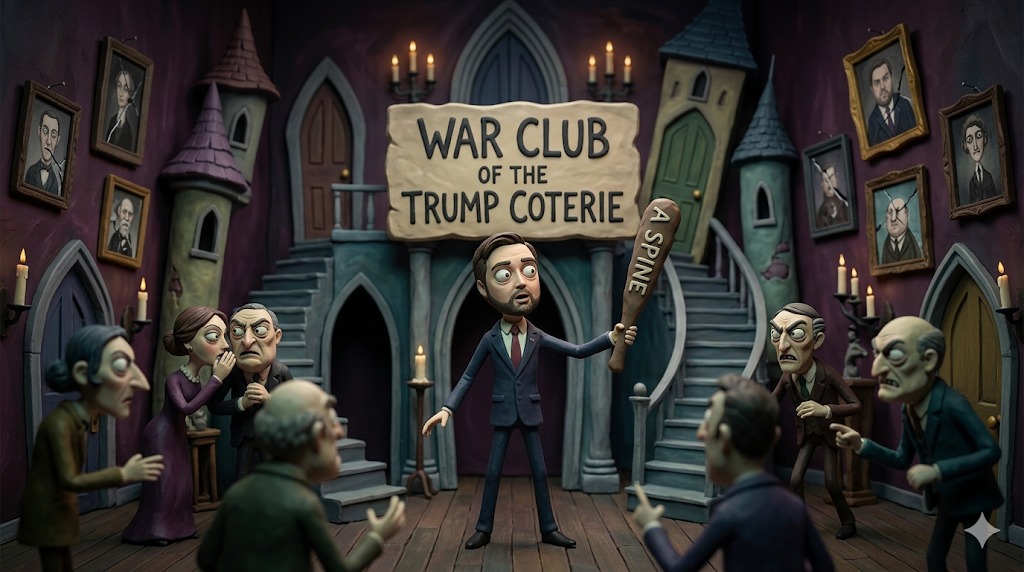
The Trump coterie, in this reading of events, looked less like a governing circle and more like a fan club for impulsive escalation. The mood was familiar: if the temperature rises, call it strength; if diplomacy fails, blame weakness; if the situation grows dangerous, declare that danger itself is evidence of toughness.
It is a beautiful little political trick. First, create the tension. Then, congratulate yourself for surviving it. Finally, ask the public to admire your courage for not noticing the fire.
The hawks in the room, if they were feeling poetic, probably imagined themselves as historic men making hard choices. More likely, they were just enjoying the old diplomatic sport of turning another nation’s crisis into a personal test of dominance. War, after all, is always easiest to support from a safe distance, ideally with a camera nearby and no one asking who pays the price.
J.D. Vance, Temporary Citizen of Reality
And then, unexpectedly, comes J.D. Vance – the man who, for one shining moment, appears to have wandered into the room carrying something revolutionary: hesitation.
While the others were busy auditioning for the role of Most Enthusiastic Catastrophe, Vance reportedly stood aside and said the obvious thing: this is a bad idea. In a political climate where loyalty often means applauding the cliff edge, even basic resistance can look heroic.
That is the joke at the center of modern power: not that one person opposed war, but that it took so much effort to locate the one person willing to say no. The rest of the room, presumably, had already mistaken adrenaline for principle and noise for statesmanship.
War as a Lifestyle Brand
This is how the machinery works. Leaders flirt with conflict, advisers cheer from the sidelines, and everyone pretends the whole thing is a solemn obligation. Meanwhile, the public is expected to believe that every military impulse is born from wisdom, not from vanity, pressure, or the ancient political urge to look strong while doing something foolish.
The saddest part is that the warning always sounds simple after the damage begins. Before the bombs, dissent is treated like disloyalty. After the wreckage, it is called insight.
So yes, in this saga, the room was crowded with people who seemed to think war was a thrilling concept – an adrenaline prescription for politics, perhaps helped along by outside pressures and old alliances. And amid all that heroic nonsense, J.D. Vance became the unlikely bearer of common sense, which in Washington is often the same thing as being the loneliest person alive.