The Nirvik Bureau, Bhubaneswar, 21 December 2025
A masterclass in foreign policy: seize a ship with no plan, then blame the Epstein files for missing his name.
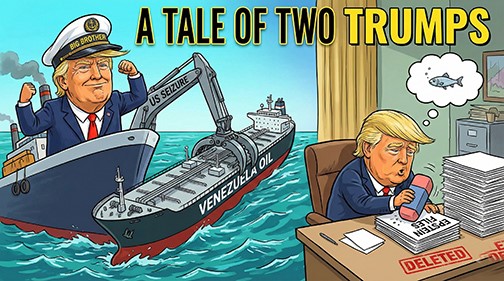
In a bold new chapter of American diplomacy, President Donald J. Trump has once again proven that international relations are best handled like a reality TV negotiation: loud, legally dubious, and with absolutely no regard for consequences. His latest triumph? The mysterious seizure of a Venezuelan oil tanker, not because it violated any clear law, but because, well, “it felt right.”
The ship in question, a floating hulk of rust and questionable paperwork, was quietly sailing through international waters when a U.S. Coast Guard vessel pulled alongside like a bouncer at a very expensive, very confused nightclub. “You’re not on the list,” the Americans reportedly said, before towing it away like a parking enforcer with a grudge. When asked under which treaty or statute this act of maritime karaoke was justified, the administration offered a response so vague it could have been generated by a random policy bingo card: “National interest. Bad actors. Very bad. Tremendous.”
Legal experts, those sad souls who still believe in things like “due process” and “sovereignty,” scratched their heads. Venezuela, already drowning in economic chaos, called it piracy. The UN called for calm. Trump called it “a beautiful seizure.” When pressed for details—like, say, evidence of wrongdoing or a coherent strategy—he simply shrugged and said, “We’re taking their oil. They’re not using it right. Sad!”
Meanwhile, back on the home front, the Epstein files finally dropped, and the internet did what the internet does best: turned a serious investigation into a celebrity scavenger hunt. People combed through hundreds of pages, not for clues about trafficking networks or systemic corruption, but to see if a certain orange-hued former president’s name appeared. And lo and behold, in the grand tradition of government redactions, some names were missing. Entire pages were blacked out like a badly censored spy novel. Conspiracy theories bloomed like weeds in a neglected garden.
Trump, of course, seized the moment with the grace of a man who has never met a scandal he couldn’t weaponize. “Look at those redactions!” he cried. “They’re hiding the truth! Probably because I’m so powerful and successful!” Never mind that the files contained plenty of names already; the real story, he insisted, was that his name wasn’t there. Or maybe it was, but they covered it up. Or maybe it was never there in the first place, but that’s even more suspicious. Logic, like the Venezuelan tanker’s cargo manifest, was optional.
The irony, of course, is delicious. On one side, a president who can command the seizure of a foreign oil tanker with less justification than a teenager confiscating his sister’s phone, yet demands ironclad proof for every accusation in a decades-old sex trafficking case. On the other, a public so obsessed with whether his name appears in a redacted document that they barely notice he just casually stole a ship.
It’s a masterclass in distraction: when the world asks, “Why did you take Venezuela’s oil?” respond with, “Why did they erase my name?” When journalists ask for evidence, reply with a tweet full of exclamation points and a poorly cropped photo of a document. When allies express concern, retweet a conspiracy theorist who claims the whole thing is a deep-state plot to protect… well, probably him.
In the end, the real scandal isn’t the missing name in the Epstein files. It’s that a man who can unilaterally command the seizure of a foreign vessel with a wink and a vague excuse somehow still expects the world to treat him like a victim whenever someone questions his past. But then again, in the Trump doctrine, consistency is for losers. And losers, like Venezuela, don’t get to keep their oil.