The Nirvik Bureau, Bhubaneswar, 26 April 2026
Where every ingredient claims it is the main course
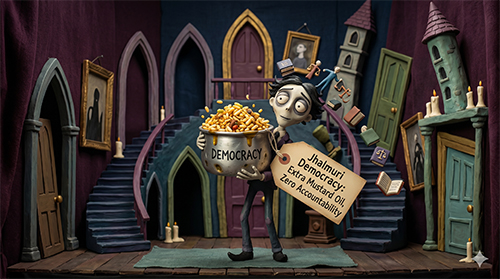
In the grand buffet of Indian democracy, West Bengal has decided that manifestos are overrated – what truly defines the political palate is jhalmuri. Not policy, not governance, not even ideology. Just a paper cone of puffed rice aggressively tossed with ambition, optics, and a splash of mustard oil strong enough to make the Constitution blink twice.
Of course, it had to be jhalmuri. What else could better capture a campaign where everyone is shouting, nobody is listening, and yet somehow everyone claims to be perfectly heard?
The Prime Minister’s carefully choreographed pause at a roadside jhalmuri stall in Jhargram was not a snack break – it was a philosophical statement. A reminder that politics, much like this iconic street food, is best consumed loudly, messily, and without asking too many questions about hygiene.
Look closely at the preparation. The vendor tosses in puffed rice – light, airy, and expanding rapidly when exposed to heat. Much like political promises. Then come the chopped onions: guaranteed to make you cry, though leaders will insist it’s because of “emotional connection with the masses.” Peanuts add crunch – symbolic of those hard, unyielding ideological positions that somehow soften when dipped in power. Chanachur enters like coalition partners – unpredictable, spicy, and occasionally unnecessary, but impossible to separate once mixed.
And then, the mustard oil. Ah yes, the true essence. Sharp, overpowering, and impossible to ignore—just like rhetoric during election season. It doesn’t matter what else is in the mix; once the oil hits, everything tastes like it. Much like a well-timed speech.
The beauty of jhalmuri lies in its chaos. No two handfuls taste the same. One bite is tangy, the next is fiery, the third leaves you questioning your life choices. Sound familiar? That’s because it mirrors the voter experience. Each rally promises a different flavour of the same mixture, each leader insisting their version is “authentic,” even as they quietly borrow ingredients from each other’s recipe books.
Meanwhile, maachh-bhaat – the supposed cultural soul of Bengal – sits in the background like an old intellectual at a tea stall, watching this spectacle unfold with quiet resignation. It represents continuity, identity, and substance. Naturally, it has no place in the current discourse.
Jhalmuri, on the other hand, thrives on immediacy. It is not meant to fill you up; it is meant to wake you up – or at least jolt your senses long enough to forget you were hungry for something more meaningful. In that sense, it is the perfect electoral offering. A quick hit of excitement, wrapped in nostalgia, served with a side of spectacle.
And like all great political experiences, it leaves behind a faint burn – on the tongue, in the eyes, and occasionally, in the conscience.
But no matter. By the time the next election rolls around, there will be a fresh batch, a new vendor, and a slightly different mix. The paper cone will change hands, the slogans will evolve, but the recipe will remain comfortingly chaotic.
Because in the end, Indian democracy isn’t a carefully plated meal. It’s jhalmuri – best enjoyed standing, slightly confused, and wondering if that last bite was brilliant or just aggressively seasoned illusion.