The Nirvik Bureau, Bhubaneswar, 15 April 2026
When global power is measured in barrels, every strait becomes a stage and every sanction a magic trick.
The World’s Newest Hobby: Choking the Supply Chain
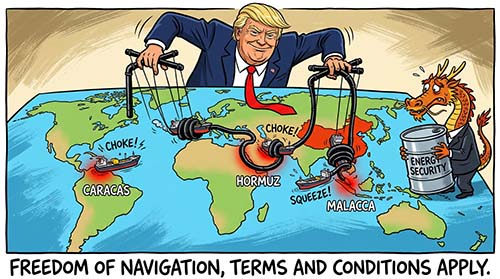
Once upon a time, empires marched on roads. Now they loiter around sea lanes, squint at maps, and pretend geography is a personal insult. The modern superpower does not merely want influence; it wants to stand at the neck of the planet and ask, with the confidence of a man blocking a doorway, “Going somewhere?”
And so the grand strategy unfolds: pressure Venezuela here, nudge the Middle East there, hover near the Malacca Strait like an overcaffeinated traffic cop, and hope the rest of the world forgets that oil is not an app you can uninstall. It is a liquid dependence with a passport stamp from everywhere and a permanent invitation to chaos.
Sanctions: The Diplomatic Equivalent of Smashing Plates
Diplomacy used to involve negotiations, alliances, and the occasional sober handshake. Today it often resembles a toddler discovering how to punish a sibling: if I can’t have the toy, I’ll throw it behind the sofa. Sanctions are announced with solemn faces and heroic language, as if economic pain were a clean, surgical instrument rather than a blunt object with bad manners.
The logic is beautiful in the way a collapsing tent is beautiful. If you squeeze the oil routes hard enough, surely the target will politely reconsider its entire foreign policy. Never mind that the squeeze also rattles markets, inflates prices, and makes everyone else reach for the aspirin. In the theatre of hard power, collateral damage is just another term for audience participation.
The Straitjacket Doctrine
There is something almost poetic about a global power trying to control trade chokepoints while insisting it is defending freedom. It is the political equivalent of locking the neighborhood gate and calling yourself a community organizer. One day it’s the Caribbean, another day the Persian Gulf, then the narrow waters of Southeast Asia – because nothing says “stable world order” like making every shipping lane feel like a nervous cat crossing a highway.
The plan, in theory, is to make a rival’s energy supply sweat. In practice, it also teaches the world a useful lesson: dependence is never innocent, and every barrel comes with an argument attached. Energy security, it turns out, is just geopolitics wearing a hard hat.
Meanwhile, in the Real World
The target does not always collapse dramatically, as the strategists imagine. It adapts, reroutes, stockpiles, negotiates, and buys from somebody else who is very happy to be uninvited to the lecture on moral commerce. Markets shift. Ships change routes. Middlemen bloom like weeds. And the original mastermind, having mistaken pressure for precision, discovers that global trade is less like a switch and more like a bowl of noodles thrown at a ceiling.
Final Act: The Map Laughs Last
The funniest part of all this is that every empire eventually rediscovers the same inconvenient truth: geography does not take orders. Oceans do not salute. Straits do not obey. And oil, that slippery monarch of modern civilization, moves wherever fear, profit, and necessity allow it to move.
So the superpower may keep pointing at maps, tightening screws, and speaking in the noble language of strategy. But the planet has heard this speech before. It usually ends the same way: with higher prices, louder speeches, and a world quietly asking, “Who exactly is being strangled here?”