The Nirvik Bureau, Bhubaneswar, 29 April 2026
When paperwork outlives people
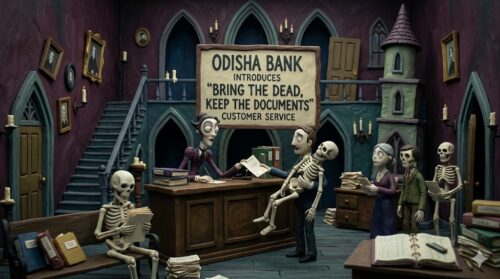
In a country where every document is sacred except the ones you actually need, Odisha has reportedly gifted us a new chapter in public-service absurdity: a man allegedly had to carry his sister’s skeleton to a bank to prove she was dead, because apparently death itself is no longer enough without the right form, signature, and possibly a blood sample from the afterlife.
The bank, naturally, clarified that it had only asked for papers. And that is the true beauty of modern governance. A human being may vanish, decay, and become a skeleton, but the file remains eternal. The file does not age. The file does not mourn. The file only asks, “Where is the certificate?”
The sacred ritual of document worship
In India, the citizen is not a person; the citizen is a folder. And the folder must contain proof of birth, proof of residence, proof of identity, proof of existence, proof of death, proof that the proof is not fake, and sometimes proof that the previous proof was really proof.
So when a bereaved family member walks into an institution hoping for a little compassion, what they often receive is a seminar in administrative immortality. The counter clerk, trained in the fine art of saying “bring another document,” becomes the high priest of procedure. The dead may rest in peace, but the office cannot move without a photocopy.
The bank’s version of empathy
To be fair, the bank may not have asked for a skeleton specifically. It only asked for papers. And this is where our system’s genius shines: it never says “no,” it simply creates conditions under which yes becomes medically and emotionally impossible.
Need a death claim settled? Submit the death certificate.
Can’t get the death certificate because the body is missing? Submit police papers.
Can’t get police papers because the body is not identified? Submit evidence.
Can’t submit evidence because the institution wants original documents.
Can’t produce original documents because the person is dead.
And there, in that elegant loop, the system achieves what philosophers call the “infinite bureaucracy theorem.”
The skeleton as a file attachment
The most tragic part is not even the incident itself. It is that we are no longer shocked by it. We see the headlines and nod like seasoned survivors of administrative comedy. Of course someone had to carry a skeleton. Of course a bank said it wanted papers. Of course the system responded to grief the way a printer responds to low ink: not with urgency, but with a blinking message.
Somewhere in a dusty office, a clerk is probably still defending the process. “Rules are rules,” he says, adjusting his chair like a philosopher of inconvenience. “If we bend them for one case, what will happen to discipline?”
What will happen, indeed? Perhaps humanity. Perhaps efficiency. Perhaps the terrifying possibility that institutions might begin to serve people instead of worshipping stamps.
The final irony
The real outrage is not that a skeleton was brought to a bank. The real outrage is that, in 2026, this does not feel impossible. We have built a nation where the dead may need paperwork before the living receive mercy. The body can disappear, but the form remains undefeated.
And that, in the grand Indian tradition of official logic, is called system.