The Nirvik Bureau, Bhubaneswar, 10 May 2026
When victory speeches promise sweetness but deliver costlier vegetables and existential spelling crises
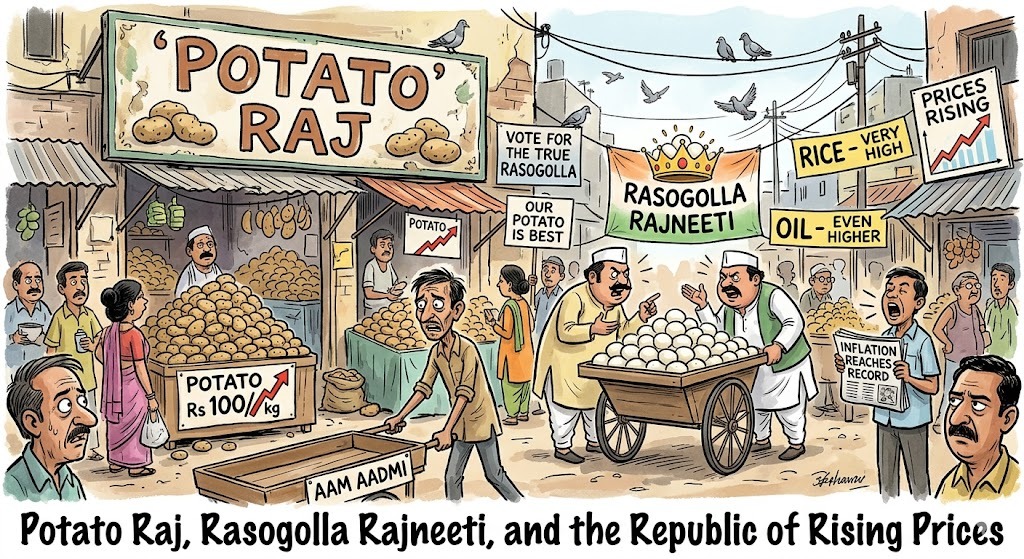
Mohan Majhi must be a man of vision. After all, it takes remarkable foresight to celebrate a political victory in West Bengal while Odisha quietly turns into a live demonstration of inflation, chaos, and creative governance. The BJP’s win in Bengal was supposed to usher in a new era—at least for potatoes. The humble aloo, long oppressed by previous regimes, was expected to finally achieve economic liberation. Instead, in a touching tribute to irony, wholesale prices have risen by three rupees. Clearly, the potato did not get the memo about regime change.
But perhaps we are asking the wrong questions. Maybe this was never about prices. Maybe this was about identity. Which brings us to the more pressing national concern: the Rasogolla. Or is it Rasgulla? Or Roshogolla? Or, under a newly enthusiastic administrative hand, will it soon be rebranded as “Rasagolaaah”—with a cultural footnote and a trademark dispute attached? One can only imagine committees being formed, syllables debated, and experts flown in to determine how sweet a sweet should sound under a new political dispensation.
Meanwhile, somewhere between linguistic nationalism and dessert diplomacy lies the ghost of the Jagannath Dham controversy. Once a roaring storm, it now lingers like an unfinished WhatsApp forward – half-forgotten, occasionally resurrected, but never fully resolved. It serves as a gentle reminder that in modern governance, symbolism often travels faster than substance.
Back in Odisha, however, reality refuses to be rebranded. Law and order has apparently taken voluntary retirement. Women navigate streets like participants in an unsponsored survival game, while traffic conditions resemble a live-action puzzle where no one knows the rules and everyone is losing. The city doesn’t move anymore—it negotiates its existence, honk by honk, inch by inch.
And then comes inflation, the most loyal government companion. Milk prices have gone up by four rupees per litre, ensuring that even your morning tea now carries a subtle aftertaste of fiscal policy. At this rate, cows might soon demand security cover and economic advisory roles.
The beauty of it all lies in the contrast. On one hand, we have grand narratives—electoral victories, cultural assertions, and symbolic battles over sweets. On the other, we have the quiet, stubborn arithmetic of daily life – potatoes that cost more, milk that pinches harder, and streets that feel less safe than before.
Mohan Majhi, in this grand theatre, appears less like a chief minister and more like a ringmaster juggling flaming issues while the audience debates whether the circus tent should be called a shamiana or a pavilion. The performance continues, the applause is selectively edited, and the script keeps rewriting itself.
In the end, the citizen is left with a simple choice: argue about the spelling of Rasogolla, or calculate how many potatoes one can still afford. Either way, the sweetness seems increasingly theoretical.