The Nirvik Bureau, Bhubaneswar, 19 June 2026
Students now instructed to worship aerodynamics, memorise Karnataka’s monuments as Odisha’s, and treat equinoxes like lines of longitude.
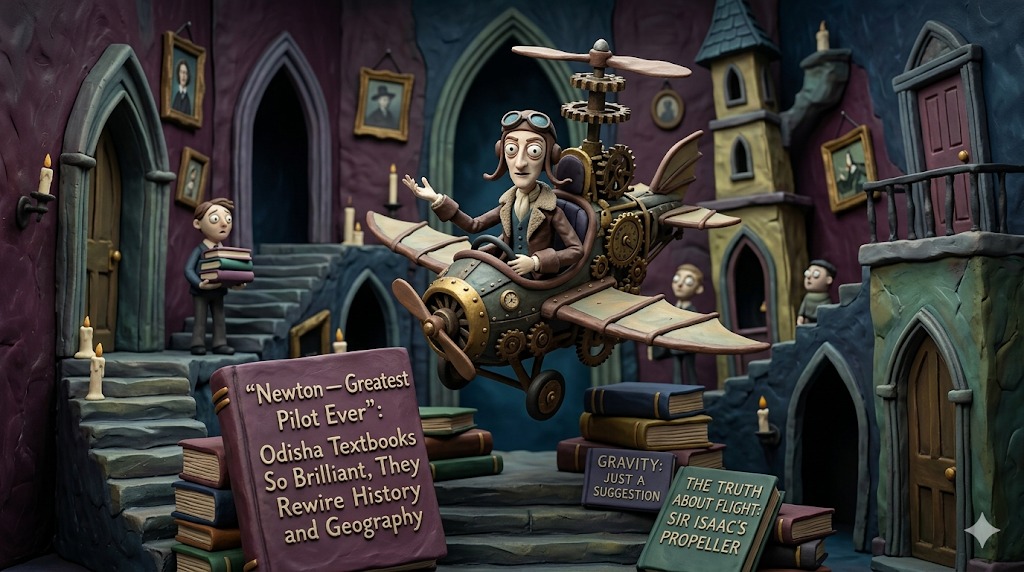
They wanted creativity in classrooms; they got creative curricula. In a bold educational pivot that will surely make curriculum designers around the world weep with envy, Odisha’s new schoolbooks have liberated facts from the tyranny of accuracy. Why be burdened by boring truths when you can upgrade Newton from “scientist” to “greatest pilot,” convert Hampi into Konark (tourism revenue, reallocated), and relocate Niyamgiri to Jharkhand as part of a timely cross-state exchange programme?
Teachers, once mere transmitters of textbook gospel, have been promoted overnight to heroic fact-correctors. Armed with corrigenda and a can-do spirit, they will teach children that wheat is modern paddy, pressure is a polite synonym for temperature, and the food web is actually an elaborate recycling plan gone social. Class 8 students, who bravely carry 705 errors apiece, will graduate with the rarest of skills: the ability to think beyond maps, logic, and physics.
The textbook committee deserves credit for narrative economy. Why clutter a single page with multiple specialists when one mislabelled photograph can simultaneously refine civics and plant identification? A snapshot of the Karnataka Legislative Assembly now doubles as Odisha’s seat of power – a masterstroke in inter-state diplomacy and Photoshop minimalism. Students can learn two states for the price of one photograph and save valuable ink.
A three-member high-level probe has been ordered, which is both reassuring and efficient: three humans, seven days, 1,678 errors – the arithmetic of accountability is gloriously optimistic. The Development Commissioner will lead, because who better to untangle scientific misnomers than a manager schooled in development jargon? Expectations are modest: perhaps a press release, a sternly worded memo, and a committee photo that will hang in the corridor of decisive governance.
The errors are pedagogically inclusive. From Class 1 to 8, every child receives an equal opportunity to learn alternate realities. Early grades will build character by wondering whether the Equator should be celebrated twice a year; middle-schoolers will practice ethical ambiguity while deciding if Berhampur is a city or a district; and seniors will achieve epistemological maturity by reconciling equinoxes with longitudes. This curriculum does not teach answers – it trains adaptable humans who can thrive when Google disagrees with their textbooks.
Critics asked how such mistakes passed review. The answer is simple: the review panel was probably on leave, attending a national seminar on “Flexible Facts in the Age of NEP.” Or perhaps the textbooks underwent a rigorous quality check – by a highly advanced artificial intelligence that, after a few martinis, decided Newton piloted a cosmic flight and that wheat always aspires to be paddy.
The government’s corrigendum is a thoughtful touch. Rather than reprinting, they gifted schools the timeless art of improvisation. Teachers can now turn errors into live exercises: “Spot the mistake – if you can find all 1,678, you win a prize.” The prize, naturally, is additional responsibilities.
In the brave new classroom of Odisha, certainty is passé. Ambiguity is on the syllabus, geographical boundaries are suggestions, and science is a performance art. Parents should relax: by the time these children enter public life, they will be uniquely prepared to navigate any briefing, reinterpret any fact, and pilot – metaphorically, if not literally – through whatever bureaucratic turbulence awaits. Would you like this sharpened into a cartoon script or a shorter social-media zinger?