
Dhanada K Mishra, Hong Kong, 8 July 2026
There was a time—not very long ago—when accuracy was considered a virtue. Facts were verified, citations were checked, and textbooks were expected—rather unfashionably—to contain correct information. Courts, too, were assumed to rely on precedents that actually existed. That era now appears to be gently receding, making way for a more imaginative age—one in which confidence often outruns correctness, and reality is treated as a flexible suggestion.
Welcome to the age of productive hallucination.
Artificial Intelligence, we are told, occasionally “hallucinates.” This term, regrettably, carries a negative tone. A more generous interpretation would be “creative interpolation under conditions of incomplete data.” Faced with uncertainty, why should a system admit ignorance when it can instead produce a coherent and confident answer?
To be fair, AI is hardly the pioneer here. Humans have long practised this art. Political rhetoric, consultancy reports, and even academic writing have, at times, demonstrated a similar ability to bridge inconvenient gaps in knowledge with persuasive invention. AI has simply industrialised the process—faster, cheaper, and available on demand.
Consider a classroom in Odisha.
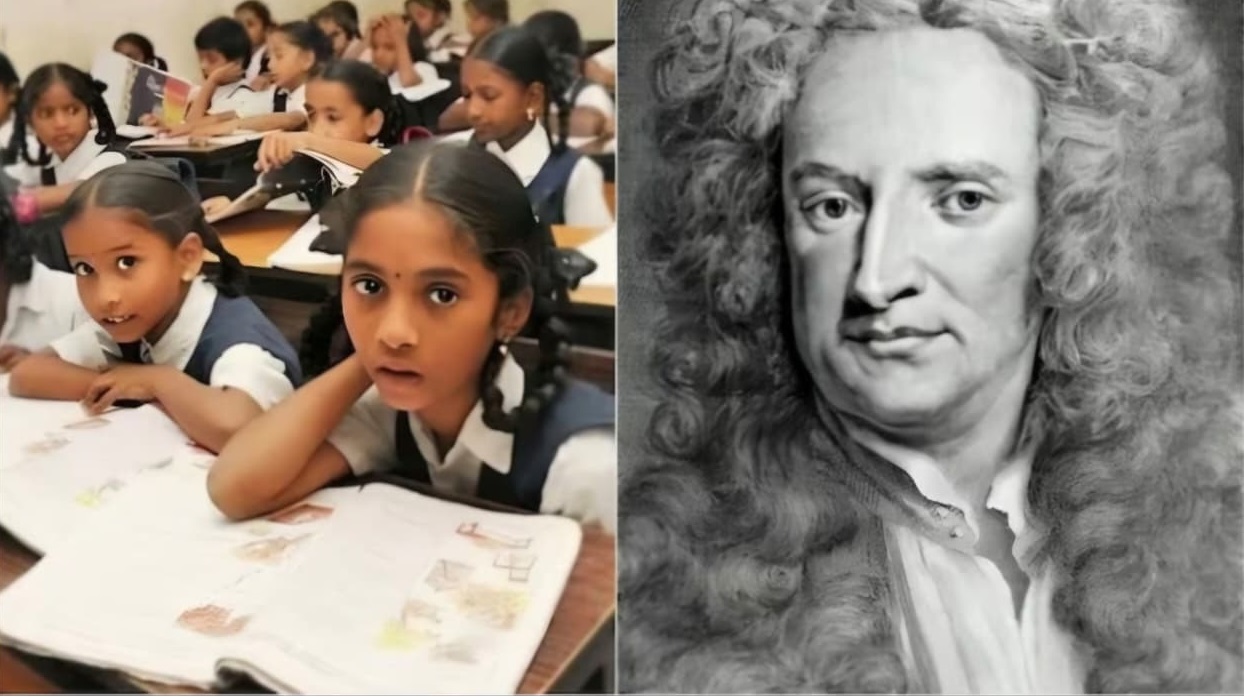
A diligent twelve-year-old sits at her desk, reading aloud from a newly issued textbook. She learns that a historical event occurred in the wrong century, that a scientific principle is explained with charming but incorrect logic, and that a national figure is credited with an achievement they never claimed. She pauses, puzzled, and asks her teacher for clarification. The teacher, equally reliant on the same text, hesitates. A discussion begins. Phones are consulted. Someone searches online. The class divides into competing interpretations.
Apparently, they found 1678 errors in 55 newly printed textbooks from Class I to VIII. The special investigation team is still determining whether it is all due to use or rather mis-use of AI or simply careless proofreading! But it is certainly unprecedented in scale and scope with examples like Newton being described as a “great pilot,” Hampi being shown as the Konark Sun Temple, and the Karnataka Legislative Assembly being used instead of the Odisha Assembly!
What appears, at first glance, to be an error has now transformed into an interactive learning experience.
The student learns several valuable lessons that no traditional curriculum could have delivered as effectively. First, that printed material is not infallible. Second, that authority does not guarantee accuracy. Third, that knowledge requires verification. In one stroke, the education system has moved beyond rote memorisation into critical inquiry.
Admittedly, there is a minor side effect: the student may never again fully trust a textbook. But in a world overflowing with information, a healthy scepticism may be considered a feature rather than a flaw.
The legal profession, too, has recently offered a compelling demonstration of hallucination’s creative potential. In a widely discussed case, a legal submission relied on prior judgments that, upon closer inspection, did not exist. These citations were not merely misinterpreted; they were entirely fabricated, reportedly generated with the assistance of AI.
One might view this as deeply concerning. Alternatively, one could admire the efficiency.
Traditionally, legal research requires painstaking effort—locating precedents, verifying their relevance, and interpreting their applicability. AI-assisted hallucination streamlines this process dramatically. Why search for the perfect precedent when one can generate it? Why be constrained by the past when the present demands something more convenient?
Of course, the court was less enthusiastic about this innovation. The incident raised serious questions about diligence, accountability, and the risks of over-reliance on AI-generated content. Yet, from a purely satirical standpoint, it represents a fascinating evolution: jurisprudence no longer limited by the inconvenience of reality.
The benefits of hallucination extend into governance, business, and consulting. Strategic plans frequently rely on projections that are, at best, optimistic approximations. Vision documents describe futures that have yet to consider feasibility. Presentations often achieve a level of certainty that underlying data cannot quite support.
AI does not disrupt this ecosystem—it harmonises with it.
Why spend weeks gathering and validating data when a plausible narrative can be assembled in seconds? Why allow uncertainty to delay decisions when it can be replaced with articulate confidence? In many settings, the appearance of coherence is indistinguishable from coherence itself.
There is also a democratizing dimension worth noting. The ability to produce authoritative-sounding inaccuracies was once limited to a trained elite. Today, anyone with access to AI can generate reports, essays, or legal arguments that appear impressively rigorous. Authority is no longer earned through effort alone; it can be approximated through computation.
This is, in its own way, a form of inclusivity.
Naturally, such power calls for governance. Eliminating hallucination entirely is neither practical nor, perhaps, even desirable. A more realistic approach is to manage it. Imagine a system where every document carries a “Hallucination Disclosure”—a simple indicator of how much of its content is verified versus inferred. Organisations might appoint “Verification Leads” alongside content creators. Educational institutions could teach “AI literacy” as a core skill, emphasising not just how to use tools, but how to question them.
More importantly, individuals can adopt simple, practical safeguards.
A common reader need not become an expert to detect hallucinations. A few habits can significantly reduce risk:
- Cross-check key facts using at least two independent and credible sources.
- Treat highly specific claims—dates, case names, statistics—with extra scrutiny.
- Ask a simple question: “Can this be verified elsewhere?” If not, treat it as provisional.
- Use AI iteratively: ask it to provide sources, then verify those sources independently.
- Maintain a bias toward primary material—original judgments, official reports, and direct data—over summarised interpretations.
Returning to our classroom, imagine that same twelve-year-old student, now equipped with these habits. She reads the questionable passage, pauses, and decides to verify it. Within minutes, she identifies the inconsistency and raises it. The error is corrected—not by authority, but by inquiry.
That is the paradox of hallucination. It introduces error, but it can also provoke awareness. It undermines certainty, but it can strengthen critical thinking—if we respond appropriately.
Satire, of course, thrives on exaggeration. The world has not abandoned accuracy, nor is it likely to do so entirely. But recent incidents—from flawed textbooks to fabricated legal citations—highlight a subtle shift. We are becoming more comfortable with outputs that sound right, even when they are not.
The danger is not that AI hallucinates. That is now well understood. The greater risk is that we grow accustomed to it—that we stop questioning, stop verifying, and eventually stop noticing.
At that point, hallucination will have achieved its highest form of productivity: a world in which everything appears credible, nothing is certain, and reality itself becomes just another optional input.