
The Nirvik Bureau, Bhubaneswar, 1 October 2026
Capital launches bold new safety plan: curfews for daughters, barricades for protests, and unlimited freedom for the male gaze
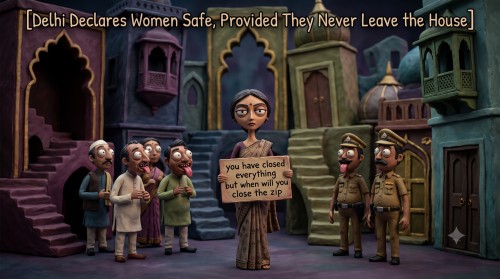
NEW DELHI: In a landmark achievement for urban governance, Delhi has finally solved the women’s-safety crisis by issuing its most dependable instruction yet: “Please be careful.”
The advisory, praised by officials as “gender-sensitive,” requests women avoid dark roads, empty roads, busy roads, parks, Metro stations, college gates, cabs, buses, crowds, isolated places, friendly places, unfamiliar men, familiar men, and – if possible – the outside world.
The city, which can deploy water cannons, barricades, riot police, metal detectors and three layers of administrative anxiety within minutes of a student protest, remains cautiously unable to deploy the same urgency against stalking, harassment, obscene gestures and sexual violence.
Officials explained that crime is a complicated issue, whereas stopping women from protesting is a highly manageable logistical exercise.
“Safety is our top priority,” said an unnamed authority, standing behind five barricades and a fleet of police vans. “That is why we have created a secure zone around the Secretariat – primarily to protect it from women asking why they are unsafe.”
Beti Bachao, But First: Where Is She Going?
For decades, India has lovingly called girls “goddesses,” a status that comes with the privilege of being worshipped during festivals and monitored for the remaining 360 days of the year.
A woman may be Durga, Lakshmi, Saraswati or Kali – but after 7 pm, she is advised to become invisible.
The national affection for daughters remains profound. They must be saved, educated, celebrated, photographed at school functions, and then gently advised not to wear “short clothes,” not to sit in parks, not to travel alone, not to have male friends, not to return late, not to answer back, and not to inconvenience society by expecting basic public safety.
The slogan “Beti Padhao, Beti Bachao” has therefore received a practical update:
“Beti Padhao, Beti Bachao, Beti Ko Samjhao Ki Bahar Mat Jao.”
Education, experts say, is important. It helps young women read all the warnings telling them how to live smaller.
A City of Excellent Barricades
The protesting students outside Delhi Secretariat were reportedly astonished to discover that the city possesses an enormous reserve of police personnel – previously believed to be a myth, like accountability or a well-lit footpath.
There were barricades. There were security forces. There were water-cannon vehicles. There was surveillance. There was order.
For a brief, magnificent moment, Delhi appeared capable of protecting public space.
Unfortunately, the public space being protected was the government building from students holding placards.
One officer reportedly reassured protesters: “The protest will end soon. They will go home.”
This was considered an especially efficient solution, since women are safest, according to the ancient administrative sciences, when sent home early.
The same principle has long been applied to college campuses. If women complain of harassment, the institution may heroically respond by regulating their hemlines. This saves everyone the inconvenience of confronting men who harass them.
Why educate boys about consent when you can measure a girl’s sleeves with the precision of a forensic investigation?
The Crime Scene: A Woman Existing
The most innovative feature of Delhi’s safety culture is its forensic method. Before investigating a man’s conduct, society carefully examines the woman’s existence.
What was she wearing?
Why was she there?
Who was she with?
Why was she out late?
Why did she trust someone?
Why did she not trust no one?
Why did she not predict the crime before the criminal committed it?
In this system, women are expected to possess a supernatural GPS, a criminal-psychology degree, martial-arts training, a portable CCTV unit and the ability to vanish at sunset.
Men, meanwhile, are granted the constitutional right to be “boys,” a species apparently incapable of controlling itself but fully capable of objecting when women describe the consequences.
The placard saying, “I am born nude. The pervert is you,” has caused particular discomfort among the moral-policing community. It is difficult to blame fabric when the problem is staring directly back at you.
Freedom, With Terms and Conditions
The women on Delhi’s streets are not demanding a luxury item. They are not asking for a VIP convoy, an armoured vehicle or a state-sponsored bodyguard with a whistle.
They are asking to walk.
To study. To sit in a park. To travel home. To meet a friend. To wear clothes without submitting them for committee approval. To occupy public space without being treated as public property.
Their protest asks a question that embarrasses every grand speech about development, civilisation and the “Nari Shakti” poster campaign:
If a woman needs permission, precautions, apologies and a return ticket before stepping outside, then whose city is Delhi?
And if her freedom ends where a man’s stare begins, perhaps the problem was never her clothes, her timing, her friend, her park, or her presence.
Perhaps, as the placard says, the pervert was always the one reading it.