The Nirvik Bureau, Bhubaneswar, 17 November 2026
Small Change, Big Consequences
Odisha’s fight against corruption has apparently achieved something remarkable: government action faster than a citizen can get a land document registered.
According to the supplied report, probationary revenue officer Manisha Mishra was allegedly caught accepting Rs 7,000, arrested, and dismissed within days. Somewhere, a dusty government file must have looked up in astonishment.
“So we can move?”
“Of course,” replied another file. “Provided we are moving against someone sufficiently junior.”
The state’s message appeared uncompromising: corruption will not be tolerated. At least not in such embarrassing denominations.
The Economy-Class Scandal
Mishra’s alleged offence involved an initial demand of Rs 10,000, reportedly negotiated down to Rs 7,000. In our imaginary Academy of Administrative Optics, this would raise immediate concerns.
“Discounting?” asks the instructor. “During probation? What precedent does this set?”
A trainee raises a hand. “That bribery is wrong?”
“Certainly. But please answer the question on the slide.”
Meanwhile, the comparison attracting attention is with IAS officer Dhiman Chakma, arrested over an alleged Rs 10 lakh bribe in June 2025 and reinstated in May 2026 while his case remained pending. Reinstatement, naturally, does not establish innocence, just as arrest does not establish guilt. It does, however, provide excellent material for a government slogan: Different Strokes for Different Pay Scales.
Due Process, With Priority Boarding
In an imaginary departmental briefing, a spokesperson explains the distinction.
“You must understand: service rules differ.”
“Does accountability differ?”
“Please restrict yourself to questions covered by the service rules.”
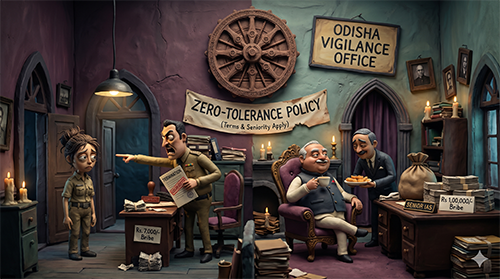
The spokesperson then unveils a helpful diagram. At the bottom sits the probationer, beneath a large red button marked “Immediate Action”. Higher up, a senior officer enjoys a shaded veranda labelled “Procedural Considerations”.
“Is due process available downstairs?” a journalist asks.
“Certainly. Please submit an application upstairs.”
There are, of course, genuine legal differences between terminating a probationer and proceeding against a confirmed officer. But public confidence is not a departmental examination. Citizens are unlikely to award extra marks for explaining why the smaller allegation produced the more spectacular exit.
Disaster Management, Internally Applied
Chakma’s return to the Revenue and Disaster Management Department offers the satirist an almost unfair advantage.
In our fictional secretariat, an orientation officer welcomes a returning colleague.
“We handle floods, cyclones and reputational damage.”
“Which receives the quickest response?”
“That depends whose reputation.”
Outside, a citizen waits with a land-registration application. He has brought identification, photocopies and the touching belief that the published fee is the complete fee.
He reads a poster: Report Corruption Without Fear.
“Whose fear?” he wonders.
Equality Before the Letterhead
Nobody needs a lenient system for petty corruption. Citizens need an equally serious system for every allegation, with fair procedure that does not become a privilege of rank.
Until then, our imaginary Odisha integrity campaign has its perfect closing announcement:
“All officers are equal before the law. Kindly arrange them in order of seniority before the law arrives.”