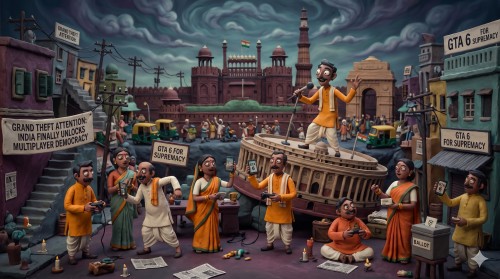
The Nirvik Bureau, Bhubaneswar, 23 November 2026
Mission One: Press X to Claim Credit
Indian democracy achieved a historic milestone this week: both major political parties discovered that young people could be addressed without first being told to put their phones away.
The occasion was GTA VI. The BJP borrowed the game’s visual style to showcase national progress. Congress examined the game’s criminal protagonists and declared that the choice of imagery had explained rather more than intended.
A franchise famous for satirising society had apparently been overtaken by its customers.
At an imaginary emergency meeting of the Ministry of Being Relatable, officials celebrated.
“We have cracked the youth vote,” announced one strategist. “The Prime Minister has posted in a font they recognise.”
“Should we also address their concerns?”
“Certainly. Can unemployment be made into a carousel?”
Development, Now Available in Story Mode
The government’s presentation compared India between GTA V and GTA VI, establishing the release schedule of an American video game as an exciting new unit of national planning.
Five-Year Plans were out. Rockstar Intervals were in.
Henceforth, economic performance would be measured as “before the trailer,” “after the trailer,” and “during the period everyone thought it would be delayed again.”
A fictional spokesperson explained the methodology.
“Look at the highways. Look at the solar capacity. Look at the start-ups.”
“May we examine the underlying comparisons?”
“Of course. Swipe left.”
A citizen studying the slides noticed that his neighbourhood road remained unfinished.
“That is not a pothole,” an official clarified. “It is an open-world feature. We encourage exploration.”
Opposition Discovers the Plot
Congress, meanwhile, adopted the position that borrowing a game’s typography required accepting responsibility for everything its fictional characters did.
This was a bold interpretive standard for a political culture that routinely borrows film songs without submitting to the jurisdiction of their lyrics.
In a fictional strategy session, a worker suggested challenging the government’s figures.
“Later,” said a senior leader. “First, we must establish whether the getaway vehicle represents coalition politics.”
Another proposed a detailed employment critique.
“Too long. Can you find twelve seconds of someone stealing a car?”
By evening, the party had produced a video condemning the government’s association with violent gaming imagery, thereby introducing that imagery to several people who had missed the original post.
The BJP thanked them for the additional reach.
The Citizen Remains a Non-Playable Character
Caught between the two campaigns, the voter attempted an old-fashioned intervention.
“My recruitment examination has been postponed.”
The government’s account replied with a development graphic.
“The results from my previous examination are also pending.”
The Opposition replied with a clip of a fictional robbery.
“Is there a helpline?”
Both parties invited him to follow, share and turn on notifications.
For the first time, he understood the appeal of an open-world game: somewhere, apparently, a person could walk into an office and receive a mission with a clearly stated objective.
Achievement Unlocked: Engagement
By nightfall, both parties had declared victory.
The BJP had reached the youth. Congress had exposed the symbolism. Television panels had debated whether a stolen virtual sports car was pro-development or constitutionally troubling.
The voter’s problem remained unresolved, but his engagement had been successfully recorded.
Somewhere, a campaign consultant prepared the next slide:
“We got a political argument about GTA VI before we got an answer.”