Dhanada K Mishra, Hong Kong, 8 January 2026
I first met Raghav – an unassuming, sincere soul with a ready smile and always ready to help anybody in need some time over a couple of years back. That was when we were to meet a desperate family at the Chung King Mansion located at Tsim Sa Tsui (TST) in Hong Kong. The family was in transit from Mumbai to Toronto, having decided to migrate out of India in search of a better life. The elderly father, unfortunately, had a heart attack just as the plane landed in Hong Kong and had to be hospitalised and treated. The family was in no position to meet the emergency, as they knew nobody in Hong Kong and didn’t have the financial means to pay the bills. Thanks to the untiring efforts of Raghav, with a little help from many like me, the situation could be resolved as the community stepped forward. That’s when I came to know about the Hong Kong Help Group.
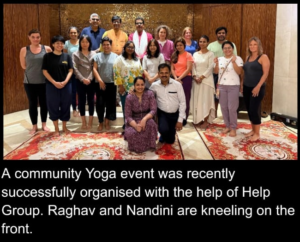
The Hong Kong Help Group demonstrates how a simple WhatsApp network, founded on trust and discipline, can evolve into a vital lifeline for an entire diaspora community. At a time when social media is often blamed for noise, division, and distraction, this volunteer-driven initiative, led by Raghav and his equally committed partner, Nandini, and close friend Sanjay and many others, demonstrates how the same tools can be repurposed for dignity, solidarity, and everyday problem-solving at scale.
A community born of crisis
The Help Group began with a clear purpose: to help fellow Indians in Hong Kong navigate life in a city where family support networks are often thousands of kilometres away. During Covid, that purpose became urgent. Members coordinated critical medicines and essentials from India when supply chains were disrupted, turning chat groups into informal logistics hubs. There are many cases, almost daily, where people seek help from the group, be it someone needing simple information related to a visa or passport or people looking for a job or now even a separate group for match making! Just like the case of the stranded family in medical emergency, the same community spirit surfaced again recently when members rallied to support a woman whose husband went missing in Hong Kong on a trip, or when funds were raised to send the mortal remains of a community member back to family in India—moments where virtual messages translated into tangible rescue, comfort and closure.
Discipline as an act of care
Unlike many social groups that drown in forwards and small talk, the Help Group is deliberately structured for signal over noise. The primary guidelines insist that members post only responses to specific questions, self-validate information, avoid jokes, pleasantries and “good morning” messages, and keep all communication precise, factual and short. English is mandated as the common language to ensure inclusivity across India’s regions, and message forwarding is discouraged unless explicitly cleared by admins, sharply reducing misinformation and spam. There is also a clear red line against requests that may break local law, such as hiring part-time domestic helpers, reinforcing that community support cannot come at the cost of regulatory compliance.
This discipline is not about control for its own sake; it is about respecting the time, attention and safety of nearly ten thousand people whose phones are constantly buzzing. The quiet heroism here lies in admins who are prepared to delete non-compliant posts, accept that they “do not take any responsibility” for products or services mentioned, and repeatedly remind members to exercise due diligence—subtly teaching digital literacy and civic responsibility along the way.
Turning advertising into altruism
One of the most innovative ideas in the Hong Kong Help ecosystem is the way it converts commercial intent into charitable action. As of September 2022, all advertising—whether for renting or selling property, promoting services, or even second-hand sales—is allowed only after the advertiser makes a minimum donation of HKD 50 to a registered charity under Section 88 of Hong Kong’s Inland Revenue Ordinance. The advertiser then privately sends the flyer and deposit slip to designated admins, who alone are authorised to post the ad across the groups.
Crucially, no money flows to admins; they do not gain any financial benefit and explicitly position this mechanism as part of a long-term endeavour to “extend helping hands to people in need.” Recommended charities include Indian-origin initiatives such as Be The Change Hong Kong, Erase Poverty, Help The Blind Foundation, We The Solution, animal welfare groups like LAP, and broader community foundations like The Zubin Foundation, though members are free to choose any registered charity they trust. Over time, the group has further refined this model: non-local or “overseas” advertisements now require a higher minimum donation of HKD 500 and are generally discouraged unless clearly beneficial to Hong Kong-based members, ensuring the ecosystem remains locally anchored.
What emerges is a remarkable micro-economy of goodwill: every time someone wishes to derive commercial benefit from the community’s attention, they must first contribute to the wider social fabric. It is a subtle but powerful inversion of the usual logic of social media, where attention is monetised privately and rarely recycled into a public good.
Invisible admins, visible impact
Behind the scenes, a distributed team of admins holds this system together. As of late 2022, the Help Group spans at least 10 sub-groups reaching around 5,000 people, and has since grown closer to 10,000 Indian-origin residents in Hong Kong. Admins are spread across geographies, some even outside Hong Kong, yet operate almost entirely online and remotely, acting as gatekeepers, mediators and facilitators round the clock. They review advertisement requests, verify donation slips, enforce posting rules, and, when necessary, coordinate responses to emergencies—all while balancing their own professional and personal commitments.
Nandini plays a central leadership role across multiple sub-groups, appearing as the point of contact for several Help clusters, while Raghav anchors one of the main Help groups and the overall ethos of service. Sanjay – a close friend and colleague of Raghav, was one of the early supporters who even went around asking people to join the Help group in its early days. Other admins—Deepak, Deepthi, Mani, Sagar, and Senthil—form a distributed governance network that keeps the system resilient, so that no single individual becomes a bottleneck or a “face” overshadowing the collective. This shared stewardship is the opposite of influencer culture; it is quiet, steady, and largely invisible unless one watches closely.
A template for other communities
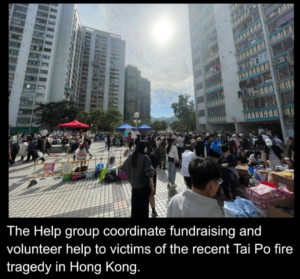
Recently, during the Tai Po fire in Hong Kong, many residents got trapped because there was no means of quick communication that could reach all residents. While most residential buildings have WhatsApp groups for owners – the same may not be the case for tenants. I wonder if a Help group for all the residents could have saved lives! For building societies, resident welfare associations, trade unions or even extended families, the Hong Kong Help Group offers a practical blueprint. At its core are a few simple principles: a clear purpose (help, not gossip), strict but fair rules, zero-tolerance for spam and illegality, transparent separation of money and moderation, and an elegant mechanism that channels commercial activity into charitable giving. Layered on top of this is a culture of mutual aid where helping a stranger in crisis—whether it is tracking a missing spouse, arranging emergency medical support, or raising funds to send a loved one home—is treated as normal, not exceptional.
In an age where social media often amplifies division and narcissism, the Hong Kong Help Group reminds us that technology is only as noble as the intentions and systems wrapped around it. When communities self-organise with humility, discipline and a shared moral compass—like that exemplified by Raghav, Nandini and their admin team—ten thousand phone screens can transform from mere devices into a living, breathing safety net. That is a story worth retelling in every city that is still learning how to be a community.