Dr Manoj Dash, Bhubaneswar, 9 July 2026
Odisha’s political journey over the last 25 years has been closely intertwined with the quiet presence of Naveen Patnaik. In a state often associated with natural disasters, economic challenges, and struggles for development, his image of calm administration and political stability became a familiar part of public life. Millions of Odias saw BJD not merely as a political party but as an established system of governance. That is why the 2024 election verdict represented a historic turning point.
As BJD struggles to rediscover its identity in opposition, a larger question has emerged among the people of the state: has the party begun a genuine process of renewal, or is it attempting to preserve the same power structure that contributed to its decline? The recent entry of Sujata Rout Karthikeyan into active politics has brought this question sharply back into public debate. It has also reopened questions about leadership, succession, internal democracy, and the future direction of BJD.
The defeat of the Biju Janata Dal (BJD) in the 2024 Odisha Assembly elections marked the end of a 24-year political era. For a party that had built an unmatched reputation for electoral stability and administrative continuity under Naveen Patnaik, the transition from government to opposition has brought a new set of challenges. The most significant among them is not merely electoral recovery but the question of whether the party can transform itself from a leader-centric organization into an institution capable of sustaining itself beyond one individual.
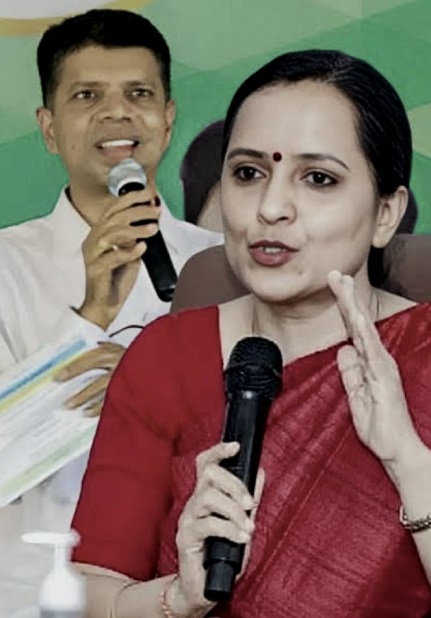
In this context, the entry of former bureaucrat Sujata Rout Karthikeyan into the BJD has generated considerable discussion in Odisha’s political circles. While her supporters argue that her administrative experience and understanding of grassroots programmes can strengthen the party, critics believe that her entry reinforces a public perception that the influence structure associated with her husband, former bureaucrat-turned-politician V. K. Pandian, continues to shape the party’s direction.
The debate surrounding her entry is therefore not only about an individual joining politics. It is about the larger question of whether BJD has been able to move beyond the organisational culture that many believe contributed to its electoral setback in 2024.
The post-defeat challenge of BJD
After the election defeat, BJD faced a familiar problem that many long-governing parties experience: the sudden loss of political power exposed organisational weaknesses that were less visible while the party was in government.
For nearly a quarter of a century, BJD’s political strength was closely associated with Naveen Patnaik’s personal image of clean governance, administrative efficiency, and welfare-oriented politics. However, once the party moved into opposition, several challenges became apparent.
Many grassroots workers who had benefited from access to government machinery and political influence suddenly found themselves without the advantages of incumbency. At the same time, questions emerged about internal decision-making, leadership visibility, and the future direction of the party.
The role of V. K. Pandian became a major point of political debate. As Naveen Patnaik’s close aide and chief strategist, Pandian was seen by many as a powerful figure in the functioning of the party. The BJP successfully used this perception during the election campaign by framing the issue around Odia identity and questioning the influence of an unelected individual in the political affairs of Odisha.
Pandian’s decision to withdraw from active politics shortly after the election defeat was expected to reduce this controversy. However, the continuing discussion around influence, leadership, and control suggests that the political perception created during the election has not completely disappeared.
Why Sujata Karthikeyan’s entry has attracted attention?
Sujata Karthikeyan’s formal entry into BJD was accompanied by Naveen Patnaik’s assertion that he would continue to lead the party in the next elections. The statement was clearly intended to address speculation regarding leadership and succession.
Her supporters point to her long administrative experience, particularly her association with Mission Shakti, one of Odisha’s most prominent women-focused programmes. They argue that her understanding of women’s self-help groups and grassroots administration could help BJD reconnect with voters.
However, the political challenge lies in perception. A section of the public views her entry through the lens of her association with V. K. Pandian. Since Pandian’s political role became one of the BJP’s most effective electoral arguments in 2024, the presence of his wife in active politics has naturally revived questions about whether the party has genuinely moved toward collective leadership or whether it remains dependent on a small circle around the former chief minister.
In politics, perception often becomes as important as reality. Even if Sujata Karthikeyan independently establishes her political identity, overcoming the existing perception will be a significant challenge.
From administrative leadership to political leadership
A major question before Sujata Karthikeyan is whether administrative experience can successfully translate into political leadership.
Bureaucracy and politics operate through very different mechanisms. A senior government official exercises authority through institutional position, while a politician must build trust through public interaction, organisational relationships, electoral accountability, and sustained engagement with citizens.
Mission Shakti provided her with significant exposure to women’s groups across Odisha. However, political mobilisation without the support of government machinery and administrative authority is a different challenge. Building an independent political network requires continuous engagement with workers, communities, and local leaders.
Therefore, the coming years will determine whether she can develop an independent political identity beyond her administrative background and family association.
The larger question: Has BJD solved its leadership problem?
The most important issue facing BJD is not the entry of one individual but the unresolved question of succession and institutional leadership.
Naveen Patnaik remains the party’s tallest leader, and his personal popularity continues to be an important asset. However, a political party that has governed for 24 years must eventually demonstrate that its strength comes from more than one personality.
The absence of a visible second line of leadership has become a concern. Several senior leaders have moved toward the BJP, while others appear uncertain about the party’s future direction. A strong regional party requires empowered state-level, district-level, and grassroots leaders who can independently connect with voters.
If BJD’s revival strategy appears to depend primarily on another individual, it may strengthen the perception that the party has not addressed its fundamental organisational weaknesses.
The opposition challenge
Another difficulty for BJD is defining its role as an opposition party.
During its years in power, BJD maintained strategic distance from both the BJP and Congress while cooperating with the central government on selected issues. This approach helped it project itself as an Odisha-focused regional party.
However, in opposition, the same strategy creates questions about political positioning. A party seeking to defeat the ruling party must clearly communicate its alternative vision, build alliances where necessary, and lead sustained public campaigns on issues affecting people.
Limited reactions through statements and occasional protests may not be sufficient to occupy the political space required for a serious challenge in 2029.
The road ahead for BJD
BJD’s recovery will depend on whether it can move beyond nostalgia for its long period in power. The party still possesses important strengths: a recognisable brand, a committed voter base, and Naveen Patnaik’s enduring goodwill among many sections of society.
However, rebuilding requires more than relying on past achievements. The party needs:
- a transparent and credible leadership transition plan;
- stronger district-level organisations;
- greater independence and empowerment of local leaders;
- a clear political and policy agenda for Odisha’s future;
- sustained engagement with people outside electoral cycles.
Sujata Karthikeyan’s entry may prove beneficial if she succeeds in building her own political credibility and strengthening the organisation. However, if it is perceived merely as a continuation of an existing influence structure, it may deepen concerns about whether BJD has truly changed after its defeat.
The central challenge before Naveen Patnaik and the BJD leadership is therefore not just enhancing its chances of winning the next election. It is rather about convincing the people of Odisha that the party has evolved into a broader democratic institution capable of representing the aspirations of the state beyond one leader, one family connection, or one organisational circle.
The debate over Sujata Karthikeyan’s entry is ultimately a reflection of this larger question: Has BJD moved beyond the political culture that contributed to its defeat, or is it still carrying the weight of the past?