The Nirvik Bureau, Bhubaneswar, 5 October 2026
The emergency election kit
In every democracy, tucked somewhere between the national flag and the emergency television studio lighting, lies a small red button marked: “In case of poor polling, declare danger.”
Press it once and the nation is threatened. Press it twice and the opposition becomes suspiciously sympathetic to the enemy. Press it three times and every question about inflation, unemployment, corruption, crumbling hospitals, or the mysterious disappearance of public money is declared a distraction from “the larger national interest.”
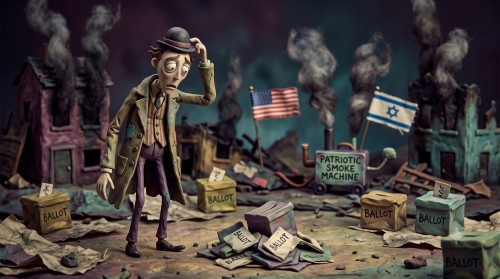
War, after all, is the ultimate political deodorant. It does not solve the smell. It merely sprays patriotism over it.
A government struggling with bread prices can suddenly become a government defending civilisation. A leader who cannot repair a bridge may nevertheless promise to flatten a foreign capital. The pothole outside your house remains a crater of municipal incompetence, but citizens are urged to admire the precision of missiles falling elsewhere.
This is called strategic priorities.
Polling booths under air raid sirens
The theory is simple: frightened people prefer familiar faces. Especially if the familiar face is standing before a large map, pointing at arrows, wearing an expression of grave responsibility, and assuring everyone that the nation will prevail just as soon as they stop asking about the price of onions.
In the old days, rulers needed a genuine invasion to become heroic. Now, thanks to twenty-four-hour news channels, a tense photograph, a grainy video, one anonymous intelligence official, and a retired general shouting at a split screen can do half the job.
The public is told that a threat is imminent, terrifying and possibly invisible. Conveniently, its exact details cannot be disclosed for national security reasons. Citizens are asked to trust the government, the same government they would not trust to organise a queue outside a ration shop.
The leader then announces: “This is not the time for politics.”
Naturally, this statement is delivered from a rally stage decorated with party flags, televised advertisements, campaign slogans and a soundtrack that sounds like a trailer for a superhero film funded by taxpayers.
The enemy, now available in HD
Nothing unites a divided country like an enemy. Nothing divides it again like the electricity bill.
For a brief, beautiful period, ideological arguments vanish. Liberals, conservatives, centrists, conspiracy theorists and that uncle who sends “Good Morning” roses on WhatsApp can all agree that the enemy is monstrous, irrational and probably jealous of the nation’s ancient wisdom.
But wars have an unfortunate tendency to continue after the applause has ended.
The flags fade. The martial music grows repetitive. Soldiers return, if they return. Families count graves. Markets react badly to missile diplomacy. Young people discover that patriotism is a thrilling emotion until it arrives with a recruitment form. And the voter, once asked to sacrifice for the homeland, commits the gravest sin imaginable: asking what exactly was achieved.
That is when the magic begins to wear off.
The inconvenient voter
History has repeatedly shown that voters can be shamelessly ungrateful. Winston Churchill helped defeat Hitler and was rewarded with an election loss. George H. W. Bush won a war in the Gulf and then encountered Bill Clinton, whose weapon of mass destruction was the phrase: “It’s the economy, stupid.”
Even the most cinematic war cannot permanently outvote an empty wallet.
A government may conquer a hill, sink a ship, bomb a bunker or announce that it has taught someone a lesson. But if salaries stagnate, rents rise and kitchen gas becomes a luxury item, citizens eventually develop a dangerous fascination with domestic affairs.
They begin wondering whether national security includes food security, job security, medical security and the security of not falling through an open manhole.
Peace: the real campaign liability
So modern leaders have developed a more sophisticated approach. They must look warlike enough to appear strong, but peaceful enough to avoid the bill. They must promise decisive action while hinting at an imminent peace deal. They must threaten devastation at breakfast and announce diplomacy by lunch.
The ideal conflict is one that produces dramatic television, heroic speeches, soaring approval ratings and absolutely no consequences.
Unfortunately, reality remains stubbornly unscripted.
War may still win an election. Fear is persuasive, flags are photogenic, and patriotism remains the cheapest fuel available to politicians. But it has diminishing returns. Eventually, even the most obedient electorate notices that every emergency arrives suspiciously close to polling day.
And then comes the truly terrifying national-security threat:
A voter who remembers.