The Nirvik Bureau, Bhubaneswar, 27 September 2026
Prime-time democracy defeats prime-time sport
With political turmoil now available in India in breakfast, lunch, dinner, and twenty-four-hour television formats, the country has reportedly found itself too emotionally overbooked to follow the Asian Games in Japan.
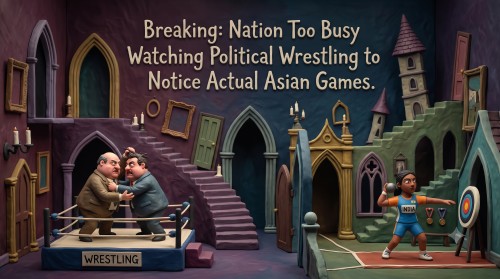
Somewhere in Japan, Indian athletes are running, jumping, lifting, shooting, wrestling, and winning medals. Somewhere in India, citizens are also running, jumping, lifting, shooting and wrestling – mostly from one political scandal to the next, from one press conference to another, and from one breaking-news banner to the next.
The difference is that Indian athletes wear tracksuits. Indian politicians wear expressions of national concern.
“Of course we are proud of our athletes,” said a citizen while watching six politicians shout simultaneously on television. “But first we must know who insulted whom, who switched parties, who hugged whom, who filed a case against whom, and whether the nation is safe from a twenty-second video clip that has been looping since morning.”
The citizen then promised to watch the Asian Games “later,” a sacred Indian time zone in which exercise begins, bills get paid, and non-cricket sports receive attention.
The only wrestling India can follow
The Asian Games may include wrestling, boxing, shooting and archery, but India has developed its own superior domestic versions.
Political wrestling takes place daily on television studios, where contestants pin each other down using allegations, old tweets, leaked audio clips and the phrase, “You are anti-national!” Boxing is performed at party headquarters, usually without gloves but with microphones. Shooting occurs through press statements. Archery survives in the form of targeted social-media posts.
Why watch an athlete aim carefully at a distant bullseye when every political spokesperson is already firing wildly at every available opponent?
In Japan, an Indian archer may win gold after years of training, concentration and mental discipline. In India, a political panel may win a rating point after years of yelling, interruption and total immunity from facts.
Naturally, the latter receives more coverage.
Medal tally awaits election tally
Every time an Indian athlete wins a medal, news channels try to interrupt the political apocalypse.
“India wins gold in—”
“BREAKING NEWS! Senior leader says something vague but extremely serious!”
The medal disappears beneath graphics of waving flags, exploding sirens, rotating maps, angry faces, and an anchor demanding answers from someone who clearly has none.
By the time viewers return to the Games, the athlete has completed the podium ceremony, thanked the country, called their parents, eaten dinner and possibly boarded a flight home. The audience is still trying to understand whether a coalition has collapsed, expanded, split, merged, rebelled, reunited, or simply changed its WhatsApp group.
“Sport is important,” explained one political analyst. “But can it defeat the suspense of a resignation that may happen, may not happen, or may be denied three minutes after it happens?”
Apparently not.
National pride, subject to breaking news
The tragedy is not that India has too much politics. A democracy should have politics. The tragedy is that politics has become an all-consuming serial, with new villains every evening, cliff-hangers every hour and no season finale in sight.
Meanwhile, athletes who have trained quietly for years compete under the Indian flag with far less noise and far more purpose. They do not need a panel discussion to prove their commitment. They do not need hashtags to announce sacrifice. They simply perform.
Perhaps India should spare a few minutes from its endless political circus to watch them.
After all, while politicians keep asking who will win the next battle, Indian athletes are out there doing the unfashionable thing: actually winning one.