
The Nirvik Bureau, Bhubaneswar, 5 November 2026
A Government of Taste
In the imaginary Republic of Lunch, situated suspiciously close to Odisha’s corridors of power, the most urgent agricultural question is not “Have the farmers eaten?” but “What is the chief minister eating?”
This distinction is essential to good governance. The first question involves debt, irrigation, storage and other depressing subjects. The second can be settled with butter and a garnish.
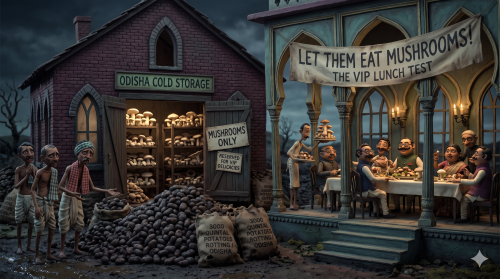
Meanwhile, nearly 3,000 quintals of potatoes reportedly rotted in a private cold storage at Jalarpur. Farmers allege that mushroom cultivation received priority over preserving their produce.
At last, an agricultural success story with a clear hierarchy: mushrooms get a future; potatoes get an obituary.
The Potato’s Fatal Lack of Connections
The potato’s mistake was believing that paying for cold storage entitled it to remain cold.
How quaint.
According to the farmers’ grievance, around 1,500 farmers had deposited their potatoes at the facility, paying ₹110 per 50-kilogram bag. They apparently misunderstood the service. They thought they were purchasing preservation, when they may merely have reserved a comfortable location for decomposition.
In our fictional ministerial kitchen, meanwhile, a chef presents the day’s special.
“Locally inspired mushroom delicacy, sir.”
“And the potatoes?”
“Unavailable, sir. They have entered the grievance process.”
“Excellent. Very participatory.”
The mushroom understands public life. It grows quietly, avoids awkward questions and looks respectable beside expensive crockery. The potato, by contrast, insists on feeding ordinary people. Politically, a limited ambition.
From Farm to File
Some of the ruined stock was seed potato intended for the next cropping season. This adds an impressive dimension to the disaster: not merely losing today’s harvest, but getting an early start on losing tomorrow’s.
An imaginary official explains the administrative advantage.
“Normally, agricultural distress arrives season by season. Here we have achieved advance delivery.”
The farmers, displaying their customary inability to appreciate innovation, ask for accountability.
A file is opened.
This is reassuring. Unlike a refrigeration unit, a file requires no electricity to keep a problem cold.
It moves from desk to desk, acquiring signatures, observations and the faint aroma of institutional helplessness. Somewhere, a clerk writes “urgent” with the relaxed confidence of a man whose own lunch is assured.
A Full Plate, an Empty Field
No actual evidence connects these mushrooms to the chief minister’s dining table. But in satire’s dining room, the imagined menu practically writes itself:
Cream of Administrative Silence.
Mushrooms à la Priority.
Farmers’ Grievances, indefinitely reserved.
The absent potato remains the evening’s most eloquent guest.
Outside, farmers count losses. Inside our fictional banquet, someone requests a second helping.
And that is the trouble with governing by appetite: a leader can finish lunch feeling completely satisfied while the people who grow the food are still waiting to be served.