The Nirvik Bureau, Bhubaneswar, 1 November 2026
The Ministry of Convenient Confidence
Indian democracy has achieved what political scientists thought impossible: an election can now be perfectly legitimate and entirely fraudulent, depending on which party spokesperson is holding the microphone.
“We have complete faith in the wisdom of the electorate,” announced a senior leader, before adding, “except in constituencies where the electorate has clearly misunderstood its assignment.”
To simplify matters, parties proposed a new results form with two boxes:
- We won: a historic mandate.
- We lost: a historic conspiracy.
The Election Commission was asked to provide both versions in advance to save valuable television time.
Order, Order! Has Anyone Ordered the Chairs?
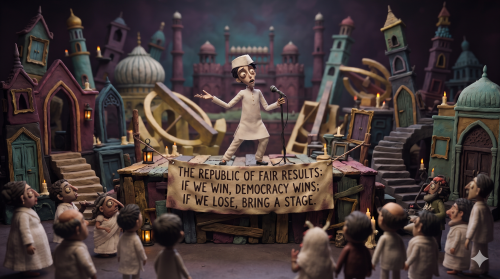
At opposition headquarters, preparations began for a grand public impeachment.
“Have we assembled the evidence?” asked a junior worker.
“Better,” replied the organiser. “We have assembled the audience.”
A stage was booked, microphones tested, and democracy positioned prominently on the backdrop, where it would remain safe from inconvenient questions.
Someone suggested that serious allegations deserved a precise dossier, independently checkable evidence and sustained institutional pressure.
He was immediately transferred to the Committee for Lowering Enthusiasm.
The mock court required a prosecutor, a judge and a jury. Fortunately, the party had sufficient senior leaders available to perform all three functions, provided nobody expected them to agree on the seating arrangement.
“The verdict must be impartial,” declared the convenor. “Please ensure it is printed before lunch.”
Meanwhile, at the Department of Calf Affairs
Far from the capital’s political dust, the Prime Minister enjoyed a meeting with calves.
Observers praised the interaction as unusually constructive: the participants listened patiently, demanded no press conference and displayed no interest in electoral rolls.
Aides considered arranging more such consultations.
“Excellent optics,” one whispered. “Not a single supplementary question.”
Back in Delhi, citizens searching for explanations encountered the modern administrative equivalent of a closed door: content unavailable.
This was reassuring. Nothing demonstrates confidence in public debate quite like removing the public’s half of it.
The Opposition’s Selective Memory Clinic
Congress, meanwhile, opened a museum dedicated to the sanctity of institutions.
The contemporary wing was enormous. The historical wing was temporarily closed for renovation.
Visitors asking about the party’s own institutional record were directed towards a gift shop selling pocket mirrors with the reflective surface removed.
“We must learn from history,” explained the curator, “but there is no need to make it personal.”
Across the aisle, government supporters applauded this discovery of accountability, while carefully ensuring it travelled in only one direction.
The Voter Requests a Refund
Eventually, an ordinary voter approached the assembled guardians of democracy.
“Could someone examine the complaints properly, publish the relevant information and explain the findings?”
There was an uncomfortable silence.
“Are you with us or against us?” asked both sides simultaneously.
“With the election,” the voter replied.
This answer caused considerable confusion. No party had anticipated an independent candidate called Accountability.