
The Nirvik Bureau, Bhubaneswar, 25 May 2026
A report card nobody can read, exams nobody can trust, and a silence everybody must maintain
In a bold and visionary move, our Union Education Minister has successfully redefined education—not as a system of learning, but as a nationwide experiment in confusion. The New Education Policy (NEP), that grand philosophical document, has achieved what centuries of pedagogy could not: universal agreement that nobody understands it.
Students don’t understand it. Teachers don’t understand it. Bureaucrats explain it in PowerPoint slides that somehow make it less clear. But clarity, as it turns out, is an outdated colonial concept. In the new India, ambiguity is innovation.
Chapter Deleted: Judiciary, Accountability, and the Cost of Selective Amnesia
In a remarkable display of responsive governance, the NCERT’s brush with the judiciary proved that nothing travels faster than outrage – except perhaps the decision to erase it. What began as a “critical” mention of judicial corruption quickly turned into a national emergency of reputational management. The Chief Justice’s disapproval echoed loud enough that the system sprang into action—not to debate, defend, or discuss – but to delete.
Entire chapters were not just edited, but practically exorcised. Textbooks were recalled with the urgency usually reserved for defective airbags, except this time the defect was inconvenient content. Trucks moved, printers rolled, and taxpayers unknowingly sponsored this grand exercise in academic sanitisation.
The cost? Financially enormous, intellectually priceless. Because what is a few crores when compared to the comfort of a perfectly unblemished narrative?
Students, of course, learned an important real-world lesson: in modern civics, institutions are best understood not by studying them – but by noticing what suddenly disappears from the syllabus.
NEET: National Eligibility cum Entrance Test or National Exercise in Anxiety Training?
Meanwhile, the NEET examination has evolved into a thriller series with annual plot twists. Paper leaks have become so routine that they now qualify as a feature rather than a flaw.
Students prepare for years, only to discover that the real test is not biology or chemistry—but luck, timing, and whether someone somewhere has already solved their question paper the night before.
And when things go wrong? Silence. Because in the new academic ecosystem, transparency is considered an extracurricular activity.
Digital India, Server Down India
The CBSE re-evaluation process added another chapter to this educational epic. Students seeking clarity were instead greeted by the most reliable authority in the system: a crashed server.
Nothing says “meritocracy” like refreshing a webpage for six hours while your future buffers endlessly. It is perhaps the most honest metaphor for the current system – ambition meets infrastructure, and infrastructure politely declines.
Marks, Mental Health, and the Mathematics of Tragedy
Behind the statistics, however, lies a darker syllabus – one written in distress and despair. The rising number of student suicides linked to exam pressures, particularly NEET, is no longer an anomaly. It is becoming a pattern.
But patterns require acknowledgment, and acknowledgment requires discussion—something that has been carefully streamlined out of the curriculum.
Because what cannot be reported cannot exist.
The Final Lesson: Speak Less, Score Less, Question Nothing
Perhaps the greatest innovation of this era is not the NEP, or digital education, or curriculum reform. It is the silent understanding that questioning the system is now a higher-risk activity than failing an exam.
In this brave new classroom, students are taught the most important lesson of all: not critical thinking, not curiosity, but compliance.
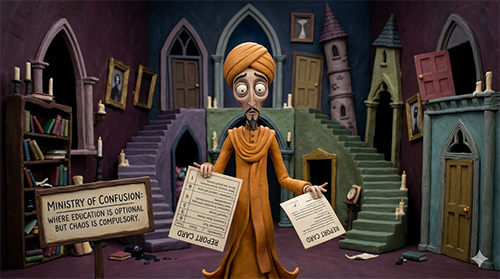
And so, the report card of our education system stands – unreadable, unaccountable, and unquestionably successful.
After all, if no one understands it, no one can fail it.