The Nirvik Bureau, Bhubaneswar, 24 May 2026
When satire becomes vermin, and outrage the official pesticide
In a landmark evolution of democratic hygiene, the nation has finally identified its most dangerous pest: satire. Not corruption, not cronyism, not the occasional collapse of institutions under the weight of their own press releases – no, the real menace, it turns out, has six legs, a smirk, and an inconvenient habit of surviving truth.
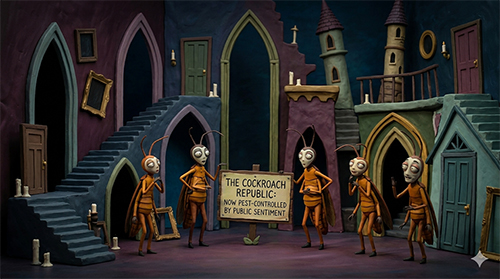
Enter the Cockroach Janata Party (CJP), the newest political formation in the country’s ever-expanding ecosystem of sensitivities. Their manifesto is refreshingly simple: if it crawls, criticizes, or causes discomfort, it must be crushed – preferably before it trends.
The controversy began, as all great national crises do, with a joke. A satire piece—reckless, irresponsible, and worst of all, readable – dared to compare public life to a kitchen infested with cockroaches. Naturally, this triggered a wave of concern among those who felt deeply represented by the metaphor.
Soon, outrage achieved escape velocity. Panels were convened. Hashtags marched. Legal notices bloomed like algae in a neglected pond. The underlying principle was clear: if satire can mock power, then power must learn to mock satire back – preferably with penalties.
The judiciary, always the reluctant protagonist in our national soap opera, found itself drawn into this pest-control debate. Questions were raised. Lines were drawn. And somewhere in the middle of it all stood the humble cockroach, now elevated from kitchen nuisance to constitutional crisis.
One must admire the efficiency of this transformation. In a country where files move slower than glaciers on vacation, outrage travels at broadband speed. Within hours, satire was no longer a literary device but a biohazard. Freedom of expression was carefully rebranded as “freedom with conditions,” much like a sale that applies only if you buy everything except what you actually want.
Of course, the real genius lies in the inversion. The satire that once exposed absurdity is now itself declared absurd. The mirror has been accused of defamation for accurately reflecting the face. And the audience, once expected to laugh, is now expected to litigate.
Meanwhile, the Cockroach Janata Party continues to gain support. Their slogan – “Cleanliness is next to Godliness, especially in thought” – has struck a chord with those who believe that the best way to deal with uncomfortable ideas is to fumigate them out of existence.
Critics argue that this approach may lead to a sterile public discourse, where only the safest opinions survive. But the CJP dismisses such concerns. After all, what is democracy if not the right to feel perpetually offended, and to ensure that no one else enjoys the luxury of irreverence?
In this brave new republic, satire must now carry a warning label: “May contain traces of dissent.” Writers must tread carefully, armed not with wit but with disclaimers. Cartoonists may soon require protective gear, lest their ink be classified as a hazardous substance.
And yet, like the cockroach it has been accused of resembling, satire is notoriously resilient. It thrives in the cracks, survives the sprays, and reappears precisely when you think you’ve eradicated it.
Which is perhaps the real problem.
Because in the end, the issue is not that satire exists. It is that it refuses to die quietly.