The Nirvik Bureau, Bhubaneswar, 28 September 2026
Islamabad discovers that “playing both sides” becomes difficult when every side has brought missiles, sanctions, sectarian politics, and an unpaid fuel bill.
The Great Diplomatic Circus
Pakistan has long perfected a rare geopolitical sport: standing shoulder-to-shoulder with everybody while keeping both hands extended for assistance. It has pledged loyalty to Saudi Arabia, sought energy relief through Iranian channels, maintained contacts with the Taliban, condemned terrorism, negotiated with factions that produce it, and somehow expected the world to admire this as “strategic flexibility.”
Now, unfortunately, the map has become crowded.
Saudi Arabia wants protection from Iranian-aligned forces. Iran is useful when Pakistan desperately needs fuel. Qatar supplies LNG. China is everybody’s friend until everybody asks what that friendship actually means. Turkey arrives with mediation. Afghanistan receives bombs. The Houthis receive speeches. And somewhere in the middle, a retired Pakistani general has been assigned to help run a shiny new Mecca defence alliance.
The job description appears straightforward: protect Saudi Arabia, avoid upsetting Iran, do not annoy China, please Qatar, keep Turkey interested, contain Afghanistan, pacify domestic sectarian tensions, manage terrorism, calm inflation, and perhaps locate a functioning electricity bill.
No pressure, General.

The Mecca Pact’s First Miracle
The new security architecture is being built with the familiar ingredients of regional defence: emergency meetings, solemn communiqués, strongly worded condemnations, and enough acronyms to frighten an enemy into retirement.
Pakistan has reportedly supplied a retired lieutenant-general as secretary-general of the alliance. This is a sensible appointment. Retired generals are ideal for complicated diplomacy because they understand the principle of strategic ambiguity: say “we stand firmly with our brothers,” then immediately ask whether “firmly” requires boots, planes, ships, money, or merely a well-lit photo opportunity.
Pakistan’s Parliament already provided the template in 2015. When Riyadh asked for military help, Islamabad heroically offered the most renewable resource in South Asian diplomacy: moral support.
Troops? Complicated. Fighter aircraft? Sensitive. Warships? Difficult. A sentence containing “shoulder-to-shoulder”? Delivered promptly, wrapped in velvet, and valid until further notice.
LNG: The Fuel of Neutrality
Nothing captures Pakistan’s foreign policy more elegantly than the possibility of receiving vital LNG through Iranian assistance on the same day it appoints an official to a Saudi-centred security alliance designed largely around threats linked to Iran.
This is not hypocrisy. It is what foreign-policy experts call “multilateral energy-enabled strategic contradiction.” Ordinary people call it buying gas from the person you may soon be asked to glare at.
Pakistan has discovered a revolutionary doctrine: burn Iranian LNG while defending Saudi Arabia from Iran.
It is an environmentally efficient arrangement. Why waste fuel travelling to an ideological position when one can combust it domestically?
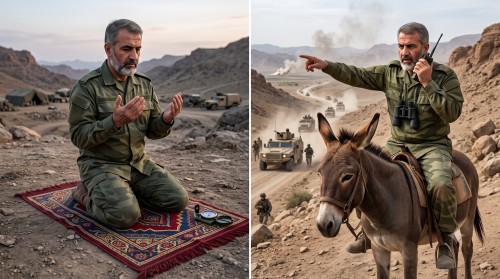
Meanwhile, politicians protesting fuel prices on donkeys may have accidentally produced the country’s most honest policy paper. The donkey, unlike the state, does not claim to be allied with Saudi Arabia, dependent on Iran, supported by China, mediated by Turkey, and simultaneously surprised by Afghanistan.
The donkey simply carries the burden.
A Country With Several Fronts
Pakistan’s security challenge is less a “two-front war” than an all-inclusive buffet. The Afghan border is unstable. Militancy is resurging. Sectarian tensions remain combustible. Economic stress is severe. Political opposition is constrained, jailed, barricaded, or treated as an administrative inconvenience requiring extra barbed wire.
Yet the state is being invited to contemplate another regional military commitment.
This is like a man whose house is on fire volunteering to manage the neighbour’s barbecue because he once attended a fire-safety seminar.
The uncomfortable truth is that Pakistan cannot easily fight Iran’s allies abroad while relying on Iran’s goodwill next door. It cannot promise Saudi Arabia unlimited solidarity while fearing domestic sectarian fallout. It cannot wage war against militancy while its own internal security landscape keeps producing fresh vacancies in the category marked “stability.”
The Final Balancing Act
For decades, Pakistan’s establishment has treated geopolitics like a card table: keep every player hopeful, never show the full hand, and make sure someone else pays for the snacks.
But the cards are no longer being dealt; they are exploding.
The old strategy of running with the hare and hunting with the hounds worked when the hare, the hounds, the referee, and the bookmaker all needed Pakistan for different reasons. Now they want receipts.
Pakistan may still find a way to stand with Riyadh, trade with Tehran, reassure Beijing, thank Doha, consult Ankara, manage Kabul, contain militants, and suppress dissent – preferably before breakfast.
After all, it has survived on contradictions for decades.
The real question is whether contradictions can now afford Pakistan.