The Nirvik Bureau, Bhubaneswar, 8 February 2026
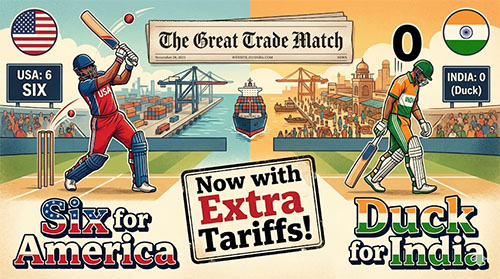
While the US scores runs in technology, pharma, and agriculture, India applauds from the pavilion – eyes fixed on the T20 scoreboard.
New Delhi, February 2026 – The India – US trade deal finally got signed amid flashbulbs, tweets, and a stadium-sized promise: “A partnership for the century.” It was unclear whether the century would be scored by India or the US, but the crowd cheered anyway – not for the deal, but because Rohit Sharma hit a six thirty seconds later.
The Ministry of Commerce called it a “win-win arrangement.” Independent analysts nodded sagely: yes, America wins once, and then India wins… the right to import more. In the fine print (the part no one reads because that’s the job of future historians), India agreed to open up its agricultural markets so that U.S. corn and dairy could compete “fairly” — meaning American subsidies versus Indian farmers armed with hope and monsoon prayers.
Farmers in Punjab wondered if this “great opportunity” meant selling milk to the US or buying theirs at Walmart. “At least the cows are local,” one sighed as commentators screamed about another boundary in the background.
Silicon Dreams, Silicon Valley
In tech, the US secured “enhanced data-market collaboration.” Essentially, American tech giants got easier access to Indian data pools, while India got a fresh round of “commitments to digital skill building.” Translation: we export our information; they import our engineers – to America. The slogans read “knowledge exchange,” but as one Delhi professor put it, “We keep giving the knowledge; they keep taking the exchange.”
Data localization rules were also quietly bent to “strengthen cooperation.” Cooperation, apparently, means letting someone else keep your diary but promising they won’t peek (too much). Yet the public didn’t mind – the powerplay was on and India needed six runs from four balls.
Big Pharma, Small Print
The pharmaceutical chapter was hailed as a “breakthrough.” Indeed, U.S. drug patents will now enjoy longer protections in India. In return, India hopes for “investment in healthcare infrastructure,” preferably before another pandemic. Indian pharma firms, long known for affordable generics, are now recalculating how to make “affordable” mean “twice the price.”
The health minister called it “a global step for medicine accessibility.” Opposition MPs pointed out that accessibility fades when antibiotics cost as much as IPL tickets – though both can now cure sleeplessness, one through drowsiness and the other through despair.
The Final Overs
When asked if India had sold out, a government spokesperson laughed: “Not at all! This is partnership, not sale!” Which is technically true — it was more of a lease with no return clause. The press conference ended with photo ops and hashtags: #NewEraOfTrade, #BothSidesWon, #GoTeamIndia.
And in living rooms across the country, as the match went into the super over, the deal scrolled past the ticker unnoticed. A victory for global diplomacy; a defeat by distraction.