
The Nirvik Bureau, Bhubaneswar, 12 May 2026
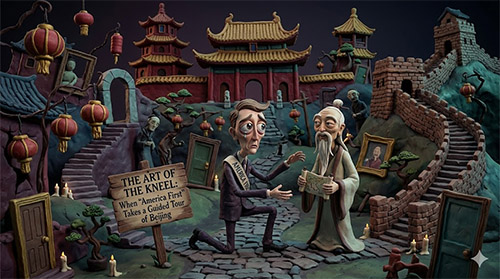
In a surprising diplomatic innovation, strength is redefined as politely waiting outside while the other guy holds all the cards – and the door.
In what historians are already calling “a masterclass in strategic humility,” Donald Trump is reportedly heading to China, where Xi Jinping is expected to graciously demonstrate how leverage works – slowly, patiently, and preferably on live television.
For years, global politics has functioned like a high-stakes poker game. The United States traditionally brought chips, confidence, and occasionally the table itself. China, on the other hand, brought a calculator, a long-term plan, and a quiet smile that suggested it already owned the casino.
Now, as Trump prepares for his diplomatic pilgrimage, the roles seem to have reversed. The man who once promised to “win so much you’ll get tired of winning” is reportedly packing an extra suitcase – just in case he needs to bring back some borrowed dignity.
The issue, as always, is trade. Or, more accurately, the art of calling something “trade negotiations” when it increasingly resembles a polite request for economic mercy. With Taiwan tensions simmering and global supply chains acting like emotionally unavailable partners, the U.S. finds itself in the awkward position of needing China just a little more than it would like to admit on social media.
Xi Jinping, meanwhile, has perfected the ancient diplomatic technique of saying very little while meaning everything. Sources suggest he plans to welcome Trump with a firm handshake, a measured smile, and a subtle reminder that patience is a virtue – especially when your opponent is running on election timelines and caffeine.
Observers note that this meeting is less about negotiation and more about choreography. Trump will likely speak in bold declarations, possibly involving the words “tremendous” and “historic,” while Xi will respond with the geopolitical equivalent of a raised eyebrow and a five-year plan.
There is also the matter of Taiwan, that persistent geopolitical subplot that refuses to stay in the background. For China, it is a core interest. For the U.S., it is a principle—one that becomes slightly more flexible when supply chains and semiconductor dependencies start sending passive-aggressive reminders.
Meanwhile, allies around the world are watching with the kind of fascination usually reserved for reality television finales. Europe is taking notes, Asia is recalibrating, and everyone else is quietly Googling “How to pivot foreign policy without looking obvious.”
Of course, none of this will be framed as weakness. In modern diplomacy, optics are everything. A concession is merely a “strategic adjustment.” A compromise is a “mutually beneficial framework.” And standing outside someone else’s door is simply “respecting cultural protocols.”
In the end, the visit will likely be declared a success by all parties involved. Statements will be issued. Hands will be shaken. Markets will react in ways that sound confident but feel confused.
And somewhere in Beijing, as the cameras flash and the headlines roll in, Xi Jinping will do what he does best – nothing dramatic, nothing loud, just a quiet continuation of a strategy that doesn’t need to shout because it already knows where the world is heading.
As for Trump, he may yet return home victorious – after all, in politics, winning is less about what happens and more about how loudly you describe it afterward.