
The Nirvik Bureau, Bhubaneswar, 23 June 2026
Come for the communal catharsis, stay because there’s nowhere to run – local police provide excellent directions in the opposite direction.
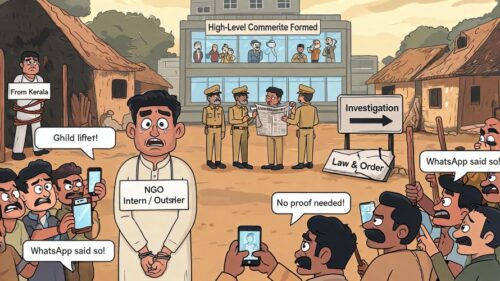
Odisha has quietly rebranded. No longer content with mere festivals or sambal, the state now hosts a year‑round public ritual: the spontaneous, community‑led disposal of inconvenient strangers. First it polished its technique on NGO interns – bright-eyed urban volunteers temporarily converted into notorious child lifters by villagers’ collective imagination – and, having achieved bronze in mob justice, moved on to a silver medal performance: last week’s tragic lynching of a migrant from Kerala. The official motto must be: Why wait for evidence when outrage is so much faster?
This is efficient governance. Investigations slow things down; they require paperwork and inconvenient questions like “Where’s the proof?” and “Did anyone call the police?” Instead, Odisha’s new system replaces those time‑consuming rituals with instant verdicts, delivered by citizens who have mastered both moral certainty and improvised weaponry. The benefit to the state is obvious: fewer criminals to rehabilitate, fewer trials, and a pleasingly simple statistic – swift local action equals lower crime rates (if you ignore the bodies).
The police response has been admirable in its creativity. When mobs gather to chase and beat, law enforcement practices a venerable technique: the long stare. Officers have perfected the art of looking at the horizon, arranging themselves at precisely the wrong angle, and providing post‑event statements that blend sorrow with a dash of bewilderment. “We will look into it,” they say, as if the missing evidence is a carefully disguised chameleon and not a corpse.
Meanwhile, ministers and spokespeople stage their own performance art. They promise stern inquiries, form committees, and, in press briefings, demonstrate an impressive ability to conflate condolence with deflection. When asked whether mob violence reflects a breakdown in law and order, the standard reply is a soothing metaphor: “It’s a temporary lapse, like a power cut.” The political genius here is subtle – call it brownout governance: keep the lights dim, people will assume the house is being renovated, not burned down.
The public discourse has also evolved. Social media analysts call it “moral outsourcing.” Citizens no longer need the burden of due process; they delegate judgment to adrenaline and groupthink. Explanations multiply: remote NGOs are suspect, migrants are suspicious, strangers deserve no presumption of innocence. Every rumor becomes a crusade; every shadow is a suspect; evidence leaves, like common sense, in the first vanishing bus.
There are, of course, the predictable distractions: promises of “stringent action” that arrive after the fact, attended by ritualized condolence selfies and selective outrage. There will be meetings, then forgetfulness. There will be inquiries with deadlines that evaporate, reports that go into drawers, and an occasional suspension of a low‑ranking officer whose career has long been scheduled for voluntary limbo.
If Odisha is the new frontier of ad‑hoc justice, the rest of the country watches – some with alarm, others with envy, and a few with the pragmatic thought that this is what happens when institutions age like unrefrigerated milk. The lesson is clear: when the rule of law becomes optional, vigilantism fills the vacancy with porous, violent efficiency.
So congratulations, Odisha. You have perfected the civic sausage machine: feed it rumor, turn the handle of suspicion, and out comes irreversible tragedy. The only question left is logistical: do you charge admission for the next festival, or is it still complimentary?