The Nirvik Bureau, Bhubaneswar, 15 September 2026
Jadavpur Gets a New Visiting Faculty: Renunciation Studies, Sponsored by Power
Jadavpur University has long been known for difficult ideas, inconvenient questions, damaged walls, unfinished dissertations, and the occasional student who believes freedom of speech includes the freedom to pronounce “hegemony” after two puffs of something botanical.
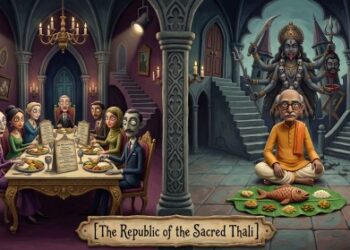
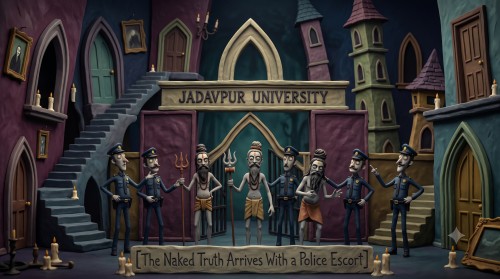
But on September 9, the campus received an even more advanced seminar: Asceticism, Statecraft and Crowd Management, conducted outdoors by a delegation of saffron-clad – or almost unclad – holy men accompanying the Chief Minister.
It was a remarkable educational intervention. Universities usually invite retired professors, Nobel laureates, poets, or at least someone who has read the reading list. Jadavpur, however, was gifted Naga sadhus at its gates: representatives of a spiritual tradition historically devoted to renouncing worldly vanity, material possession, social status and political power – now deployed in a public procession alongside political power.
This is not contradiction. This is Indian innovation.
Austerity With Security Detail
The sadhu, traditionally, owns nothing. Not clothes, not property, not a future, not even a strong opinion about whether the self exists. The political leader, traditionally, owns everything except perhaps responsibility: banners, microphones, slogans, supporters, television debates, and several versions of the same statement depending on the channel.
The two have now discovered a common purpose.
The sadhu brings detachment.
The state brings barricades.
The sadhu brings silence.
The state brings loudspeakers.
The sadhu rejects worldly pride.
The state brings “gerua samman” – saffron pride – printed in block capitals.
It is a partnership made in heaven, or at least in a carefully managed photo opportunity.
One can imagine Diogenes of Sinope, that famously insolent Greek philosopher, watching this spectacle from his barrel. When Alexander offered him anything he wanted, Diogenes merely asked the emperor to move away because he was blocking the sun.
Today’s Diogenes would perhaps be asked to submit that request through the proper administrative channel, obtain a permission letter, avoid offending public sentiment, and stand behind the barricade until the convoy has passed.
From “Stand Aside” to “Stand With Us”
The old naked philosophers were dangerous not because they lacked clothing but because they lacked obedience. Their nakedness was not costume; it was a refusal. It said: “Your empire cannot buy me, your reputation cannot dress me, and your judgement cannot define me.”
That is inconvenient philosophy.
Modern public spirituality has solved the inconvenience. The naked philosopher need no longer tell Alexander to move aside. He may now stand beside Alexander, preferably in a group, preferably before cameras, preferably near a university gate where students can be instructed in the moral dangers of intoxicants, dissent, hair length and independent thought.
The ancient ascetic suspended judgement to attain serenity. The modern political ascetic seems to suspend only trousers, while judgement arrives fully clothed, armed with slogans and accompanied by a state convoy.
Kabir warned that if nakedness alone brought liberation, forest deer would achieve salvation first. He did not live long enough to see that nakedness, once politically useful, could bring not liberation but placement in the front row.
The New Centre of Excellence
Jadavpur University was reportedly reminded that it is a “Centre of Excellence.” This is reassuring. A Centre of Excellence must obviously be protected from dangerous substances such as cannabis, critical inquiry and the alarming possibility that students might talk freely.
Political spectacle, on the other hand, is entirely organic.
Nothing elevates a university more than a state-approved procession teaching it the true meaning of intellectual freedom: you may think anything you like, provided it is compatible with the procession’s route map.
The university emblem may be damaged, campus autonomy may be dented, and public debate may be bruised. But saffron pride, apparently, must remain spotless – like an election-season kurta, washed daily in the detergent of moral outrage.
The Final Renunciation
The saddest irony is not that sadhus appeared at a university gate. A university should have room for saints, sceptics, atheists, believers, naked philosophers and badly dressed students alike.
The irony is that a tradition of renunciation is being asked to decorate authority.
The old sadhu renounced power so completely that an emperor could not tempt him. The new public sadhu is invited to power’s doorstep, where renunciation becomes stage design and silence becomes a slogan.
Perhaps the true gymnosophist at Jadavpur is not the man wearing almost nothing.
Perhaps it is the student who, surrounded by leaders, police, cameras, outrage and sanctimony, still manages to ask the most indecent question of all:
“Why is power so terrified of a university?”