The Nirvik Bureau, Bhubaneswar, 7 October 2026
Please Keep Your Blowback Upright
The international community was shocked to discover that extremism, unlike an airline’s complimentary baggage allowance, does not respect national boundaries.
For years, important people had treated Syria as a convenient warehouse for inconvenient ambitions. Weapons went in. Speeches came out. Ordinary Syrians were advised to remain resilient, preferably somewhere outside the camera frame.
Then terror allegedly entered a passenger cockpit, and suddenly instability became a serious matter. Not because people might die – that possibility had enjoyed years of diplomatic flexibility – but because they might die holding boarding passes.

A devastated neighbourhood is a regional issue. A threatened aircraft is a global concern. Geography becomes wonderfully elastic when the passengers include potential customers.
Our Militants Have Excellent References
At the Ministry of Strategic Innocence, officials immediately opened an investigation into how yesterday’s useful armed men could become today’s dangerous armed men without submitting the appropriate paperwork.
“We supported stability,” explained a spokesperson, standing before a map resembling a shattered dinner plate.
Asked why stability required so many competing militias, he clarified that these were not militias. They were locally empowered security stakeholders.
“And the extremists?”
“Those were somebody else’s stakeholders.”
Every foreign capital possessed an immaculate filing system. Its own interventions were assistance. Its rivals’ interventions were interference. Its preferred gunmen were partners. Their preferred gunmen were terrorists.
Occasionally, a partner became a terrorist. This was unfortunate, but easily corrected by replacing his photograph in the briefing folder.
Dictatorship: Now With Nostalgia
Meanwhile, the Department of Selective Memory unveiled its latest product: the Good Old Days.
Apparently, a sufficiently ruined present can turn yesterday’s prison into a charming heritage property.
“Yes, there was repression,” conceded the brochure, “but the repression was predictable.”
This is the political equivalent of recommending a coffin because the neighbourhood is quiet.
Syrians were offered the familiar bargain: choose between a ruler who might crush you and armed factions that might classify you before crushing you.
Foreign commentators described this as a complex dilemma. Syrians, being less generously compensated for their analysis, generally described it as trying to survive.
Rebranding At The Departure Gate
The international image consultants were equally busy.
A violent past need not obstruct a respectable future, provided the suit fits and the press conference lighting is flattering.
Yesterday: a troubling ideological history.
Today: a pragmatic leader navigating a challenging transition.
Tomorrow: a keynote address on inclusive governance, sponsored by people who would never leave their children alone with the keynote speaker.
Minorities were asked to be patient. Patience, unlike protection, costs donors nothing.
The Smoke Is Not Our Responsibility
Oman’s bridge-building reputation made the alleged incident especially jarring. But bridges cannot guarantee that nobody crossing them has brought a match.
The wider lesson was promptly referred to a committee.
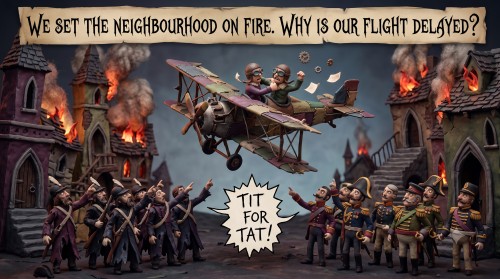
Its preliminary finding: setting someone else’s house ablaze remains an acceptable strategic instrument, provided the smoke stays abroad.
Passengers should therefore fasten their seat belts.
The sponsors of regional chaos have already secured their preferred seats: far from the wreckage, beside the emergency exit, with responsibility checked through to somebody else’s destination.