
Dhanada K Mishra, Hong Kong, 8 March 2026
In the midst of escalating tensions between the United States and Iran in early 2026, a riveting interview on the independent news show Breaking Points has captured global attention. Hosted by Krystal Ball and Saagar Enjeti, the segment featured Professor Jiang Xueqin, a Canadian-Chinese educator and geopolitical analyst known for his YouTube channel “Predictive History.” With a background that includes education at Yale in English History, a controversial arrest in China on espionage charges, and a return to teaching in Beijing, Jiang has built a reputation for using game theory and historical patterns to forecast world events. His channel, boasting millions of views, focuses on geopolitics, human civilisation, and civics, often delving into unconventional theories about global power structures.
The interview, aired on March 2, 2026, comes at a critical juncture. Just days after U.S. and Israeli strikes on Iranian targets, public opinion in America has soured on the conflict, with polls showing 78% opposition to the initial airstrikes. Jeffrey Sachs, another guest on the same episode, lambasted Israeli Prime Minister Netanyahu for dragging the U.S. into the fray. But it was Jiang’s bold assertion—that the U.S. will ultimately lose the war—that sent shockwaves through social media and policy circles. Drawing from predictions he made back in 2024, Jiang outlined a scenario where Iran’s strategic patience and asymmetric warfare dismantle American hegemony, potentially ushering in a multipolar world order.
Jiang’s analysis begins with his trio of 2024 forecasts: Donald Trump’s election victory, the U.S. initiating a war with Iran, and America’s eventual defeat. As he explained to Ball and Enjeti, these predictions stem from game theory, where he models international relations as a high-stakes chess match informed by historical precedents. “I’ve been spot on so far,” Jiang noted, referencing Trump’s re-election and the rapid escalation following U.S. strikes. He argues that Iran, framed by its religious eschatology as the “Great Satan” fighter, has spent two decades preparing for this moment. Through proxies like the Houthis, Hezbollah, Hamas, and Shia militias in Iraq and Syria, Iran has tested U.S. responses in “practice runs,” such as the brief exchanges in June of the previous year.
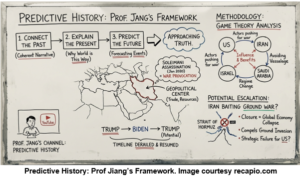
Central to Jiang’s prediction of U.S. defeat is the concept of attrition warfare. Unlike conventional battles, Iran isn’t aiming for quick victories but for exhausting American resources. Jiang highlighted the asymmetry in costs: Iranian drones, priced at around $50,000 each, can evade or overwhelm U.S. defences that rely on million-dollar interceptors. “The U.S. is running out of munitions,” he warned, pointing to reports of depleted stockpiles after initial barrages. Historical examples abound—no air campaign has ever achieved regime change alone, from Vietnam to Iraq and most recently in Afghanistan. Jiang foresees mounting pressure for a ground invasion, as airstrikes fail to topple the Iranian regime. Gulf Cooperation Council (GCC) states like Saudi Arabia and the UAE, battered by Iranian retaliatory strikes, may demand U.S. troops or massive indemnities—potentially $5 trillion—to safeguard their territories.
A particularly alarming aspect of Jiang’s breakdown involves Iran’s targeting of critical infrastructure. He described how Iran could disrupt the global economy by attacking the Strait of Hormuz, through which 20% of the world’s oil passes, and desalination plants that supply 60% of the GCC’s water. “If a cheap drone hits a plant in Riyadh, serving 10 million people, water runs out in two weeks,” Jiang said. This isn’t mere speculation; Iran’s closure of the strait has already halted 90% of GCC food imports, threatening famine and instability in key U.S. allies. Saudi Arabia’s pivot to tourism—signing stars like Cristiano Ronaldo and investing in e-gaming and mega-projects like The Line—becomes futile without regional oil dominance, which Iran challenges through its support for anti-monarchy forces like the Houthis.
Economically, Jiang paints a dire picture of U.S. vulnerability. He calls the American economy a “financial Ponzi scheme,” sustained by petro-dollars from Gulf oil sales recycled into U.S. investments, particularly AI data centres. “The AI bubble is funded by Gulf money,” he claimed, suggesting that disruptions could burst this illusion, leading to the dollar’s collapse as the global reserve currency. This echoes broader critiques of U.S. hegemony post-Soviet Union, where military might has masked underlying frailties. Jiang’s view aligns with reports from outlets like Geo TV, which noted his predictions of prolonged conflict exhausting U.S. supply lines and political will.
What elevates the interview from standard analysis to controversy are Jiang’s forays into conspiracy territory. He attributes Trump’s decision to launch the war—despite Joint Chiefs’ warnings—to hubris from early successes, personal financial incentives, and deeper esoteric influences. Jiang referenced bribes, including $2 billion funnelled to Jared Kushner’s fund from Saudi Arabia and $250 million from Israeli donor Miriam Adelson to secure Trump’s third term. More provocatively, he invoked “secret societies” like the Illuminati, divided into subgroups: Jesuits controlling the Vatican, Sabbatean Frankists influencing Israel, and Freemasons dominating U.S. national security. Drawing from Jeffrey Epstein’s files, Jiang suggested these elites script global events toward an “end times” narrative, viewing the Middle East conflict as a pathway to “heaven on earth.” This “eschatological factor” explains why rational actors pursue irrational wars, he argued.
Such claims have drawn scepticism. Critics on platforms like Reddit and Facebook label Jiang a potential CCP intelligence asset, citing his Yale education, deportation from China, and subsequent rehabilitation in Beijing. His non-peer-reviewed research on elite control of Western institutions fuels accusations of disinformation. Yet, supporters point to his accurate forecasts, including U.S. tensions with Venezuela and the Iran war itself, as evidence of insight. In a separate January 2026 interview on the Greater Eurasia Podcast, Jiang expanded on these themes, warning of Trump’s April state visit to China as a pivotal event in global realignment.
The implications of Jiang’s predictions are profound. A U.S. loss could accelerate the shift to multipolarity, with China and Russia filling power vacuums. Domestically, war could grant Trump emergency powers, delaying midterms and consolidating authority amid declining polls. As one Instagram reel noted, “The true reasons for the war and its outcome” challenge the official narrative of defending allies against aggression. Economically, the petro-dollar’s fall might trigger hyperinflation and stock market crashes, exposing the fragility of AI-driven growth.
Critics argue Jiang overlooks U.S. advantages, like naval superiority and alliances, which have already decimated Iran’s navy and air force in initial clashes. Comments on the viral clip question his grasp on military realities, with one X user quipping, “What is this dude smoking?” Yet, as munitions shortages mount and Iranian proxies intensify attacks, elements of his forecast ring true. Public rejection of the war, echoed in MRFF complaints about religious proselytising in the military, underscores eroding domestic support.
In conclusion, Professor Jiang’s interview is a provocative blend of strategic insight and fringe theory, challenging viewers to question the drivers of U.S. foreign policy. Whether his doomsday scenario unfolds remains uncertain, but in a world of rapid geopolitical shifts, dismissing such voices could prove costly. As the conflict drags on, Jiang’s words serve as a stark reminder: wars are won not just on battlefields, but through endurance, economics, and unseen influences. His call for a multipolar future may yet redefine global power dynamics.