
Dhanada K Mishra, Hong Kong, 8 May 2026
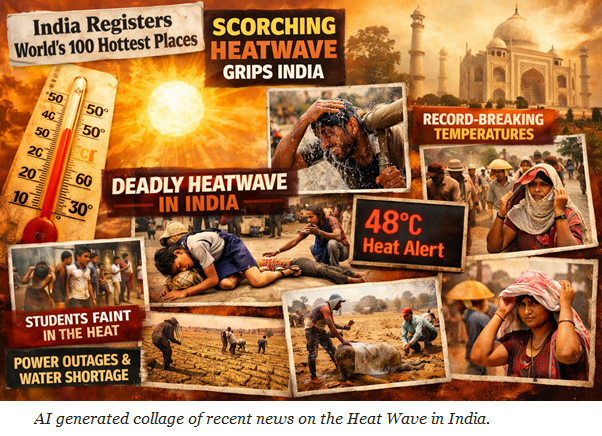
On 24 April 2026, a striking and sobering statistic circulated on news feeds across India: 95 of the world’s 100 hottest cities were located within the country’s borders. In Uttar Pradesh, Prayagraj, Moradabad, Ghazipur and Varanasi touched 44°C. Cities in Odisha — Balangir, Raurkela and Talcher — registered the same scorching temperature. Maharashtra, Telangana, Bihar and Madhya Pradesh were not far behind. For the millions of people living in these cities — workers on construction sites, students in classrooms, families without air conditioning — this was not a data point. It was a daily ordeal.
Er. Manoranjan Mishra, Engineer-in-Chief (Retd) of the Government of Odisha, frames the stakes precisely: “A built environment is more important than the building itself. The current heatwave, with temperatures up to 44°C across 95 of the world’s 100 hottest cities in India, serves as a warning that the built environment is now our most critical frontline defense.” That frontline, across much of urban India, is cracking under pressure it was never designed to withstand.
ENSO, a warming planet and India’s double threat
India’s April 2026 heatwave did not arrive in isolation. The India Meteorological Department (IMD) has already warned of a below-normal southwest monsoon this year, citing the likely development of El Niño conditions by mid-2026. El Niño — the warm-ocean phase of the El Niño–Southern Oscillation (ENSO) cycle — historically weakens India’s monsoon, which delivers nearly 70% of the country’s annual rainfall. A weaker monsoon means drought risk for agriculture, tighter water supplies, and power grids already strained by record peak demand.
What makes this doubly alarming is that El Niño now operates on top of a rising global temperature baseline. Climate scientist Dhrubajyoti Samanta, associate editor of Geophysical Research Letters and a member of UN Ocean Decade and CLIVAR panels, warns: “It is not just about whether we are on El Niño or La Niña anymore, it is about how fast conditions swing between extremes, and how those swings amplify flood and storm risks.” For India, this means the country faces a sequence of compound hazards: extreme heat now, a potentially weaker monsoon through the summer, and then heavier, more erratic rainfall events during and after the ENSO transition, each one stressing infrastructure that was designed for a gentler climate.
India’s peak power demand surged to approximately 256 gigawatts on 25 April 2026, as millions simultaneously turned up fans and coolers, and several states adjusted school timings or ordered temporary closures as classrooms became unsafe during afternoon heat. These are not marginal inconveniences; they are signals that urban infrastructure is already operating near the edge of its design limits.
The urban heat island: a crisis of design
A large part of India’s heat crisis is a man-made problem layered onto a natural one. Meteorologists have linked the intensity of this heatwave partly to the urban heat island (UHI) effect, where dense concentrations of concrete, asphalt, metal roofing and minimal green cover trap and re-radiate solar energy long after sunset. Even in normal years, major Indian cities record nighttime temperatures 3°C to 5°C above surrounding rural areas because of this effect.
Er. Mishra puts the design challenge directly: “What actively traps heat through the Urban Heat Island effect is to be considered toward an approach to urban design… prioritizing blue-green infrastructure, we can have spaces that naturally mitigate extreme temperatures.” Addressing UHI is no longer an aesthetic or environmental luxury; it is a public health and structural imperative. Surfaces that hold heat damage road bitumen, warp rail tracks, stress electrical cables and degrade building materials — compounding the physical toll of the storm or heatwave itself.
Ahmedabad’s Heat Action Plan, widely cited as India’s most successful city-level heat response, has demonstrated that cool roofs, tree canopies, adjusted outdoor work schedules and community cooling centers can measurably reduce heat-related illness and death. The challenge is replicating and scaling that model to the hundreds of secondary and tertiary cities — Balangir, Ghazipur, Talcher — that appeared in the April 2026 hottest-cities list but lack the institutional and financial capacity of a Ahmedabad or Mumbai.
Building for compound extremes
The coming months are likely to test Indian infrastructure in a different but equally demanding way. If El Niño develops as forecast, the risk of late, erratic and geographically uneven monsoon rainfall increases. Regions that have spent months baked by heat may face sudden, intense downpours on parched, compacted soils — exactly the conditions that generate flash floods, landslides and waterlogged streets.
This compound heat-then-flood sequence is a pattern that Dr. Samanta describes as central to ENSO-era risk: “Regions that were dry can suddenly face above-normal rainfall, raising the chances of river flooding and landslides. Coastal areas, already dealing with rising sea levels, become more vulnerable when heavy rainfall and high tides occur together. For communities in the Global South, such as in Southeast Asian countries, this is particularly challenging because infrastructure, early warning systems, and drainage capacity are often already under stress.” Change “Southeast Asian countries” to “Indian states,” and the description is precise.
Er. Dr. David Ng Chew Chiat, co-founder and executive director of ONE SMART ENGINEERING PL, IES Council member and adjunct lecturer at NUS and IESA, offers a practical engineering response from Singapore’s experience. He points to the Active, Beautiful, Clean (ABC) Waters approach — integrating raingardens, vegetated canal edges and detention ponds into the urban fabric — as “a temporary detention pond to prevent over-loading of the water body during storm,” a model he says is “very suitable and flexible to be implemented in the cities in the South East Asian countries,” including India.
The principle translates directly to India’s context: storm drains designed for average monsoon rain need retrofitting to handle short, intense cloudbursts; riverbanks and canal edges are underused assets for green buffer infrastructure; and city master plans should designate floodable parks and wetlands in low-lying areas rather than allow further construction there.
Resilience as the primary metric
At the heart of this crisis is a question of what we build for. Er. Mishra states it with clarity that every urban planner and engineer in India needs to hear: “In such climate reality, the resilience of our buildings and public works is no longer a secondary design goal; rather it is the primary metric of successful, human-centric engineering.”
That reframing matters. For decades, Indian infrastructure has been designed to standards derived from historical climate data — rainfall averages, wind speeds, temperature norms — that are now being systematically exceeded. National Building Codes and local bye-laws still reflect assumptions about climate variability that ENSO-era extremes are invalidating season by season. Dr. Samanta’s advice to planners globally applies with full force in India: “Plan for variability, not averages, because ENSO keeps shifting the risks, its swings are becoming stronger with climate change, and we’re now seeing that major El Niño events can carry real human and economic costs, so infrastructure needs to be flexible and ready for more extreme climate events.”
India has begun to move in this direction. Cities like Mumbai, Bengaluru and Chennai have outlined resilience-building measures integrating heat and flood responses. The National Mission on Sustainable Habitat recommends local urban heat island maps to inform city design. AI-driven early warning systems, including Google’s March 2026 urban flash-flood forecasting tool — which can predict local flood risk 24 hours ahead in cities across 150 countries — are now available to Indian municipal authorities as well.
The cost of not acting
The economic stakes are enormous. Agriculture employs close to half of India’s 1.4 billion people and accounts for roughly 18% of its economy. A below-normal monsoon triggered or deepened by El Niño would hit food production, groundwater recharge and rural incomes simultaneously. Meanwhile, the power grid, already at record peak demand, faces rising structural stress every summer, with heat-warped transmission lines and degraded transformer performance adding to vulnerability.
Research globally has consistently shown that each rupee spent on proactive hazard mitigation and climate-resilient infrastructure saves several rupees in post-disaster recovery. India’s rapid urbanization makes this calculation even more pressing: decisions made in the next five years about drainage, urban greening, building codes and coastal defenses will shape the vulnerability of hundreds of millions of city-dwellers for the next half-century.
From crisis to renewal
India’s April 2026 heatwave should be read not only as a climate event but as a diagnostic report on the built environment. The cities baking at 44°C and above are sending a clear message: the infrastructure we inherited was designed for a climate that no longer exists.
The good news is that the tools, knowledge and examples exist. Blue-green urban design can mitigate both heat and flooding. Adaptive drainage and nature-based water management can handle ENSO-driven cloudbursts. Improved seasonal forecasts and AI-powered flood alerts give cities and citizens time to act before hazards become disasters. A generation of engineers and policymakers is now being trained in climate-resilient design thinking.
Er. Mishra’s insight — that “the resilience of our buildings and public works is no longer a secondary design goal; rather it is the primary metric of successful, human-centric engineering” — is both a critique and an invitation. It is a critique of infrastructure built for comfort and cost alone, and an invitation to reimagine India’s cities, drains, roads and public spaces as a frontline defense against a climate that is shifting faster than most of our plans anticipated.
If that invitation is accepted — and this ENSO-driven season of heat, drought risk and approaching monsoon uncertainty gives every reason to accept it urgently — then the fear that comes with watching a thermometer climb past 44°C in a hundred Indian cities can yet become the catalyst for a generation of renewal.