The Nirvik Bureau, Bhubaneswar, 21 May 2026
When GDP takes a backseat and slogans drive the nation forward
In a historic breakthrough in political science, the ruling establishment has finally proven what economists feared and magicians admired: reality is optional if the narrative is strong enough. While traditional governance models insisted on tedious metrics like employment rates, consumption demand, and GDP growth, the new model has streamlined success into a far simpler formula – win elections, repeat.
The economy, once considered the backbone of a nation, has now been gracefully demoted to a supporting character. It appears occasionally in speeches, mostly as a villain from the past, and is swiftly defeated with applause lines. Growth may be sluggish, consumption may be cautious, and jobs may be elusive – but none of these can compete with the soaring trajectory of electoral success graphs, which, unlike economic indicators, never seem to dip.
Subhead: GDP vs. NDA – A Contest of Numbers
There was a time when quarterly GDP figures caused anxiety in policy circles. Now, the only numbers that matter come every five years – or sooner, depending on the election calendar. A falling GDP can always be explained, contextualized, or blamed on global headwinds. A falling vote share, however, is treated as a national emergency.
In this new paradigm, economic distress is not denied; it is merely outperformed. Why worry about inflation when you can inflate nationalism? Why address unemployment when you can employ rhetoric? The marketplace may be quiet, but the campaign trail is booming – and that, apparently, is the more reliable indicator of national health.
Subhead: The Art of Strategic Distraction
Critics argue that the economy is weakening. But critics, as we know, are notoriously fixated on facts. The modern voter, on the other hand, is offered a richer menu: identity, pride, historical grievances, and the occasional infrastructure project ribbon-cutting.
This is not governance; this is content creation. Each election is a new season, each speech a viral episode. The economy may be struggling to create jobs, but the narrative industry is in full employment. There are hashtags to trend, enemies to highlight, and achievements to amplify – whether or not they reflect lived reality.
Subhead: Reforming the Definition of Success
Perhaps the real innovation lies in redefining what “success” means. In the old world, success meant improving livelihoods, boosting incomes, and ensuring stability. In the new world, success is measured by the ability to win despite all that.
It is a bold experiment: can a government continue to dominate politically while the economy sends increasingly urgent distress signals? Can electoral charisma indefinitely substitute for economic credibility? The answer, so far, appears to be yes – or at least, not yet no.
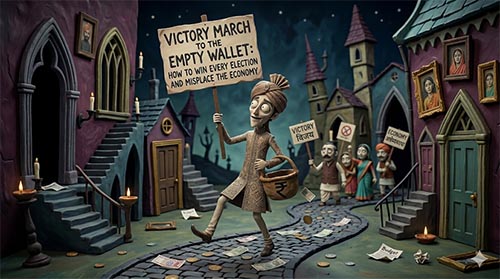
As the country marches confidently from one electoral victory to another, the economy quietly trails behind, like an underperforming extra in a blockbuster film. It still matters, of course – but mostly in theory, and occasionally in footnotes.
Until then, the message is clear: ballots over balance sheets, optics over output, and above all, victory over everything.