The Nirvik Bureau, Bhubaneswar, 14 May 2026
A competition so sacred, it begins with dreams and ends with blood pressure
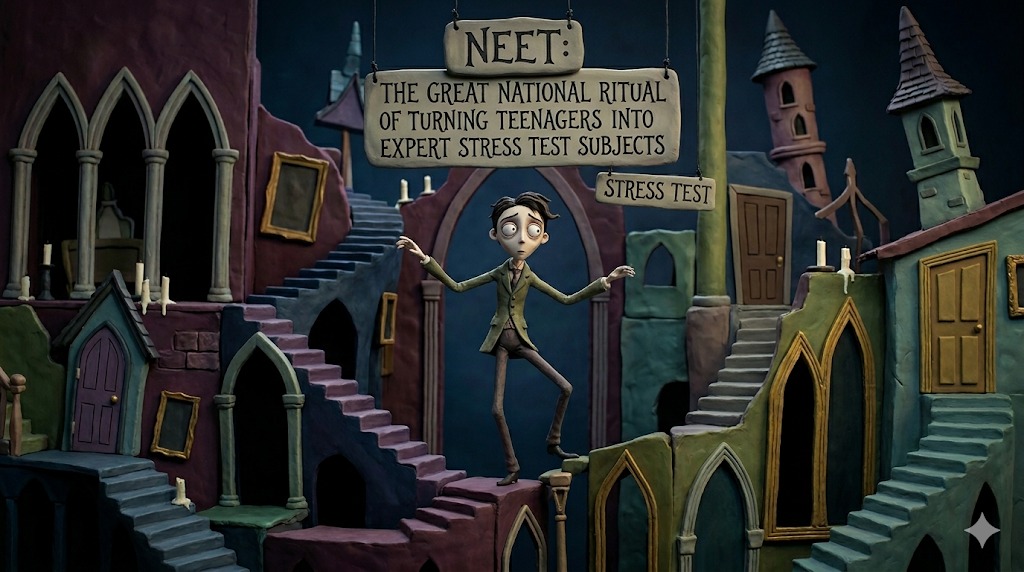
In India, we do not merely educate our children. We conduct long-form stress experiments on them, document the results in real time, and then call it “merit.”
And at the grand center of this annual performance stands NEET – a glorious, all-conquering examination that promises to sort the future doctors from the rest, while quietly sorting the rest into therapy, regret, and family silence. The system sells it as a fair test. Fairness, of course, being that magical word we use when 22 lakh students are asked to sprint through a maze designed by adults who haven’t sat for an exam in decades but still speak about “pressure” as if they invented it.
The syllabus is not just a syllabus. It is a lifestyle choice
By the time a student begins preparing for NEET, the teenager’s actual age becomes a technicality. Their real identity is no longer “child,” “student,” or “human being.” They become a syllabus with a pulse.
Biology is no longer a subject. It is a religion. Physics is no longer logic. It is punishment with formulas. Chemistry floats somewhere in between, like a diplomatic state that promises balance but delivers confusion. The family dining table becomes a war room, the bedroom becomes a bunker, and every neighbor becomes an educational consultant after one YouTube video and two WhatsApp forwards.
Parents, too, are drafted into this noble campaign. They stop asking, “How are you?” and begin asking, “How many mock tests did you get right?” Love is now measured in rank predictions.
The coaching industry, where hope is packaged with fluorescent lights
Then comes the coaching ecosystem, that proud industrial complex where aspiration is processed into monthly installments. Here, ambition is not encouraged; it is monetized.
A student enters one of these centers with a dream of becoming a doctor. By month two, they are carrying ten books, three notebooks, one water bottle, and the expression of a factory worker on a double shift. Walls are decorated with toppers’ photos, as if smiling under high pressure is the first medical skill.
The message is subtle and powerful: if you are not succeeding, you are simply not suffering correctly.
Results day: democracy, but with worse emotional damage
The exam happens. The waiting happens. The result arrives. And at that moment, the nation briefly becomes a therapist with no training, no license, and a fixation on “what went wrong.”
If a student scores well, they are praised as proof that the system works. If they don’t, the system is still declared perfect, because apparently the most efficient machine in the country is the one that always survives criticism by blaming the user.
This is the genius of the setup. It is never the exam that is cruel. It is always the student who “couldn’t handle pressure.” Teenagers, we are told, must become emotionally bulletproof before they are legally allowed to vote, drive, or order food without their parents’ help.
A nation that wants doctors, not survivors
India urgently needs doctors. No doubt. But what kind of future are we building if the gateway to a noble profession is a machine that routinely damages the mental health of the people entering it?
If a system produces expertise by manufacturing trauma, perhaps the system deserves a medical check-up of its own.
Because at some point, the country must ask a dangerous question: are we selecting future doctors, or simply selecting the students most willing to endure a public ordeal and call it destiny?
Until then, NEET will remain what it has become: not just an exam, but a national festival of anxiety, where families pray, coaching centers cash in, and teenagers learn the oldest lesson in Indian education – that merit is important, provided you can afford the pain of proving it.