Dhanada K Mishra, Hong Kong, 10 August 2026
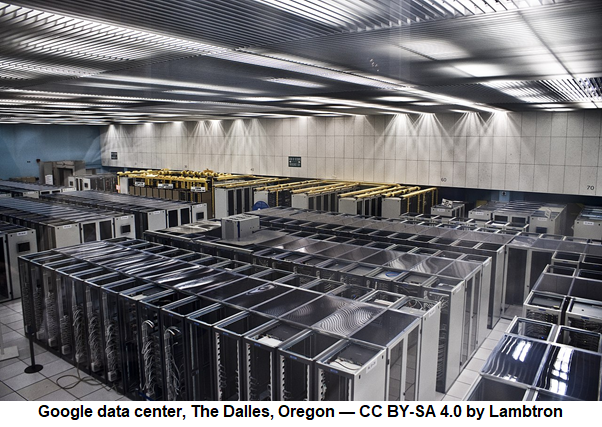
At first glance, a data centre appears almost unreal. There are no chimneys, no moving vehicles, and rarely any visible human activity. Behind its sealed walls, however, thousands of servers work continuously—processing payments, storing medical records, supporting digital government services, training artificial-intelligence models, and powering the applications that have become part of everyday life.
The cloud, in other words, is not in the sky. It is a vast physical infrastructure of land, concrete, steel, fibre-optic cables, electricity, batteries, diesel generators and cooling systems.
India is now racing to build this infrastructure. The country’s installed data-centre capacity has increased from approximately 520 MW in 2020 to nearly 1.5 GW by mid-2025, and it could reach 4.5–6.5 GW by 2030. Between 2019 and 2025, committed investment in the sector reached approximately US$95 billion.
This expansion is understandable. India generates almost one-fifth of the world’s data but hosts only about 3% of global data centres—roughly 150 out of more than 11,000 worldwide. Digital payments, e-commerce, cloud computing, telemedicine, streaming, 5G and artificial intelligence all require more domestic computing power.
Yet, behind the language of digital sovereignty and technological progress lies a difficult question: Can India build its digital future without placing intolerable pressure on its water, energy, land and communities?
Key Facts
| Metric | Current | Projected |
| India’s installed data-centre capacity | ~1.5 GW (2025) | 4.5–6.5 GW by 2030 |
| Committed investment (2019–2025) | ~US$95 billion | — |
| India’s share of global data centres | ~3% | — |
| India’s data-centre electricity use | ~0.5% of national consumption | More than double by 2030 |
| India’s data-centre water use | ~150 billion litres/year (2025) | ~358 billion litres/year by 2030 |
| Global data-centre electricity consumption | 415 TWh (~1.5% of global) | ~945 TWh by 2030 |
| Global data-centre water consumption | ~560 billion litres/year | ~1.2 trillion litres/year by 2030 |
A village at the edge of the cloud
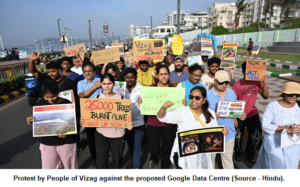
The question became concrete in Tarluvada, near Visakhapatnam in Andhra Pradesh.
In April 2026, the foundation stone was laid for a proposed data-centre park associated with Google’s planned artificial-intelligence hub. The Andhra Pradesh government has allotted approximately 480 acres for the development, while other large-scale data-centre proposals are also being discussed in the Visakhapatnam region.
For investors, this is an extraordinary opportunity. For local communities, it is a transformation of the landscape—and possibly of their relationship with water and electricity.
Environmental activists and lawyers have questioned the project’s approval because important details about operational water consumption and its source were not clearly disclosed. According to reporting by Mongabay-India, the environmental clearance did not specify whether cooling water would come from groundwater, surface water, desalination or another source.
That omission matters. A 100 MW hyperscale data centre can consume approximately two million litres of water per day for on-site cooling, depending on its design and climate. A 1 GW campus is not simply ten times a typical facility in every practical respect, but its scale makes the water question impossible to treat as a technical footnote.
Visakhapatnam is also not a place where water can be assumed to be abundant. The city currently receives around 410 million litres of water a day against an estimated requirement of 480 million litres, leaving a daily gap of about 70 million litres. Reporting has highlighted concerns about the district’s limited groundwater availability and the potential implications of seawater cooling for coastal ecosystems, fishing communities and coastal regulation.
For a resident whose daily life depends on a local well, irrigation channel or municipal supply, the phrase “data-centre campus” may not signify innovation. It may raise a more immediate question: Will there still be enough water for us?
The global warning
India is not confronting this dilemma alone.
In the United States, communities have increasingly challenged large data-centre projects because of their electricity consumption, water use, noise and dependence on backup generators. In parts of Europe, electricity-grid constraints have slowed or complicated new developments. In Latin America, journalists and civil-society groups have reported that communities are often given little information about the infrastructure being built near them.
The pattern is remarkably consistent. Companies describe data centres as clean, modern and essential to the digital economy. Communities see large industrial facilities whose resource requirements are difficult to understand and whose environmental disclosures may be incomplete.
Globally, data centres consumed approximately 415 TWh of electricity in 2024—about 1.5% of worldwide electricity consumption—and demand is expected to rise sharply as artificial intelligence expands. The International Energy Agency projects that global data-centre electricity use could approach 945 TWh by 2030.
The water footprint is equally significant. The International Energy Agency estimates that data centres globally consume more than 560 billion litres of water annually, a figure that could rise to as much as 1.2 trillion litres by 2030. Much of this is used for cooling. In some locations, the water used by a data centre competes directly with domestic, agricultural and ecological needs.
The problem is not that digital infrastructure exists. The problem is that its physical consequences have often remained invisible.
India’s local vulnerability
At the national level, India’s data centres currently account for approximately 0.5% of electricity consumption and an estimated 150 billion litres of water use. Both figures are projected to more than double by 2030.
These national percentages may appear modest. But national averages can conceal local crises.
A data centre does not draw “national water”; it draws water from a particular aquifer, reservoir, treatment plant or coastline. It does not use “national electricity”; it depends on a particular substation, transmission corridor and generation mix. If several facilities cluster in the same region, their cumulative impact may be much greater than the impact of any individual project.
According to WRI India’s mapping, more than half of India’s approximately 271 data centres are already located in water-stressed areas. Around 75% of active and upcoming facilities are concentrated across just five states—Maharashtra, Tamil Nadu, Karnataka, Telangana and Uttar Pradesh—several of which already face significant pressure on urban water resources. Mumbai, Chennai, Hyderabad and Bengaluru—all major technology and data-centre hubs—already face varying degrees of flooding, heat, water scarcity or pressure on urban infrastructure. An S&P Global study projects that 60 to 80% of India’s data-centre facilities could face high water stress before the end of this decade.
Climate change makes these risks more severe. India is experiencing hotter summers, more intense rainfall, coastal flooding and increasingly unpredictable water availability. A facility designed around historical climate data may not remain resilient during the next decade of extreme weather.
This is why site selection must become an environmental decision, not merely a real-estate or connectivity decision.
The cooling trade-off
Cooling reveals the difficult choices at the heart of data-centre sustainability.
Evaporative cooling can be energy-efficient but consumes water. In such systems, up to 85% of the water simply evaporates rather than returning to the local supply. Air-cooled systems reduce water use but may require more electricity, particularly in India’s hot and humid climates. Closed-loop systems reuse water, while direct-to-chip liquid cooling can manage the heat produced by high-density AI servers more efficiently.
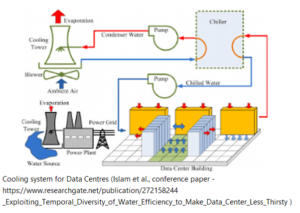
There is no universal solution. The appropriate technology depends on local temperature, humidity, water availability, rack density, electricity carbon intensity and operational requirements.
But one principle should be non-negotiable: a facility should not be approved without a transparent account of its water and energy balance.
Developers should disclose their Power Usage Effectiveness and Water Usage Effectiveness, identify every source of water, publish seasonal demand, and explain how much water will be recycled. Potable water should not be used where treated wastewater or closed-loop alternatives are technically feasible.
Similarly, renewable-energy claims should distinguish between annual offsets and genuinely reliable, time-matched clean electricity. A data centre that operates 24 hours a day cannot rely only on a glossy annual renewable-energy percentage while drawing heavily from a fossil-fuelled grid during periods of peak demand.
From incentives to accountability
India currently has no binding national framework with uniform sustainability benchmarks for data-centre development. Fifteen states have introduced their own policies, but a CEEW study found that only five explicitly include sustainability-related provisions.
This creates a risk of regulatory competition, in which states offer land, tax concessions and inexpensive power without adequately accounting for environmental costs.
The answer is not to stop data-centre investment. India needs domestic infrastructure for data security, public services and economic development. The answer is to make public incentives conditional.
Projects receiving land, power concessions, tax benefits or infrastructure support should be required to meet progressively stricter standards for:
- Renewable and low-carbon electricity.
- Water recycling and low-water cooling.
- Climate-risk assessment.
- Flood, heat and disaster resilience.
- Electronic-waste management.
- Local employment and skills.
- Public disclosure of resource consumption.
- Meaningful community consultation.
Environmental clearance should also reflect the true nature of data centres. They are not simply office buildings or commercial developments. They are energy-intensive industrial facilities with substantial implications for power, water, land and emergency planning.
A more human form of digital progress
There is another path available to India. Data centres can use treated municipal wastewater, closed-loop cooling, direct-to-chip systems, batteries, geographically diversified renewable power and cleaner backup fuels. Artificial intelligence, drones, thermal imaging, sensors and digital twins can improve inspection, predictive maintenance and energy efficiency. Data-centre campuses can be planned as resilient infrastructure systems rather than isolated buildings.
Technology pathways that can make a difference:
- Closed-loop liquid cooling Recirculates same water; removes up to 98% of server heat Higher upfront capital cost
- Direct-to-chip cooling Cools GPUs directly; reduces energy and water demand Requires server redesign
- Treated wastewater reuse Reduces pressure on freshwater sources Requires treatment infrastructure
- Waste-heat reuse Supplies heat to homes and businesses; reduces fossil-fuel reliance Requires district heating infrastructure or nearby consumers
- AI-optimised operations: Predictive maintenance and dynamic cooling reduce waste – Requires skilled personnel
India can also develop a more resource-efficient model of computing—what the CEEW report describes as “frugal AI”: smaller, task-specific systems designed for practical needs rather than unlimited computational expansion.
The essential question is not whether India should join the global data-centre race. It is whether the race should be measured only in gigawatts, investment announcements and server capacity.
A successful data centre should also be measured by the trust of the community beside it, the security of the local water supply, the resilience of the surrounding grid, the quality of its jobs and the condition of the environment after the project begins operating.
The people of Tarluvada are not standing in the way of India’s digital future. They are asking to be included in it. Their concern is a reminder that every apparently weightless digital service has a physical location and a human cost.
India’s challenge is therefore larger than building more data centres. It is to build them responsibly—so that the cloud does not become another name for a resource burden carried by those who had the least say in creating it.