Ambika Prasad Kanungo, Bhubaneswar, 10 August 2026
A democracy is not sustained by elections alone. While free and fair elections determine who governs, it is the continuous flow of accurate information, public scrutiny, and institutional accountability that determines how well a democracy functions between elections. In every mature democracy, the Legislature, the Executive, and the Judiciary constitute the three constitutional pillars of governance. Yet democratic theory has long recognized another institution that, although not formally enshrined in most constitutions, is indispensable to democratic survival, the independent medias. This is why the media is universally regarded as the Fourth Estate and often described as the watchdog of democracy.
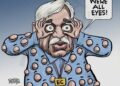
The media’s constitutional and moral responsibility extends far beyond reporting events. It serves as the eyes and ears of society by informing citizens, exposing corruption, investigating abuse of power, amplifying marginalized voices, and ensuring that governments remain accountable to the people. A free press enables citizens to evaluate public policy, scrutinize political promises, debate competing ideas, and make informed electoral choices. Without reliable information, democratic participation becomes superficial, and accountability gradually disappears.
History repeatedly demonstrates that democracy flourishes when journalism is fearless and independent. One of the most powerful examples is the Watergate investigation in the United States during the early 1970s. Persistent investigative reporting by journalists uncovered abuses of executive power, eventually leading to the resignation of President Richard Nixon. The episode remains one of the strongest illustrations of how independent journalism can protect constitutional democracy by ensuring that no public office is above scrutiny.
An equally significant example is the publication of the Pentagon Papers in 1971. The leaked documents revealed that successive American administrations had misled the public regarding the Vietnam War. Despite immense political pressure, the press defended the public’s right to know. The subsequent legal battle reinforced the principle that a free press is essential to democratic governance and that governments cannot easily suppress information simply because it is politically inconvenient.
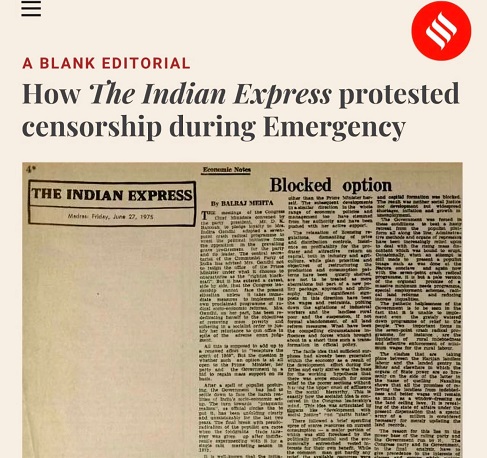
India’s own democratic history offers another powerful lesson. During the Emergency (1975–1977), when civil liberties were severely restricted and press censorship was imposed, many newspapers were prevented from publishing independent reports. Although a few newspapers continued to resist censorship, much of the press operated under unprecedented government control. The Emergency remains one of the clearest reminders that when press freedom is curtailed, democratic institutions themselves become vulnerable. It demonstrated that freedom of expression and freedom of the press are not privileges granted by governments but essential safeguards against the concentration of political power.
These historical experiences illustrate a common principle: whenever journalism becomes weak, democracy becomes weaker. For decades, newspapers across many democracies were viewed not merely as commercial businesses but as public institutions. Editors were respected because they placed editorial integrity above commercial interests. Investigative journalism uncovered scandals, editorial pages shaped national debates, and independent reporting provided citizens with reliable information. The credibility of the press became its greatest asset.Today, however, that credibility faces unprecedented challenges.
The economics of journalism has changed dramatically. Rising costs of newsprint, printing, salaries, taxation, and distribution have placed traditional media organizations under severe financial pressure. Simultaneously, advertising revenues have shifted toward digital technology companies, reducing one of the principal sources of income for newspapers and television networks. To survive financially, many media organizations have become increasingly dependent upon government advertising or corporate sponsorship.
Government advertising, by itself, is neither unusual nor undesirable. Democratic governments have legitimate responsibilities to communicate public welfare schemes, health campaigns, disaster warnings, educational initiatives, and development programmes to citizens. The concern arises when public advertising lacks transparent and objective allocation criteria.
If advertising is distributed through discretionary rather than transparent mechanisms, media organizations may begin to perceive financial incentives for favourable coverage and financial risks for critical reporting. Even when there is no explicit political interference, such economic dependence can create incentives for editorial self-censorship. More importantly, it may erode public confidence in the neutrality of journalism. In democratic societies, public trust depends not only upon actual independence but also upon the visible appearance of independence.
Another profound transformation has been driven by digital technology. The internet has fundamentally altered the production and consumption of news. Twenty-four-hour news cycles, online publishing, and competition from digital platforms have forced traditional news organizations to prioritize speed over depth. Financial pressures have resulted in shrinking newsrooms, fewer field reporters, and reduced investment in investigative journalism.
Consequently, many news organizations increasingly rely on syndicated content, online sources, agency reports, or translated digital material rather than original reporting. Investigative journalism which requires months of research, legal verification, and considerable financial investment has become increasingly difficult to sustain. Long-form policy analysis, rural reporting, environmental investigations, labour issues, and coverage of marginalized communities often receive less attention than sensational political controversies capable of generating immediate audience engagement.
This transformation affects the quality of democratic discourse. Citizens receive more information than ever before, yet often less original reporting and fewer verified investigations. Media ownership has also become increasingly concentrated across many countries. Large corporate conglomerates now own multiple newspapers, television channels, radio networks, digital platforms, and entertainment businesses simultaneously. Such concentration raises important questions regarding editorial independence, market competition, and diversity of viewpoints. Although corporate ownership does not automatically undermine journalistic integrity, excessive concentration can reduce editorial plurality and increase the possibility that commercial or political interests influence news priorities.
Another challenge concerns the relationship between journalism and politics itself. When influential editors, media owners, or prominent journalists later assume political office or accept legislative positions, public debate often turns toward potential conflicts of interest. Every citizen undoubtedly possesses the democratic right to participate in politics. Nevertheless, these transitions inevitably invite questions regarding the independence of media institutions with which they were previously associated. In journalism, perceived impartiality is nearly as important as actual impartiality.
Meanwhile, the emergence of social media has transformed the global information ecosystem. Digital platforms have democratized information by allowing ordinary citizens to publish photographs, videos, eyewitness accounts, and commentary in real time. During natural disasters, armed conflicts, elections, and public protests, social media frequently provides immediate information long before traditional media can verify and publish reports.
However, this democratization has also introduced new risks. Algorithms often prioritize engagement rather than accuracy. False information, manipulated videos, coordinated disinformation campaigns, and emotionally charged narratives can spread faster than verified facts. Unlike professional journalism, much social media content bypasses editorial review, fact-checking, and legal accountability.
Societies therefore confront a paradox. Traditional media is often criticized for selective reporting or institutional bias, while social media is criticized for misinformation and information disorder. Neither extreme adequately serves democratic society.
These concerns are reflected in contemporary international assessments of press freedom. Organizations that monitor media environments around the world consistently argue that journalism faces growing challenges from political polarization, economic dependence and legal intimidation, violence against journalists, digital surveillance, online harassment, and increasing concentration of media ownership. Although the specific circumstances differ from country to country, the broader trend raises an important democratic concern: independent journalism is becoming increasingly difficult to sustain in many parts of the world.
The health of a democracy ultimately depends upon informed citizens. Democratic participation cannot be meaningful if citizens receive incomplete, manipulated, or misleading information. Elections lose much of their significance when voters cannot evaluate governments on the basis of reliable facts. Accountability weakens when investigative journalism disappears. Public trust declines when citizens believe important stories are ignored or selectively presented.
For these reasons, modern democracies require more than simply a legally free press. They require media institutions that are financially sustainable, editorially independent, professionally competent, ethically responsible, technologically adaptive, and institutionally protected. Transparent rules governing government advertising, robust competition laws preventing excessive media concentration, stronger protections for investigative journalists, independent public broadcasting, improved media literacy among citizens, and sustainable funding models for public-interest journalism all form part of a healthy democratic ecosystem. Ultimately, the question is not merely about the future of newspapers or television channels. It concerns the future of democracy itself.
History consistently teaches that democratic decline rarely begins with the abolition of elections. More often, it begins gradually with weakened institutions, declining public trust, reduced transparency, economic pressure on independent journalism, and the slow erosion of citizens’ access to reliable information. When journalism loses its independence, democratic accountability becomes increasingly fragile.