Ambika Prasad Kanungo, Bhubaneswar, 5 September 2026
Democracy survives not merely because citizens vote, but because they trust the institutions that conduct elections and uphold public life to remain above political ambition. When that trust weakens, democracy itself begins to lose one of its essential foundations.
There was a time when the Indian media was widely regarded as the watchdog of democracy and the voice of the voiceless. Its credibility rested on its independence from power. Journalism was expected to question those in authority, scrutinise official claims and speak for citizens who had little access to the corridors of government. Today, the situation has completely changed. For journalists committed to professional independence, this creates a difficult choice: remain silent, compromise their convictions, or seek another platform where they can continue to express their views.
That compact between journalism and democracy has weakened in parts of the media landscape. When a newspaper or television channel begins to serve the political interests of a particular party, or becomes invested in manufacturing the image of a particular leader, journalism is reduced to advocacy. The professionally competent journalist is then left with a difficult choice: remain silent or find another platform.
It is in this shrinking democratic space that social media has sometimes become an alternative outlet for experienced journalists to articulate their professional anxieties and observations. The medium may be imperfect, but the instinct behind it is important. Democracy requires institutions; it also requires individuals willing to speak when institutions become uncomfortable with inconvenient truths.
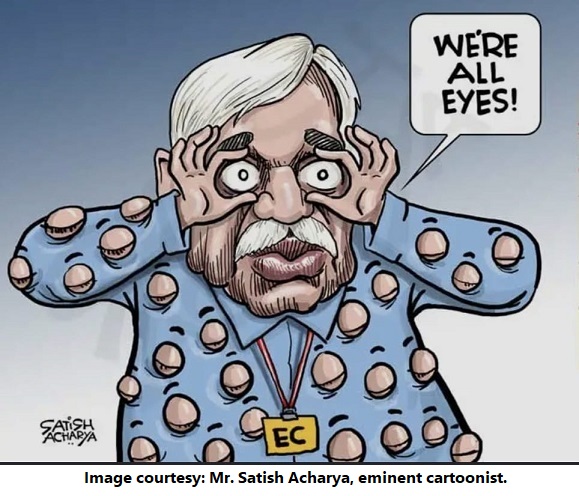
Yet, if the media is democracy’s watchdog, the Election Commission occupies an even more consequential position. The Constitution gives India the architecture of representative government. Elections give that architecture legitimacy. And the Election Commission is entrusted with the responsibility of ensuring that the journey from the citizen’s intention to the constitution of a government remains credible. This is why the independence and impartiality of the Election Commission matter so profoundly.
A democracy is not simply a system in which elections happen at regular intervals. It is a system in which those who exercise power know that power can be taken away from them through the same constitutional mechanism by which they acquired it. That possibility is the quiet discipline imposed by elections. Remove it, and democracy may continue to retain its vocabulary, viz., Parliament, elections, political parties, governments and opposition but its substance begins to thin. India’s democratic history offers compelling reminders of this elementary truth. After the Emergency, Indira Gandhi called elections in 1977. Whatever the calculations behind that decision, the electorate produced an outcome that confounded expectations. The Congress suffered a historic defeat, and one of the most powerful political figures of independent India was removed from office through the ballot.
The significance of 1977 lies not merely in the defeat of a government. It lies in what the election demonstrated: political power could still be defeated by the people. Odisha’s political history offers another instructive example. Biju Patnaik returned to power in 1990 with an extraordinary mandate. His stature in Odisha politics was immense. Yet the 1995 election produced a different verdict. Political circumstances, alliances and public perceptions certainly played their part. But beneath all these explanations was the essential democratic fact that the electorate retained the capacity to surprise even a leader at the height of his political influence.
The national election of 2004 carried a similar lesson. Atal Bihari Vajpayee’s tenure remains, for many Indians, an important chapter in the country’s political history. There was considerable expectation that he would return to office. The electorate thought otherwise. These episodes deserve to be remembered not as isolated political reversals but as moments when Indian democracy demonstrated its vitality. The real achievement of an electoral system is not that it returns a particular government back tonpower. It is that it makes every government uncertain of its return.
That is why the legacy of T. N. Seshan remains relevant. He transformed public understanding of the Election Commission’s authority. The institution was no longer seen merely as an administrative body announcing election dates and supervising polling. It came to be understood as an institution with the authority—and the obligation—to insist that political parties have to play by the rules. There is a larger philosophical principle here.
The referee in a democratic contest must be trusted by both the winner and the loser. The moment the referee is perceived as belonging to one side, the legitimacy of the contest itself begins to suffer. This is why the debate over the appointment of Election Commissioners deserves to be treated as an institutional question rather than merely a political quarrel. The change in the composition of the selection mechanism, including the exclusion of the Chief Justice of India, has raised legitimate questions about whether adequate institutional distance from the executive has been preserved. Similarly, the diminished role of the Opposition in the selection process has prompted concerns about whether the necessary checks and balances are sufficiently robust. The answer should not depend upon which political party occupies the Treasury benches. Institutions designed to protect democracy must be judged by a standard that survives changes of government.
What is good for the BJP today may be used by the Congress tomorrow. What benefits one government can become a weapon in the hands of another. Constitutional institutions, therefore, cannot be designed around the political convenience of the present. They must be designed for the uncertainty of the future.
This is where the 2024 general election offers an important reminder. The BJP emerged as the single largest party with 240 seats but did not secure a majority on its own. The Narendra Modi government continued with the support of its NDA allies. The result demonstrated once again that Indian elections retain the capacity to produce outcomes that compel political parties to negotiate, adapt and share power. The lesson should not be lost amid partisan interpretations of the result.
Democracy is healthiest when no political party believes that victory is its entitlement. That brings us to the present controversy surrounding the Special Intensive Revision of electoral rolls. There is nothing inherently undemocratic about revising electoral rolls. Indeed, accurate electoral rolls are indispensable to credible elections. Dead voters, duplicate entries and ineligible names must be identified and removed. Eligible citizens must be properly registered. But there is a crucial distinction between cleaning the electoral rolls and weakening the electorate. Every exercise of revision must therefore answer a simple question: will the process make it easier or harder for a genuine citizen to exercise the right to vote?
The distinction is not semantic. For a citizen, exclusion from the electoral roll is exclusion from one of the most fundamental instruments of democratic participation. Administrative efficiency cannot become a substitute for procedural fairness. A voter should not lose a constitutional right merely because a form was not properly processed, a document was unavailable or an administrative verification failed. The burden of ensuring the integrity of the electoral roll cannot be transferred entirely to the citizen.
The deeper danger is not necessarily that every disputed deletion is politically motivated. It is that even the perception of politically selective exclusion can corrode public faith in the electoral process. Democracy depends as much on confidence as it does on procedure.
A voter standing in a queue on Election Day carries more than an identity card. He or she carries an expectation that the system is impartial. That expectation is invisible, but it is one of democracy’s most valuable assets. Once that confidence disappears, no number of official explanations can easily restore it.
India has survived political crises, wars, emergencies, ideological conflicts and extraordinary changes of government because its democratic institutions, despite their imperfections, retained public legitimacy. That legitimacy should never be treated as an inexhaustible resource. The Constitution is not self-enforcing. Institutions are not self-sustaining. Democratic culture is not inherited permanently from one generation to another. Each generation has to defend it.
The Election Commission, therefore, must be more than legally independent; it must be visibly independent. It must not merely conduct elections fairly; it must conduct them in a manner that leaves the public with no reasonable ground to believe that the rules were written for the convenience of those already in power.
Similarly, the media must recover something of its old institutional courage. Its responsibility is not to defeat a government or elect an opposition. Its responsibility is to ensure that citizens can see power clearly. Both institutions perform different functions, but their democratic responsibilities converge at one point: accountability.
The media asks questions of power. The Election Commission subjects power to the verdict of the electorate. When either institution becomes too close to power, democracy loses one of its essential checks. India does not merely need elections. It needs elections whose fairness is beyond reasonable suspicion; electoral rolls whose integrity can be independently verified; institutions whose independence is visible; and a media that is unafraid to ask uncomfortable questions. Governments will come and go. Political leaders will rise and fall. Parties that appear invincible today may become marginal tomorrow. That is the natural rhythm of democracy. What must remain constant is the integrity of the institutions that make such change possible.
In the final analysis, the strength of Indian democracy will not be measured by how long a particular government remains in office. It will be measured by whether a government can be defeated, whether an opposition can win, whether a citizen can vote without fear or obstruction—and whether the referee can still be trusted when the stakes are highest. Democracy does not ask the referee to favour the winner. It asks the referee to protect the game.