
Dr Manoj Dash, Bhubaneswar, 12 September 2026
Every major examination cycle in India now unfolds under a cloud of suspicion. For millions of young aspirants across small towns, agrarian districts and salaried households, a competitive entrance examination is not merely an academic milestone. It is a fiercely guarded bridge to inter-generational mobility, economic security and social dignity.
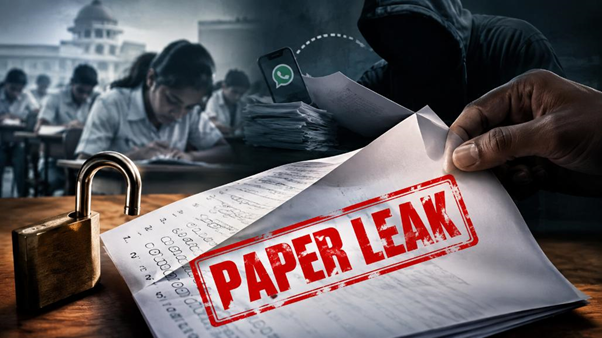
When that gateway is compromised by an organized question-paper leak syndicate, the damage extends far beyond administrative embarrassment. Months and sometimes years of preparation are thrown into uncertainty. Families that have depleted savings on coaching, accommodation and travel are left anxious and angry. Cynicism begins to displace ambition, and the democratic promise that merit can overcome circumstance suffers a serious blow.
India’s recurring examination controversies have exposed a problem larger than individual acts of corruption or negligence. The question is no longer simply how to catch the next paper-leak syndicate. It is whether India’s high-stakes examination system itself has been designed in a manner that permits catastrophic failure.
The Union government’s decision to constitute a high-level expert committee headed by former ISRO Chairman K. Radhakrishnan in July 2024 was an acknowledgement of this deeper institutional challenge. Its recommendations point towards an important shift: India must move beyond reactive cancellations and post-mortem inquiries towards a comprehensive redesign of the entire testing architecture.
The central principle should be simple. India may never guarantee that no question is ever compromised. But it can build a system in which the compromise of one paper, one official, one vendor or one centre does not jeopardize the futures of millions.
That is the difference between guarding a secret and designing a resilient institution.
The problem is catastrophic concentration of risk
India conducts some of the world’s largest and most consequential examinations, often involving millions of candidates, through a complex chain of question setters, printers, transporters, testing centres, contractual personnel and private service providers.
When millions sit for the same question paper on the same day, that paper acquires extraordinary commercial value. A criminal syndicate need not compromise the entire system. It only needs to penetrate one sufficiently vulnerable point in the chain.
The consequences are national.
This is fundamentally a single-point-of-failure problem. A weakness in question generation, printing, digital transmission, physical transport, storage or centre-level handling can contaminate an examination affecting millions. Yet India’s response has often focused on strengthening individual links rather than redesigning the chain itself.
The objective of reform should therefore not be the impossible promise of perfect secrecy. It should be fault tolerance: building an examination system in which the failure of one component does not trigger the failure of the whole.
Other countries offer useful lessons—not because India can mechanically copy their systems, but because they demonstrate different ways of managing high-stakes assessment risk.
What the world teaches us?
China’s Gaokao, the world’s largest national college entrance examination, illustrates the importance of treating high-stakes assessments as a matter of exceptional public security. Its examination system combines strict confidentiality around question preparation, tightly controlled logistics, intensive surveillance and severe criminal penalties for organized examination fraud.
Computer-based testing systems used by organizations such as ETS and Pearson VUE demonstrate another approach. Their strength lies not simply in replacing paper with computers. Large, secure item banks, randomized question sequences, multiple test sessions and, where appropriate, adaptive testing reduce the value of obtaining a single “master paper.” If candidates do not all receive an identical examination, the economics of a conventional paper leak changes fundamentally.
The lesson for India is neither to replicate China’s security apparatus nor to assume that immediate universal computer-based testing is feasible. India’s scale, uneven digital infrastructure and geographic diversity demand a hybrid solution: stronger state capacity where secrecy is unavoidable, combined with technological diversification that reduces the consequences of a breach.
From an examination chain to an examination architecture
The Radhakrishnan Committee’s recommendations provided a credible starting point.
The first priority must be institutional capacity. The National Testing Agency cannot remain excessively dependent on fragmented outsourcing arrangements for functions central to high-stakes examination integrity. An organization responsible for the futures of millions requires a permanent, professionally trained and thoroughly vetted workforce.
It must develop specialized capabilities in psychometrics, cybersecurity, digital forensics, examination logistics and risk management. Sensitive functions should be separated through clear internal controls so that no individual or vendor exercises unchecked influence over multiple stages of the examination cycle.
Examination security is not merely a technology problem. The strongest encryption can be defeated by an insider; the most secure server cannot compensate for weak chain-of-custody procedures. Every stage—from question creation to result declaration—must therefore be independently auditable. Vendors should face stringent security standards, while independent red-team exercises should periodically test the system against insider threats, cyberattacks and physical breaches.
The Election Commission offers a useful administrative analogy. National standards must be backed by clearly assigned responsibility at state and district levels. District administrations and police authorities should be part of the preventive security architecture, not brought in only after a breach.
A practical bridge to the digital future
The most important policy mistake would be to assume that India’s answer lies simply in announcing an immediate shift from paper to computers.
Digital infrastructure has expanded dramatically, but capacity remains uneven. A high-stakes examination system cannot become more unequal in the name of becoming more secure.
This is where the proposed model of Computer-Assisted Secure Pen-and-Paper Testing (CPPT) could prove valuable as a transitional architecture. Instead of printing millions of question papers days or weeks in advance and transporting them through long physical supply chains, encrypted question bundles could be securely transmitted to authorized centres and printed only shortly before the examination under tightly controlled protocols.
This would substantially reduce some of the most vulnerable stages of the traditional chain: mass printing, long-distance transport and prolonged storage.
Over time, India should move towards greater use of computer-based, multi-session testing wherever infrastructure permits. Large examinations need not always depend on a single national paper administered simultaneously to millions. Multiple sessions, equivalent question sets and scientifically robust normalization can reduce the concentration of risk.
The transition, however, must be gradual and equitable. Security cannot come at the cost of accessibility.
Build public infrastructure, not permanent vendor dependence
India should also reconsider where its examinations are conducted. A country administering some of the world’s largest public tests cannot depend indefinitely on an improvised ecosystem of private laboratories and temporary venues with uneven security standards.
The long-term objective should be a national network of secure public testing centres. Universities, IITs, NITs, Kendriya Vidyalayas and other public institutions could form the backbone of this infrastructure, supplemented by purpose-built centres in underserved regions.
Public ownership of critical testing infrastructure would reduce excessive dependence on private intermediaries. This does not mean excluding private technology providers. India will continue to need private expertise. But there is a difference between using private technology and outsourcing institutional responsibility. The state must retain control over the most sensitive elements of examination governance.
Follow the criminal ecosystem
The Public Examinations Act, 2024, has provided stronger statutory tools against organized examination malpractice. But enforcement must go beyond arresting low-level intermediaries after a breach.
Investigators must follow the entire ecosystem: compromised insiders, financial transactions, impersonation networks, digital communication channels and intermediaries who convert stolen examination material into commercial gain.
Severe punishment has a role, but deterrence alone is insufficient. Criminal syndicates flourish where rewards are high and vulnerabilities predictable. The most effective long-term strategy is to reduce both.
From secrecy to resilience
Every compromised examination damages an unwritten social contract between the aspiring citizen and the state. When families invest their savings and young people invest years of their lives preparing for a public examination, they are entitled to believe that merit—not access to a criminal network—will determine the outcome.
India’s examination crisis is therefore not just a law-and-order problem. It is an institutional design problem.
The recommendations of the Radhakrishnan Committee should not be treated as a menu of administrative improvements. They should form the foundation of a mission-mode overhaul of one of India’s most consequential public institutions.
The future lies not in the impossible promise of a perfectly guarded paper. It lies in layered security, professional institutions, diversified testing, public infrastructure and fault-tolerant design.
India must stop building examination systems that can be destroyed by one leak. Millions of young futures depend on getting that architecture right.
(This is the third and concluding part of the state of India’s examination system from ancient times to the present, with an emphasis on reforming the current system for preventing frequent leaks)