
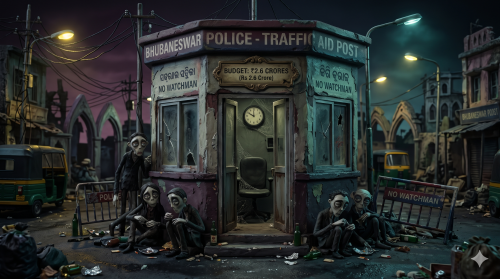
The Nirvik Bureau, Bhubaneswar, 4 November 2026
Where traffic management clocks out at 10.30 pm and irony takes the night shift.
Public Infrastructure, Private Arrangements
Bhubaneswar’s traffic aid posts were built to improve response times. Judging by a viral video reportedly showing a young man consuming brown sugar inside one near Sriya Talkies Square, the public has responded faster than the authorities.
The posts were also intended as resting places for exhausted traffic personnel. In the video, the young man could reportedly be seen lying inside. At least somebody appears to have read that part of the project brief.
His alleged choice of refreshment was, of course, not among the sanctioned amenities.
The incident occurred barely a few metres from Kharavela Nagar police station, demonstrating that proximity to law enforcement is an excellent geographical feature, though not necessarily a security arrangement.
Open Government, Broken Windows
Twenty-two new aid posts were built at a cost of ₹2.6 crore and handed over to the Commissionerate Police. Unfortunately, the handover appears to have been more durable than the doors.
Reports of broken windows, damaged entrances and stolen washroom taps suggest an ambitious experiment in transparency: citizens can now see straight through public infrastructure, sometimes without the inconvenience of glass.
The missing taps deserve particular attention. Water conservation is usually achieved by turning taps off. Removing them altogether reflects the sort of decisive implementation that committees rarely manage.
Officials might consider calling these posts “minimalist civic installations.” A building without fittings is neglect; a building without fittings and with a plaque can still be a project.
Please Commit Offences During Office Hours
A traffic officer explained that personnel cannot guard the posts around the clock and that most leave after 10.30 pm.
This is understandable. Traffic personnel have difficult jobs and need rest. What remains unclear is whether vandals received the departmental circular requesting them to observe the same working hours.
Perhaps each post could display a notice:
“Public property. Please misuse only between 9 am and 10.30 pm, when somebody is available to object.”
After hours, citizens seeking assistance may apparently rely on the traditional emergency-response mechanism: recording a video and hoping it goes viral.
The phone camera has thus become an unofficial civic employee – unpaid, untrained, but occasionally remarkably effective at getting senior officers’ attention.
The Complaints Are Safely on File
Traffic police have reportedly lodged at least ten complaints concerning theft or vandalism at the posts.
This establishes that the system is functioning: damage produces complaints, complaints produce records, and records establish that damage has occurred.
Repairing the damage would risk interrupting this dependable administrative cycle.
Meanwhile, investigators are verifying the young man’s identity and when the footage was recorded. Those are necessary questions. Another useful inquiry might establish when an aid post last enjoyed the services of a functioning door.
Coming Soon: Aid for the Aid Posts
A senior officer has promised intensified patrolling.
Excellent. Structures built to support policing will now require additional policing to remain usable.
The next logical investment is an aid post for officers guarding the aid posts.
It should have a sturdy lock.
And, ideally, someone responsible for the key.