The Nirvik Bureau, Bhubaneswar, 22 October 2026
Washington brings India an energy partnership so independent that America will choose the suppliers.
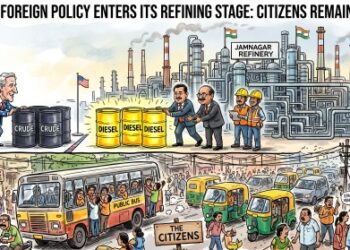
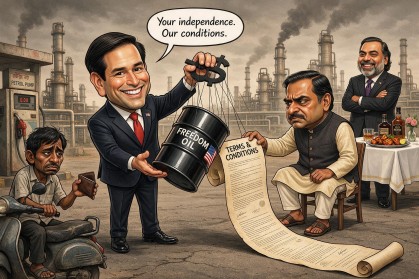
Marco Rubio arrived in Jamnagar carrying America’s newest export: oil with a foreign policy already blended in.
“Previously, you bought crude,” he explained. “Now you can purchase a comprehensive relationship.”
“Does it run a refinery?” asked an Indian executive.
“Eventually. First, it improves your attitude.”
At the Ambani gathering, everything glittered reassuringly. The hospitality was Indian, the commercial ambitions were American, and the ordinary consumer was absent – the traditional seating arrangement for discussions about his welfare.
The Customer Is Always Sovereign, Subject to Approval
Rubio’s pitch was simple: India must reduce its dependence on countries that might weaponise energy by purchasing energy from a country offering to explain the consequences of not purchasing its energy.
“This is diversification,” an aide clarified.
“From several suppliers to suppliers approved by you?”
“Exactly. A diversified portfolio of our preferences.”
An Indian official mentioned price.
The room fell silent. Someone discreetly removed the word “partnership” from a presentation and replaced it with “ongoing negotiations.”
“Russian oil is cheaper,” the official continued.
“Yes,” replied the salesman, “but have you calculated the hidden cost?”
“Freight? Insurance?”
“Disappointing us.”
This expense, unlike crude, had no known ceiling.
Yesterday’s Sanction, Today’s Special Offer
Next came Venezuelan crude, presented with the enthusiasm normally reserved for a newly discovered civilisation.
“Wasn’t that politically complicated?” asked a refinery manager.
“Not necessarily. We periodically update the morality.”
A sanctions specialist opened a folder thick enough to stop a tanker.
The proposed arrangement was beautifully modern: India could secure reliable supplies, provided the legal definition of reliability remained unchanged between loading and arrival.
“And if permission is withdrawn halfway?”
“That demonstrates the importance of remaining engaged.”
The refinery manager wrote “buy larger storage tanks” in his notebook.
Strategic Autonomy, Now Available on Instalments
India explained that its foreign policy rested on strategic autonomy.
Washington welcomed this warmly.
“We fully support your freedom to make the right choice.”
“And the wrong choice?”
“Also available. Different tariff.”
Meanwhile, the hosts maintained the serene expressions of people who understood that every international disagreement eventually required a purchase order.
Photographers captured the historic convergence of diplomacy, industry and upholstery.
Outside, a motorist watched the coverage while waiting at a petrol pump.
“Will this make fuel cheaper?” he asked.
An economist explained that energy security involved complex relationships between infrastructure, sanctions, transport costs and geopolitical risk.
“So, no?”
“Please respect the complexity.”
Please Sign Beside Your Independence
By evening, everyone agreed the talks had been constructive. America had offered options; India had defended flexibility; industry had requested the final numbers.
The communiqué promised a resilient, mutually beneficial partnership. Nobody spoiled the occasion by defining either adjective.
Before leaving, Rubio handed over the brochure.
On the cover: “Energy Independence.”
In the small print: “Supplier approval required.”
The Indian negotiator turned it over.
“Where is the price?”
“That,” said Rubio, “depends on how independent you intend to be.”